What Is Answer Engine Optimization (AEO)? The Complete 2026 Guide to Getting Cited by ChatGPT, Perplexity, and Google AI Overviews
A comprehensive guide to Answer Engine Optimization in 2026 — covering what AEO is, how it differs from SEO, why AI Overviews are reshaping search traffic, and the complete optimization framework for getting your brand cited by ChatGPT, Perplexity, Google AI Mode, and other AI-powered answer engines.
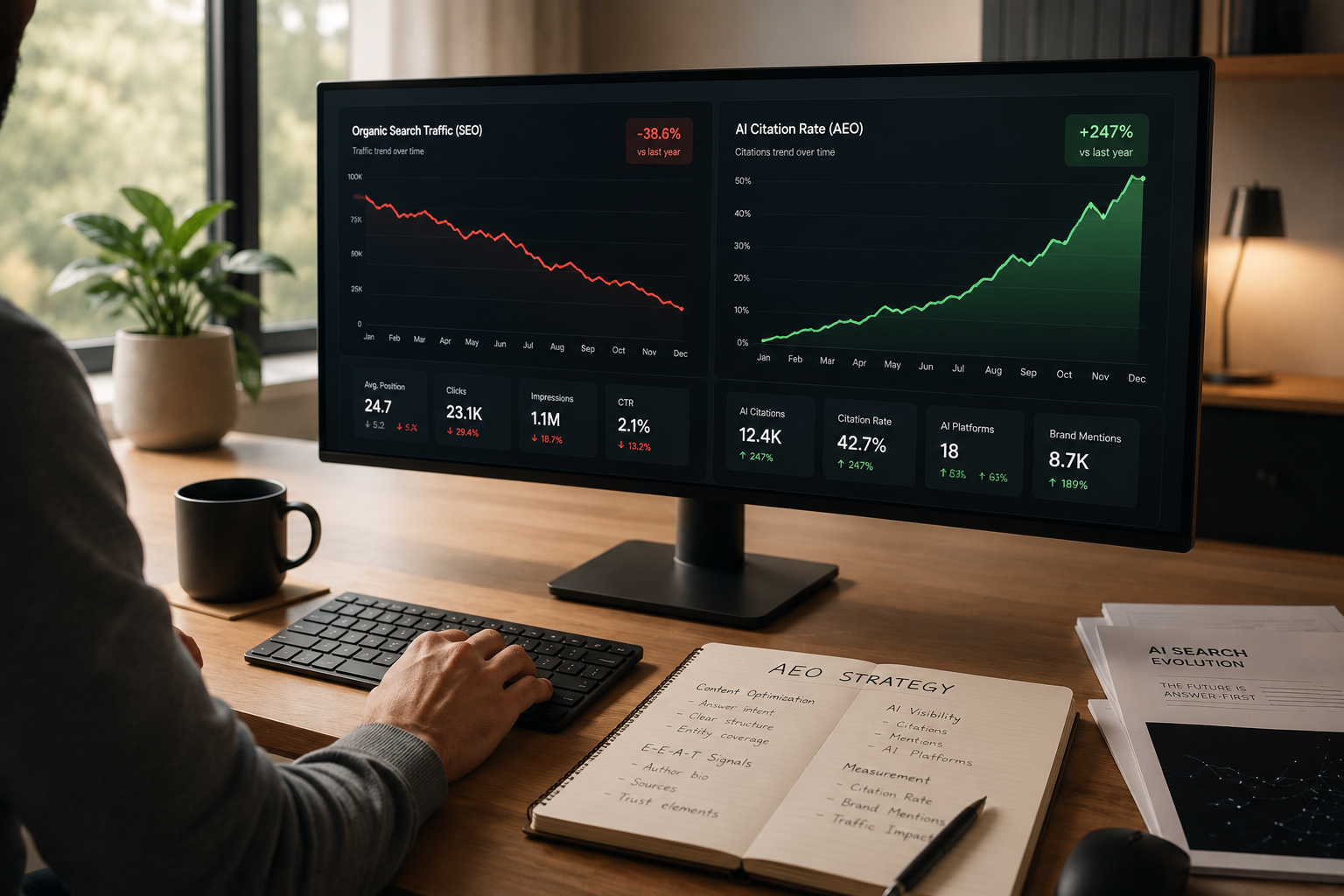
Something quiet happened to your organic traffic this year. Your Google rankings stayed roughly the same. Your content quality did not drop. Your technical SEO was fine. But the clicks stopped coming the way they used to.
You are not imagining it. And you are not alone.
AI Overviews now trigger on more than 30% of all Google searches in 2026, up from just 13% in early 2025. When an AI Overview appears above the search results, click-through rates on organic results drop by an average of 61%. In AI Mode — Google's fully AI-powered search interface — the organic click rate falls to just 7%, because users receive a complete AI-generated answer before they ever see a single blue link.
The traffic did not vanish. The click path changed. And the brands that understand what changed — and why — are capturing the discovery that others are losing.
That is what Answer Engine Optimization is. It is the discipline of ensuring that when AI systems synthesize information to answer a user's question, your brand, your content, and your expertise are what gets cited.
This is the complete guide to AEO in 2026 — what it is, why it matters more urgently than most content teams realize, and exactly how to optimize for it.
The Search Behavior Shift You Cannot Afford to Ignore
Before diving into tactics, the strategic context matters enormously — because most content and SEO teams are still optimizing for a version of search that is rapidly becoming secondary.
Here is what the data shows about how people are finding information in 2026:
Around 75% of American users now search with AI weekly. Their top use cases are quick facts, research, shopping comparisons, and health information — exactly the categories that used to drive the most valuable organic search traffic. B2B technology queries now trigger AI Overviews 82% of the time. Healthcare queries: 88%. Financial services queries: over 90%.
Meanwhile, 58.5% of US Google searches already end without a click to any external website. Zero-click behavior on mobile is even higher. The users who do click through from AI citations tend to be higher-intent and convert significantly better than average organic visitors — but the total click volume is structurally lower than it was when every ranking position generated clicks proportional to position.
The strategic picture is not that SEO is dead. Organic search traffic was down approximately 2.5% year-over-year between 2024 and early 2026 — a real decline, but not the 25-50% collapse that alarmist content predicts. The more accurate picture is that search is fragmenting. Google will remain enormous. But AI engines — ChatGPT, Perplexity, Google AI Mode, Claude, Copilot — are absorbing a growing share of research and decision queries, particularly in the high-value information categories where content marketing has historically generated the strongest ROI.
For content teams, the implication is direct: optimizing only for traditional keyword rankings is now incomplete. The brands capturing discovery in 2026 are the ones visible in both traditional search results and AI-generated answers.
What Is Answer Engine Optimization (AEO)?
Answer Engine Optimization is the practice of structuring your content, brand signals, and digital presence so that AI-powered answer engines — ChatGPT, Perplexity, Google AI Overviews, Google AI Mode, Microsoft Copilot, and similar systems — cite your brand when they generate answers to user queries.
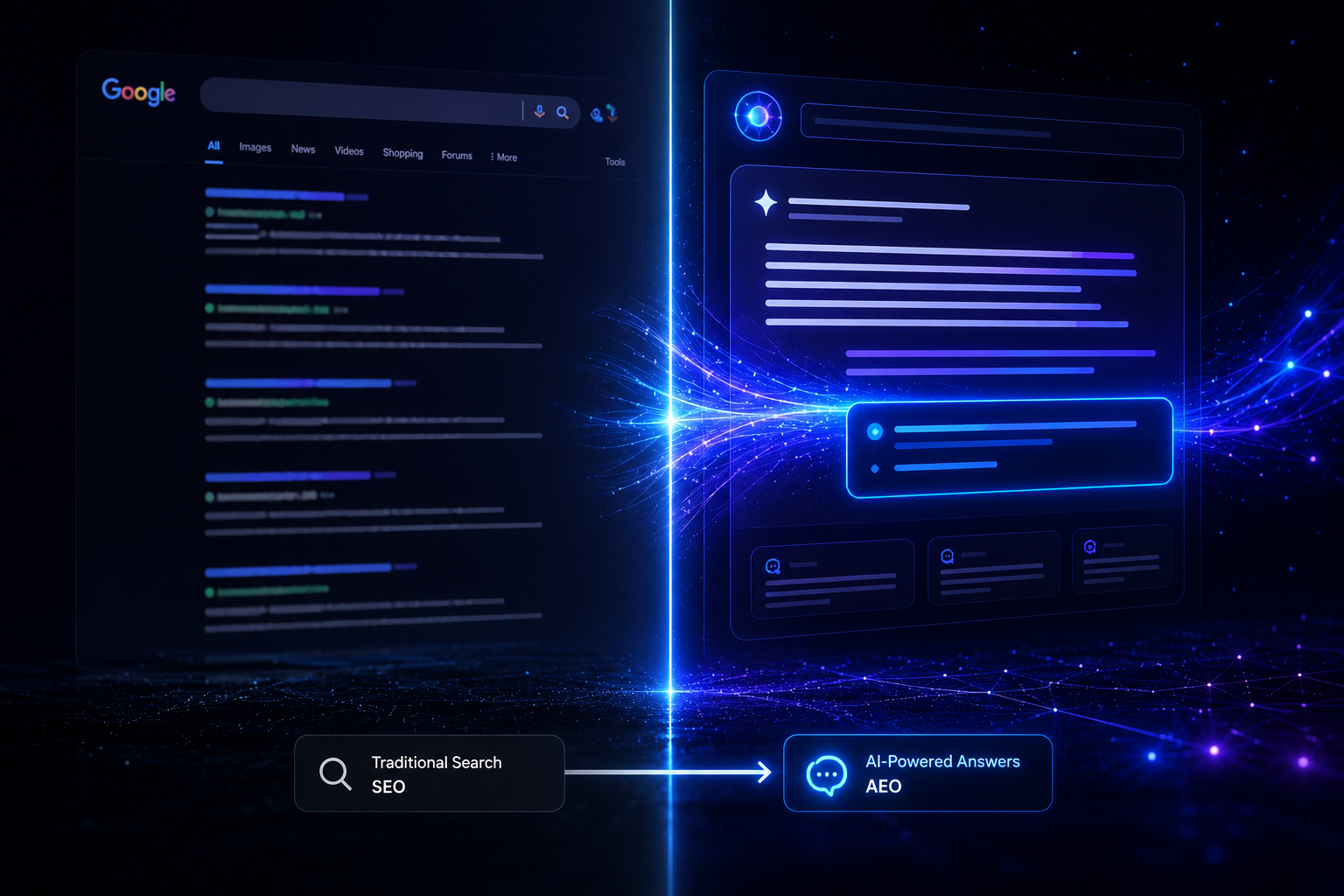
Unlike traditional SEO, which optimizes for ranking position in a list of results that users then choose from, AEO optimizes for citation — getting your content extracted, synthesized, and credited by AI systems that generate direct answers before users ever see a list of links.
The distinction is more than semantic. SEO targets a position on a results page. AEO targets selection inside an answer the AI writes before the user sees any results at all. When some users' first interaction with your category happens inside ChatGPT or Perplexity, your visibility in those answers determines whether your brand enters consideration — not your Google ranking.
AEO overlaps with two related disciplines: GEO (Generative Engine Optimization), which is the broader practice of optimizing for all generative AI systems, and traditional SEO, which still provides the foundational signals — domain authority, structured content, backlink profile — that AI systems draw on when evaluating which sources to trust. The relationship is layered: good SEO makes AEO more achievable. Strong AEO captures visibility that SEO alone cannot reach.
How AI Answer Engines Decide What to Cite
Understanding the selection mechanism is the starting point for optimization. AI answer engines do not retrieve information the way Google's traditional algorithm works. They do not simply find the page that best matches the keyword query. They synthesize information from multiple sources and generate a response — selecting sources based on a combination of signals that are different from traditional ranking factors.
The research consensus across AEO practitioners and AI citation studies in 2025 and 2026 consistently identifies the same core signals:
Structural clarity and answer-first formatting. AI systems favor pages that lead with a direct, concise answer to the implied question before adding context and detail. A 40 to 60-word direct answer block at the top of a section — written in plain language, making a clear, specific claim — consistently outperforms pages that bury the answer in paragraph three of a general introduction.
Entity consistency and brand recognition. AI models develop associations between named entities — brands, people, concepts — and specific claims, capabilities, and characteristics. Brands that are mentioned consistently across multiple authoritative sources in association with the same core claims are more reliably cited than brands whose positioning varies across different content contexts.
Content freshness and accuracy signals. AI systems handling research and informational queries weight recency heavily, particularly for topics that change over time. Pages with visible publication and update dates, accurate current statistics, and references to recent developments are more likely to be selected as authoritative sources.
Domain authority and trustworthiness. The research consistently shows that 65.3% of ChatGPT's top-cited B2B pages come from high-authority domains with a Domain Rating of 80 or higher. AEO does not make domain authority irrelevant — it makes building it more important, because AI systems inherit the trust signals that traditional SEO has quantified for decades.
Schema markup and structured data. FAQPage, HowTo, Article, and other structured data schema help AI systems extract specific answer components from your content accurately. Pages with proper schema implementation consistently appear in AI-generated answers at higher rates than equivalent content without structured markup.
Citation network and third-party mentions. AI systems learn which sources are authoritative partly by observing which sources other authoritative content references. Being cited by high-authority sources — industry publications, research organizations, recognized experts — increases the probability that AI systems treat your brand as a credible voice in your category.
According to Google's official guidance on AI Overviews and content quality, the content characteristics most associated with AI Overview citation are E-E-A-T signals (Experience, Expertise, Authoritativeness, Trustworthiness), structural clarity, and factual accuracy — which maps directly to what independent AEO research shows drives citation in third-party AI systems as well.
AEO vs SEO: The Key Differences
Understanding where AEO and traditional SEO diverge helps clarify where to invest optimization effort and how the two disciplines interact.
What you are optimizing for: SEO optimizes for ranking position in a list of search results that users browse and select from. AEO optimizes for being selected as a cited source inside an AI-generated answer that users read directly.
The content format that performs: Traditional SEO rewards comprehensive, keyword-rich long-form content that satisfies searcher intent across multiple related queries. AEO rewards direct-answer formatting — clear, specific, concise responses to exactly the question being asked, with supporting detail following rather than preceding the direct answer.
The role of backlinks: In traditional SEO, backlinks are the dominant authority signal. In AEO, backlinks remain important — they are part of the domain authority signal that AI systems use to assess trustworthiness — but they are supplemented by entity mentions, brand consistency signals, and structural content quality in ways that keyword-stuffed backlink farming does not capture.
The metric being tracked: SEO tracks keyword ranking positions and organic traffic. AEO tracks citation rate — the percentage of tracked prompts in which your brand appears as a named source in AI-generated answers. These are different metrics measuring different outcomes, and both matter in 2026.
The competitive landscape: Traditional SEO competition is well-mapped and heavily contested. AEO competition is still being established. Early movers who build citation rate in their category are building a compounding advantage that becomes harder for later entrants to displace, because AI systems develop consistent associations between brands and topics over time.
The Core AEO Optimization Framework
1. Restructure Content Around Direct Answers
The most immediately actionable AEO optimization is reformatting existing content to lead with direct answers rather than contextual buildup.
The standard approach: every major section of a piece of content that addresses a specific question should open with a 40 to 60-word direct answer to that question — written in plain, factual language, making a specific claim, before introducing nuance, examples, or qualifications.
The intuition for why this works: AI systems extracting answers from web pages need to identify the answer component quickly and accurately. A page that embeds its answer in the middle of a paragraph of contextual introduction is harder to accurately extract from than a page where the answer is the first sentence of the section.
This does not mean eliminating context, detail, or nuance. It means reorganizing content so the answer comes first and the context follows — which is also, incidentally, the structure that tends to reduce bounce rates and increase time on page for human readers who want the answer before deciding whether to read further.
2. Implement FAQ Sections With Question-Shaped Headings
FAQPage schema is one of the most reliable AEO signals available to content teams, and it compounds with structural clarity to significantly increase AI citation rates.
The implementation: add a structured FAQ section to every major content page, using question-format H3 headings that match the natural language queries your audience is likely to ask in an AI system. Each question should be followed by a concise, direct answer of 40 to 80 words — factual, specific, and self-contained without requiring the surrounding context to make sense.
The question phrasing matters. AI systems handle conversational, natural language queries differently from keyword queries. "What is the best tool for X?" and "How does X work?" perform better as FAQ headings than keyword-optimized formulations like "X tool review" or "X benefits and features."
Mark up the FAQ section with FAQPage structured data so that AI systems — and Google's traditional search features — can extract question-answer pairs accurately and attribute them to your page.
3. Build Entity Consistency Across Your Entire Digital Footprint
Entity consistency is one of the most under-addressed AEO factors for most brands, and it is one of the highest-leverage investments for building reliable AI citation.
AI systems develop associations between named entities — your brand, your key people, your core products — and specific claims, capabilities, and characteristics by observing how those entities are described across multiple sources. When the description is consistent across your website, your social profiles, your press coverage, your review sites, and your directory listings, the AI's confidence in citing those associations increases. When the description varies — different claims about what your product does, different framing of your core value proposition, different positioning across contexts — the AI's confidence decreases.
The optimization process: audit your brand's description across every significant digital touchpoint. Your LinkedIn company profile. Your Crunchbase or G2 listing. Your About page. Your press release boilerplate. Your Twitter/X bio. Identify inconsistencies and standardize around a single, clear, factually accurate description of what you do and for whom.
This standardization also supports traditional SEO entity optimization — helping Google's Knowledge Graph develop accurate associations for your brand, which feeds into AI Overview citation.
4. Produce Original Research and Primary Data
AI systems prefer citing primary sources over aggregated content. A page that publishes original survey data, proprietary benchmarks, or first-party research that cannot be replicated by rewording your content is intrinsically more citable than a page that summarizes what other sources have already published.
The practical implication: if your organization has access to proprietary data — customer usage statistics, survey results, internal performance benchmarks, case study metrics — publishing that data with clear methodology creates content that AI systems cite because no other source has the same information.
Original research also generates the kind of citation network effect that compounds AEO results over time. When your data is cited by other authoritative content creators, AI systems observe those citations and increase their confidence in your brand as an authoritative source.
Moz's research on content authority signals consistently shows that original data and research consistently generates significantly more backlinks and citations than equivalent analytical or opinion content — which feeds both traditional SEO authority and the AI citation patterns that AEO tracks.
5. Optimize for Conversational Query Patterns
The queries that AI systems handle skew strongly toward natural language and conversational phrasing compared to traditional keyword searches. Users typing into ChatGPT ask "What is the best project management tool for a remote team of ten people with a limited budget?" — not "project management software remote team."
Aligning content with conversational query patterns means going beyond keyword research into question research. Tools like AnswerThePublic, AlsoAsked, and the "People Also Ask" sections in Google results surface the natural language questions your audience is asking — which are often closer to the queries they are entering into AI systems than to the keyword phrases they might type in a traditional search bar.
Content that anticipates and directly addresses these conversational queries — in the direct-answer format described above — is structurally well-positioned for AI citation, because AI systems are essentially matching user queries to the most directly relevant answer they can find.
6. Earn Third-Party Mentions and Citations
Being cited by other authoritative sources — industry publications, analyst reports, recognized expert content, high-authority blogs — is one of the most reliable signals that AI systems use to assess whether a brand is a credible, authoritative source in its category.
This is not fundamentally different from traditional link building for SEO, but the emphasis is slightly different. For AEO, text mentions of your brand alongside specific claims — "Company X is known for Y" or "According to research from Brand Z" — in authoritative content carry citation weight that goes beyond the hyperlink itself. AI systems are reading the text of authoritative pages, not just their link structure.
Strategies that build this citation network: contributing original insights to authoritative industry publications, being quoted in analyst research, publishing data that other content creators cite, and building a PR presence that generates press coverage from recognized media outlets.
According to Semrush's research on content marketing and brand authority, content that earns third-party coverage and citations grows its topical authority signals significantly faster than content that relies exclusively on on-page optimization — making earned media a strategic AEO investment, not just a PR exercise.
7. Ensure Technical Accessibility for AI Crawlers
AI systems need to be able to crawl, read, and process your content accurately. Technical barriers that prevent or degrade this access reduce your citation probability regardless of how well your content is otherwise optimized.
The technical checklist: ensure your robots.txt does not block AI crawlers (Anthropic's ClaudeBot, OpenAI's GPTBot, Perplexity's PerplexityBot, and Google's Googlebot all need access to your content to cite it). Verify that your content loads correctly for non-JavaScript crawlers, since many AI systems process the server-rendered HTML rather than executing client-side JavaScript. Implement proper canonical tags so AI systems resolve the correct version of your content when multiple URLs contain similar material.
Structured data implementation beyond FAQPage is also valuable: Article schema with explicit author bylines and publication dates, HowTo schema for instructional content, and Breadcrumb schema for navigation structure all help AI systems accurately understand what your content is and where it sits within your site's topical architecture.

The AEO Content Types That Get Cited Most
Not all content formats have equal citation probability in AI-generated answers. The research on citation patterns in ChatGPT, Perplexity, and Google AI Overviews consistently identifies specific content structures that appear in AI answers at higher rates:
Comprehensive definition and explainer pages that directly answer "What is X?" with a clear, factual definition followed by structured explanatory content. These are the most commonly cited content type in informational AI queries.
Comparison and best-of content structured as clear, factual comparisons with specific criteria. "X vs Y" and "Best tools for Z" queries are high-frequency in AI systems, and content structured with direct comparison tables and clear recommendation logic earns frequent citations.
Step-by-step guides formatted with numbered steps and clear process logic. HowTo schema amplifies the citation probability for this content type significantly.
Original research and data publications containing proprietary statistics, survey results, or benchmark data. As noted above, primary data sources are preferentially cited over aggregated content.
FAQ-rich pages that explicitly address the natural language questions users are likely to ask in the topic area. The combination of question-format headings and FAQPage schema makes this content type consistently high-performing for AI citation.
Measuring AEO Performance
Traditional SEO metrics — keyword rankings, organic traffic volume — are insufficient for measuring AEO results, because AI citations do not necessarily translate to immediate click traffic and do not show up in ranking tracking tools.
The measurement framework that AEO practitioners use in 2026 includes:
Citation rate tracking: Manually or with specialized tools, track a defined set of target prompts in ChatGPT, Perplexity, Google AI Mode, and other relevant AI systems. Record whether and how your brand is cited in the generated answers. The percentage of tracked prompts where your brand appears as a named source is your share of answer — the primary AEO metric.
AI referral traffic in Google Analytics 4: Google Analytics 4 added an AI Assistant channel in its traffic acquisition reports in 2026. This channel captures visits referred from AI systems, separating them from traditional organic search traffic. Monitoring this channel provides a direct measurement of the click traffic your AEO is generating.
Brand mention monitoring: Using tools like Mention, Brand24, or Semrush's Brand Monitoring to track how often your brand appears in AI-generated content shared or referenced online provides a secondary signal of citation growth.
Branded search volume: As AI systems cite your brand in answers, users who encounter those citations often subsequently search for your brand directly in traditional search. Growth in branded search volume is an indirect AEO signal — indicating that AI-driven discovery is introducing your brand to new audiences who then seek you out specifically.
The AEO Tool Stack for 2026
The tooling around AEO is still maturing — the discipline is new enough that purpose-built AEO tools have only recently emerged alongside the more established SEO platforms beginning to add AI visibility tracking.
AirOps — Provides AI visibility tracking and share-of-answer measurement across major AI platforms. Its 2026 State of AI Search Report is one of the most cited primary data sources in AEO research.
Semrush — Added AI Visibility tracking to its suite in 2025, enabling monitoring of brand and keyword visibility across AI systems alongside traditional search ranking data.
Frase — Content optimization platform that has integrated AEO content structuring guidance alongside traditional SEO content optimization.
Schema markup generators — Tools like Google's Rich Results Test and Schema.org validators ensure that structured data is correctly implemented and accurately readable by AI crawlers.
Screaming Frog — Still the standard for technical crawl audits, now useful for verifying that AI crawlers can access and accurately read your content without technical barriers.
Google Search Console — The AI Overviews performance reports added in 2025 provide data on which queries are triggering AI Overviews where your content is or is not appearing.
AEO for Different Business Types
The optimal AEO strategy varies by business type and audience, because the AI systems most relevant to your audience differ and the query types your content needs to appear in vary.
SaaS and B2B Technology: B2B buyers now compare vendors directly inside AI tools before ever visiting a company website — 55% of B2B buyers use AI tools for vendor comparison according to Forrester research published in 2026. For SaaS and B2B tech companies, AEO means ensuring your product appears as a recommended solution when users ask AI systems for software recommendations in your category. Category definition pages, comparison content, and use-case specific guides are the highest-priority content types.
E-Commerce and Consumer Brands: AI systems are increasingly handling product research queries. Walmart found that purchases completed directly in ChatGPT's Instant Checkout converted at lower rates than purchases where users clicked through to the website — suggesting that for e-commerce, the goal is less about AI-native conversion and more about AI-driven traffic that converts on your site. Product-specific FAQ content, comparison guides, and review-style explainers are the highest-priority content types.
Publishers and Content Media: For content-first businesses, AEO is both an opportunity and a threat. Sites that are cited in AI answers drive traffic from AI referrals. Sites that are not cited see their most information-dense content absorbed by AI summaries without attribution. The highest-priority optimization is original research and proprietary reporting that AI systems cannot replicate by synthesizing other sources.
Local and Service Businesses: AI systems handling local and service queries pull heavily from structured local data — Google Business Profile, industry directories, review platforms. For local businesses, AEO optimization means maintaining complete, accurate, consistent information across all structured data sources and generating the review volume that AI systems use as a proxy for quality.
The Brands Getting AEO Right
The pattern among brands earning strong AI citation rates in 2026 is consistent and observable.
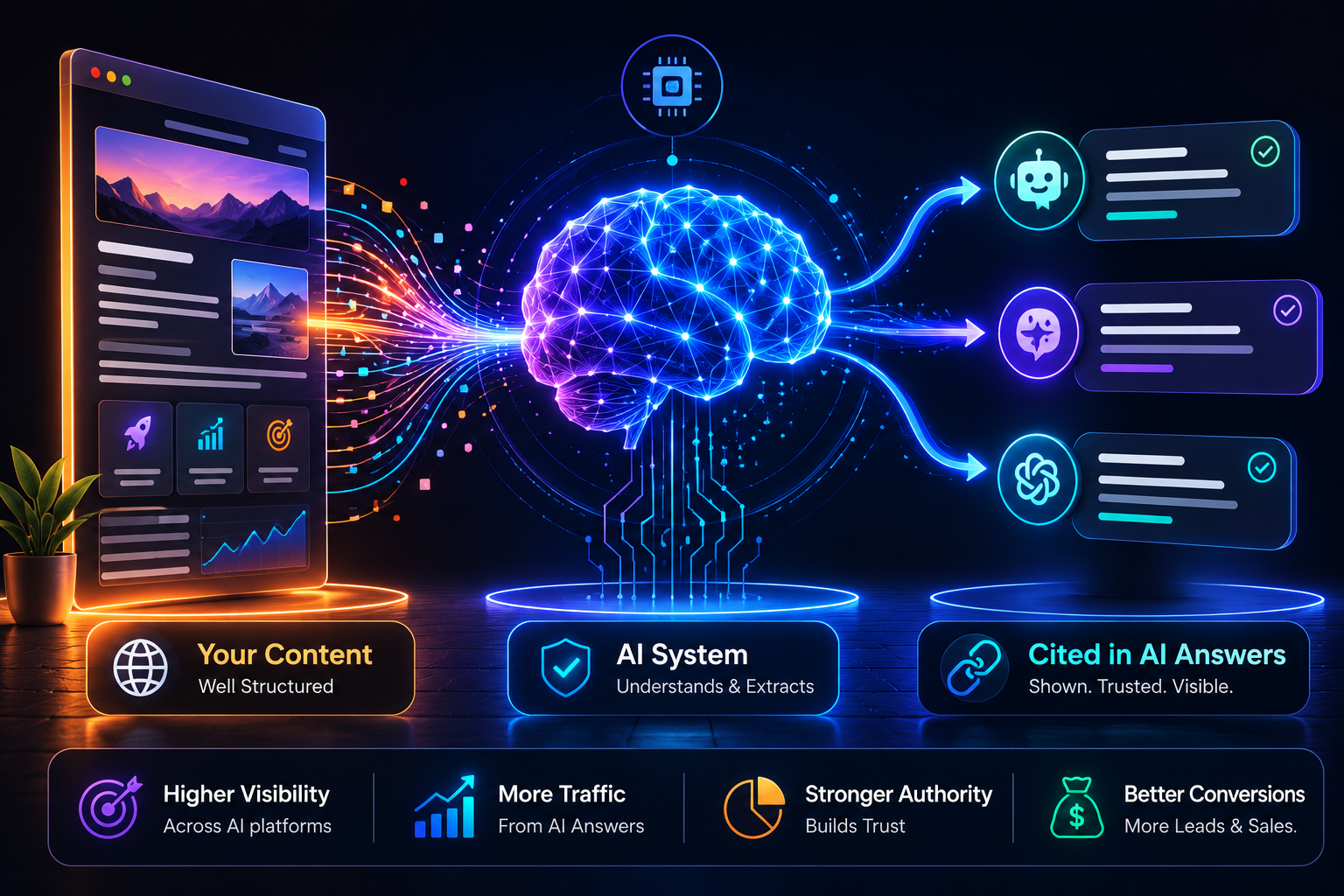
They publish specific, accurate, answer-first content rather than brand-voice essays that avoid making concrete claims. They invest in original research that gives AI systems primary data to cite rather than just re-packaging what other sources have already published. They maintain entity consistency across their entire digital footprint so AI systems develop reliable associations between their brand and their category. And they treat AEO as a compounding investment rather than a one-time optimization — continuously updating content to maintain freshness signals and building the citation network that reinforces their authority over time.
The brands losing ground in AI-driven discovery are doing the opposite — optimizing for the density of keyword mentions in text, building backlinks to thin content that makes no specific claims, and treating SEO as a game of position rather than a competition for citation quality.
According to HubSpot's 2026 State of Marketing Report, companies that have implemented structured AEO strategies — answer-first content, structured data, entity optimization — report 20% higher AI-driven traffic compared to those relying on traditional SEO practices alone. That gap will likely widen as AI search adoption continues to accelerate.
AEO and the Future of Content Marketing
Answer Engine Optimization is not a replacement for content marketing. It is a reorientation of content marketing around a shift in how information is discovered and consumed.
The brands that win in AI search are not the ones with the most content. They are the ones with the most citable content — specific, accurate, structurally clear, consistently attributed, and continuously maintained. That is actually a higher quality bar than keyword-dense content production for ranking position, and the brands that meet it are building a more defensible competitive position than content volume alone has ever provided.
Gartner's research on the future of search predicts that traditional organic search volume will continue declining as AI chatbots and virtual agents absorb query share — with the most dramatic declines concentrated in the informational query categories where AI-generated answers provide the most complete substitution. For content teams, this is not a reason for panic. It is a clear signal about where to invest optimization effort.
The opportunity for brands that adapt early is significant. Citation rate in AI systems is a compounding asset — one that builds over time as AI models develop stronger associations between brands and topics, as citation networks grow through original research and earned mentions, and as content quality compounds through consistent structured formatting.
The brands building that asset today are the ones who will define category authority in AI search tomorrow. The ones waiting for the shift to become undeniable before adapting will find the citation landscape already established by their competitors.
Getting Started With AEO: The 30-Day Action Plan
The most common mistake teams make with AEO is treating it as a complete overhaul that requires perfect implementation before any benefits materialize. In practice, AEO optimization compounds from small, consistent improvements. A structured 30-day starting point:
Days 1 to 7 — Audit and benchmark. Run 20 to 30 category-relevant prompts in ChatGPT, Perplexity, and Google AI Mode. Record whether your brand appears in AI-generated answers for your most important query types. This baseline gives you a starting citation rate to measure improvement against. Simultaneously, audit your five highest-traffic content pages for answer-first structure and FAQ schema implementation.
Days 8 to 14 — Restructure priority content. Reformat the top five pages identified in the audit to lead each major section with a 40 to 60-word direct answer. Add a structured FAQ section to each page. Implement FAQPage schema. Update publication dates to reflect the revision. This alone frequently produces measurable citation rate improvements within 4 to 8 weeks as AI systems re-crawl the updated content.
Days 15 to 21 — Entity audit and standardization. Audit your brand description across all major digital touchpoints. Standardize your About page, social profiles, directory listings, and press boilerplate around a consistent, factually specific description of what you do, who you serve, and what differentiates you. This consistency building takes time to show results but is one of the highest-leverage long-term AEO investments.
Days 22 to 30 — Identify and plan original research. Identify one piece of original research, proprietary data, or primary survey your team could publish in the next 90 days. Internal performance benchmarks, customer survey results, usage data analyses — any first-party data that your audience would find valuable and that AI systems cannot find from another source. Plan the content format, publication timeline, and distribution approach.
At the end of 30 days: rerun the same set of prompts from your initial audit. Compare citation rates. Continue the structured optimization cycle with the next tier of content.
Final Verdict: Why AEO Cannot Wait
Search is not dying. Discovery is fragmenting. And the brands that treat this fragmentation as a reason to double down on one channel at the expense of the others are the ones who will find their visibility narrowing as user behavior continues to evolve.
AEO is not an alternative to SEO. It is the extension of SEO into the channels where discovery is increasingly happening — AI-generated answers that users receive before they ever choose which search result to click.
The foundational principles are the same: produce accurate, specific, well-structured content from authoritative sources that genuinely helps users answer their questions. The implementation is different: answer-first formatting, FAQPage schema, entity consistency, original research, and citation rate measurement.
The brands building these capabilities now are building a compounding advantage in AI-driven discovery that will be significantly harder to close for competitors who start 12 months later. The citation associations AI systems develop between brands and topics do not reset easily. The content architectures that earn AI citations do not appear overnight.
The right time to start optimizing for how AI systems find and cite your brand was when ChatGPT launched. The second best time is now.
Frequently Asked Questions
What is Answer Engine Optimization (AEO)? AEO is the practice of optimizing content, brand signals, and digital presence so that AI-powered answer engines — including ChatGPT, Perplexity, Google AI Overviews, and Microsoft Copilot — cite your brand when they generate answers to user queries. It focuses on citation in AI answers rather than ranking position in traditional search results.
How is AEO different from SEO? Traditional SEO optimizes for ranking positions in search result pages that users browse and click from. AEO optimizes for being cited as a source inside AI-generated answers that users receive directly. Both are important in 2026, but they require different content structures and measure different outcomes — ranking position versus citation rate.
Does SEO still matter if AEO is the new priority? Yes. SEO and AEO are complementary. Domain authority, backlink quality, content accuracy, and technical accessibility are foundational signals that AI systems use to evaluate which sources to trust. Strong SEO makes AEO more achievable. The optimal strategy in 2026 addresses both.
How do I know if my brand is being cited by AI systems? Run targeted prompts in ChatGPT, Perplexity, and Google AI Mode related to your category and track whether your brand appears as a named source in the generated answers. Tools like AirOps and Semrush's AI Visibility feature provide more systematic tracking across larger sets of prompts. Google Analytics 4's AI Assistant channel tracks direct referral traffic from AI systems.
What content structure works best for AEO? Answer-first formatting — leading each major content section with a 40 to 60-word direct answer before adding context and detail — consistently outperforms traditional SEO content structures in AI citation studies. FAQ sections with FAQPage schema, original research and primary data, and natural language question-format headings all complement the answer-first approach.
How long does AEO take to show results? Structural content improvements — answer-first formatting, FAQ schema implementation — can produce measurable citation rate improvements within 4 to 8 weeks as AI systems re-crawl updated content. Entity consistency and citation network building are longer-term investments that compound over 6 to 18 months.
Is AEO relevant for small businesses and blogs? Yes. Smaller sites can earn AI citations in niche-specific queries more readily than in broad competitive categories, because AI systems draw from whatever authoritative sources are available in a given topic area. Well-structured, factually specific content from a consistently maintained source can earn citations in niche queries even without enterprise-level domain authority.
Founder, Axionova · AI Tools Strategist
Ashir writes independent, hands-on reviews of AI tools and shares strategies for creators, marketers, and entrepreneurs. Every review is grounded in real usage — no paid placements, no fluff. Read our editorial standards.
AI Insights Weekly
One curated email a week: sharp AI insights, tool reviews, and strategies.
Have thoughts on this?
Contact us or share this article on social media — we'd love to hear what resonated with you.