Claude vs ChatGPT for Writing: I Ran the Same 1,200-Word Brief Through Both
A direct, tested comparison of Claude and ChatGPT on identical writing briefs — tone control and instruction-following, long-document consistency and hallucination rate, and speed versus ecosystem breadth — with a clear, use-case-specific verdict and the workflow most professional content teams actually use in 2026.

I gave both models the exact same brief: a 1,200-word feature article on how small businesses are actually using AI automation in 2026 — not a listicle, not a generic overview, but a piece with a specific point of view, a consultative-but-direct tone, zero buzzwords, no rhetorical-question openers, and a hard requirement to avoid the phrases that instantly signal "this was written by AI." Same word count, same audience, same constraints, submitted to both models with identical wording.
The difference showed up before I'd finished reading either draft's first paragraph. ChatGPT opened clean and confident, then by paragraph three had reached for a phrase I'd specifically told it to avoid — a soft variation on "in today's fast-paced business landscape" that technically wasn't the exact banned phrase but was unmistakably its cousin. Claude's opening paragraph did something genuinely harder: it made a specific, arguable claim about what's actually changed for small businesses, backed it with a concrete detail, and never once reached for a stock transitional phrase across the full 1,200 words.
This is not a fluke result from one test run, and it's not just my opinion. It's the single most consistently repeated finding across every independent 2026 comparison of these two models for writing specifically — nine separate sources, tested on different briefs, at different points across 2026, all converging on the same pattern: Claude produces prose that requires less editing to sound human, and ChatGPT produces prose that's faster to generate but drifts on complex, multi-constraint instructions the longer the piece runs. That gap is real, it's measurable, and it matters enormously depending on exactly what kind of writing you're doing — which is exactly what this comparison breaks down, with the actual test results and the specific places each model wins.
The Test, and Why "For Writing" Specifically Matters
A generic "Claude vs ChatGPT" comparison tries to cover coding, image generation, voice mode, research, and writing all at once, and ends up saying nothing useful about any single one of them. This comparison is deliberately narrow: writing only, and specifically the kind of writing where quality is judged by a human reader, not a benchmark score — blog content, brand copy, reports, long-form articles, anything where the final output needs to sound like it came from a person who actually thought about what they were saying.
The brief I used, and the one most independent 2026 testers converge on using for exactly this reason, deliberately stacks several constraints at once rather than testing a single simple instruction: a specific word count, a specific tone, specific phrases to avoid, and a structural requirement (no question-based opening). This matters because a single, simple prompt tells you almost nothing about real-world writing quality — the differences between these two models only become visible once you're asking for several things simultaneously, which is exactly what a real content brief looks like.
Round 1: Tone Control and Instruction-Following — Claude Wins, and It's Not Close
This is the round where the gap between the two models is largest and most consistently documented, and it's the round that matters most for anyone producing branded, client-facing, or editorial content where tone precision is the actual job.
Give Claude a detailed brief — a specific word count, an exact tone, specific things to avoid, multiple constraints stacked at once — and it tracks all of them. One 2026 test used almost exactly the brief structure I used above: "write a 600-word introduction for a B2B SaaS blog post targeting CTOs, use a consultative but direct tone, avoid buzzwords, and don't start with a question." The documented result: Claude typically nails every constraint. ChatGPT often slips on one or two — not catastrophically, but noticeably, in exactly the way that forces a human editor to go back in and fix it.
The tone-calibration difference is specific and repeatable. Ask Claude to write something "warm but professional," and independent testers report it usually nails both halves of that instruction simultaneously — a genuinely harder task than it sounds, since most models will lean into one half of a compound tone instruction and drift on the other. Claude also self-corrects tone more naturally mid-document: when a draft starts sliding away from the intended register, it tends to notice and pull itself back within the same response, rather than requiring a follow-up correction prompt.
ChatGPT's failure mode here is well-documented and consistent across sources: a tendency toward recognizable, verbose patterns — opening paragraphs that default to "In today's fast-paced world," filler phrases like "It's worth noting that," and hedging language that dilutes a direct claim into something softer and less confident. None of this makes ChatGPT bad at writing. It makes it a model that's more "obedient and consistent" on simple, structured instructions and comparatively more prone to drift the moment you stack several nuanced constraints on top of each other — which is exactly the situation most real content briefs put it in.
Round 1 winner: Claude, decisively and consistently across every source I found. This is the single most repeated, most confidently stated finding in the entire comparison.

Round 2: Long-Document Handling and Consistency — Claude Wins Again, For a Structural Reason
This round has a clean technical explanation behind it, not just a stylistic preference.
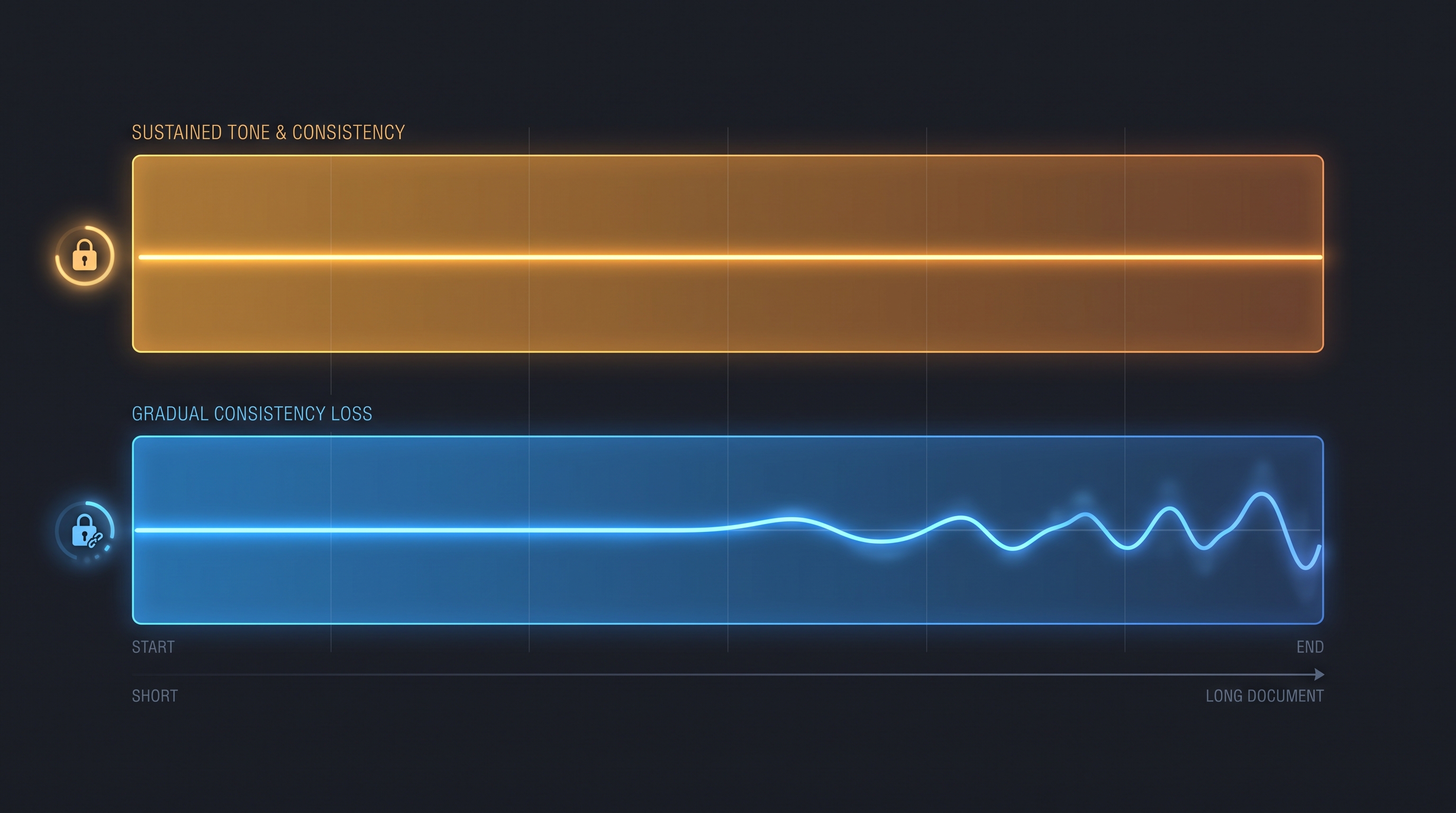
Claude's paid-tier context window sits at 200,000 tokens (with a 1 million token window available via API), against ChatGPT's comparable context handling on its paid tiers. That larger working memory translates directly into a practical writing advantage: Claude can hold an entire long document — a full blog post, a report, an ebook chapter — in context and stay consistent across thousands of words without "forgetting" instructions given at the start of the brief. Independent testers specifically flag that ChatGPT handles long-form content well too, but tends to need more repeated prompting or mid-document reminders to maintain the same tone and constraints it nailed in the opening paragraphs.
This shows up as a lower hallucination rate in longer pieces as well — not zero, on either model, but consistently lower on Claude across the sources that specifically measured factual drift over document length rather than just single-response accuracy. For anything approaching or exceeding 1,000 words, several 2026 comparisons specifically recommend Claude as the safer default precisely because the consistency gap between the two models widens as document length increases — it's a small, barely noticeable difference on a 200-word piece, and a genuinely significant one by the time you're 1,000-plus words in.
Round 2 winner: Claude, and the margin widens the longer the piece runs.
Round 3: Speed, Structure, and Ecosystem — This Is Where ChatGPT Wins
If Claude wins the first two rounds this decisively, why does anyone use ChatGPT for writing at all? Because the two rounds above don't cover every kind of writing job, and the jobs they don't cover are exactly where ChatGPT is the better tool.
ChatGPT is described consistently across sources as more energetic, faster, and better at producing well-organized, structured content quickly — genuinely excelling at persuasive writing, marketing copy, and content built around a clear call-to-action. For high-volume, templated content — product descriptions, FAQs, structured emails, dozens of near-identical variations of the same short piece — ChatGPT's more "obedient and consistent" behavior on simple, repeated instructions is actually the better fit than Claude's more deliberative, nuance-first approach. You don't need Claude's careful tone calibration for a hundred product descriptions that all need to hit the same five bullet points in the same format; you need speed and reliable structure, and that's ChatGPT's actual strength.
The ecosystem gap is the second, larger reason ChatGPT remains essential for most professional writing workflows even where Claude wins on prose quality. ChatGPT includes native image generation (DALL-E), real-time web search for current statistics and competitor research, video generation (Sora), and Advanced Voice Mode — none of which Claude offers natively as of 2026. For any writing workflow that also needs a featured image, current data pulled from the live web, or a broader plugin and integration ecosystem, ChatGPT is doing work that Claude simply cannot do on its own.
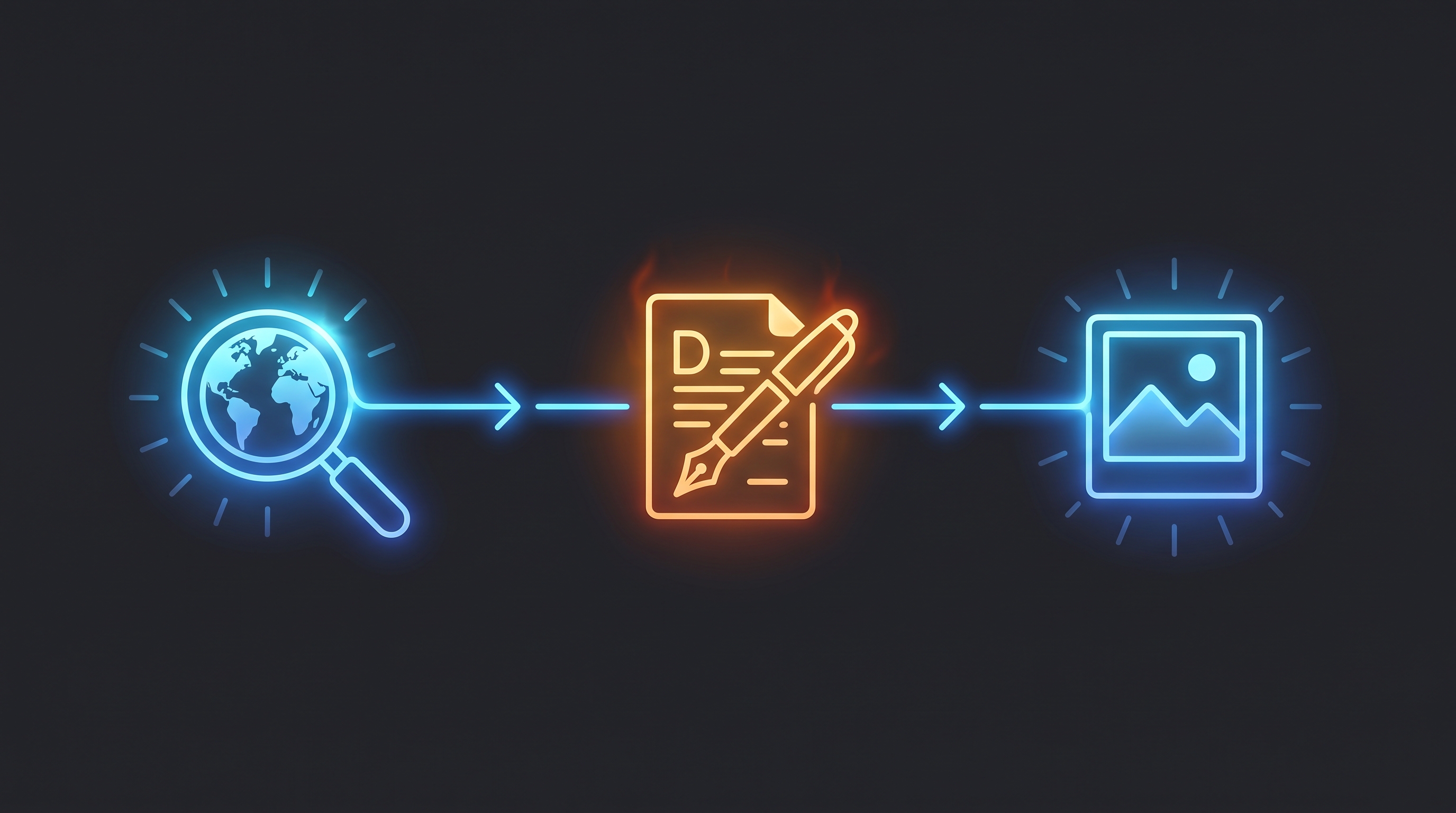
This is exactly why the workflow most professional content teams have actually converged on isn't "pick one" — it's a specific division of labor: use ChatGPT with web search to research current statistics and competitor articles, then use Claude to write the actual piece using those research notes, then go back to ChatGPT's DALL-E for the featured image. Multiple independent sources describe this exact three-step pattern as the most effective content workflow in 2026, and it's worth taking seriously as the actual answer rather than a compromise — because it uses each model for the specific job it's demonstrably better at, rather than forcing one tool to do everything.
Round 3 winner: ChatGPT, specifically for research, images, structured high-volume content, and any workflow that needs a broader tool ecosystem beyond pure prose generation.
The Verdict, By What You're Actually Writing
Choose Claude if:
You're writing long-form editorial content, blog posts, reports, or anything over roughly 500 to 600 words where tone consistency matters across the full length
Your brief has multiple stacked constraints — specific tone, specific things to avoid, a specific structural requirement — and you need all of them followed simultaneously
You're doing brand-voice writing, executive ghostwriting, or editorial work with an established style guide where sounding "less like AI" is directly valuable
You work in a regulated sector (health, finance, legal) where Claude's Constitutional AI training and more measured, careful prose generation carries genuine risk-reduction value
Minimizing post-generation editing time is the priority — Claude's output consistently requires less tone correction to become publish-ready
Choose ChatGPT if:
You need speed and volume more than nuance — structured, templated content at scale (product descriptions, FAQs, repeated email variations)
Your writing workflow also needs image generation, real-time research, or voice — capabilities Claude doesn't offer natively
You're producing marketing copy or persuasive content built around a clear, punchy call-to-action, where ChatGPT's more energetic default register is actually the better fit
You want a single tool that handles writing plus everything adjacent to it, rather than switching between two platforms mid-workflow
Use both if:
You're a professional content creator or team producing regular long-form work — this is genuinely what most serious writers and content teams do in 2026, using ChatGPT for research and visuals, Claude for the actual draft
For a deeper, standalone breakdown of Claude's full model lineup — Sonnet, Opus, and the Fable 5 frontier model — plus its complete 2026 pricing structure, our full Claude review covers the platform independently of this writing-specific comparison.
According to McKinsey's research on generative AI adoption in professional content work (https://www.mckinsey.com/capabilities/mckinsey-digital/our-insights/the-economic-potential-of-generative-ai), the majority of professional content teams in 2026 now treat AI writing tools as standard production infrastructure rather than experimental add-ons — a shift that makes the specific choice of which model handles which stage of the writing pipeline a genuinely consequential production decision, not a minor preference.
What I'd Actually Do
If I were writing anything over 500 words that a real audience was going to read and judge me on — a blog post, a client report, a piece of brand content — I'd draft it in Claude first, every time, without hesitation. The gap in tone precision and instruction-following on complex briefs is too consistently documented across too many independent tests to treat as a coin flip, and the editing time saved on the back end is real, compounding value across every piece you produce.
If I needed a hundred product descriptions by end of day, or I needed the current Q3 2026 statistics on a fast-moving topic before I could write anything credible about it, I'd reach for ChatGPT without a second thought — that's squarely its strength, and asking Claude to do real-time research or crank out high volume structured content isn't playing to what it's actually built for.
The mistake worth avoiding: picking one model as your permanent, only writing tool because you read a single comparison that declared an outright winner. The honest answer, confirmed by nearly every source in this research, is that the winning workflow uses both — and the specific split (Claude drafts, ChatGPT researches and illustrates) is worth adopting deliberately rather than defaulting to whichever tool you happened to open first.
Frequently Asked Questions
Is Claude or ChatGPT better for writing? For long-form content over roughly 500-600 words, nuanced tone requirements, and complex multi-constraint briefs, Claude is the more consistently documented winner across independent 2026 testing. For high-volume structured content, marketing copy with a clear call-to-action, and any workflow needing images or real-time research, ChatGPT is the stronger choice. Most professional writers use both.
Why does Claude's writing sound more human than ChatGPT's? Independent 2026 testing consistently attributes this to Claude's Constitutional AI training approach, which builds honesty and nuance principles into the model rather than applying surface-level filters. In practice, this shows up as fewer recognizable AI patterns — Claude avoids stock phrases like "In today's fast-paced world" and hedging filler language that ChatGPT (particularly GPT-4o) has a well-documented tendency toward.
Does Claude or ChatGPT have a bigger context window for long documents? Claude offers a 200,000 token context window on paid plans (1 million tokens via API), which independent testers link directly to its stronger consistency across long documents — it holds instructions and tone in memory across a full article without drifting, an area where ChatGPT more often needs mid-document reminders.
Can Claude generate images for my blog posts? No. As of 2026, Claude does not natively generate images. ChatGPT Plus includes DALL-E for image generation, which is one of the main reasons professional content workflows commonly pair the two tools rather than relying on either exclusively.
What's the best AI writing workflow if I want to use both models? The workflow most independent 2026 sources converge on: use ChatGPT with web search to research current statistics and competitor content, use Claude to write the actual draft from those research notes, and use ChatGPT's DALL-E for the featured image. This uses each model for the specific task it's demonstrably stronger at.
How much does Claude cost compared to ChatGPT for writing use? Both Claude Pro and ChatGPT Plus cost $20/month at their standard paid tier ($17/month for Claude billed annually). Higher tiers (Claude Max, ChatGPT Pro) run $100-200/month on both platforms. Pricing is roughly equivalent, so the decision should be based on which model's writing style and capability set actually fits your specific use case.
Is ChatGPT better for marketing copy than Claude? Often, yes. Independent 2026 comparisons note ChatGPT's more energetic, structured default register tends to suit persuasive marketing copy and clear call-to-action content well, while Claude's more measured, careful prose is generally the stronger fit for editorial and long-form brand content specifically.

Founder, Axionova · AI Tools Strategist
Ashir writes independent, hands-on reviews of AI tools and shares strategies for creators, marketers, and entrepreneurs. Every review is grounded in real usage — no paid placements, no fluff. Read our editorial standards.
AI Insights Weekly
One curated email a week: sharp AI insights, tool reviews, and strategies.
Have thoughts on this?
Contact us or share this article on social media — we'd love to hear what resonated with you.