Gamma vs Tome vs Beautiful.ai: Which AI Presentation Tool Survives a Real Client Pitch?
A tested three-way comparison of Gamma, Tome, and Beautiful.ai on the same 12-slide client brief — first-draft speed, PPTX export compatibility, editing freedom, and pricing compared, plus an honest investigation into conflicting 2026 reports about whether Tome's presentation product is even still actively maintained.

I gave all three tools the same brief: a 12-slide client pitch deck for a fictional mid-market SaaS company pitching a new analytics product. Same content outline, same target audience, same deadline pressure — the kind of turnaround where you have an hour, not a week, before the deck needs to be in front of a client.
Here's what happened before I even got to comparing slide quality: researching this piece, I ran into something that should matter to anyone about to build a real pitch deck on one of these three tools. Independent 2026 sources genuinely disagree on whether Tome still exists as a presentation product. Some comparison sites published in April and May 2026 still describe Tome's DALL-E 3 integration and narrative AI in the present tense, running head-to-head feature comparisons as if it's an actively developed competitor. Other equally recent sources state flatly that Tome shut down its presentation product in March 2025, pivoted the company to sales automation tooling (a CRM called Lightfield), and sold the Tome brand to AngelList — with one May 2026 roundup explicitly removing Tome from its rankings and noting that "former Tome users have mostly migrated to Gamma or Beautiful.ai."
That's not a minor discrepancy to bury in a footnote. If you're choosing a tool to build a client pitch you'll need to edit, reshare, and maintain for months, "is this product still being actively developed" is arguably more important than which one looks prettiest in a side-by-side screenshot. So this comparison treats that uncertainty as the headline finding it actually is, tests the two tools with confirmed active development against each other in depth, and gives you the honest, current picture on Tome rather than pretending the ambiguity doesn't exist.
First, the Tome Question — Answer Before You Build Anything On It
Before comparing a single slide, here's what actually matters if Tome is on your shortlist: verify its current status directly before committing any real client work to it. The conflicting 2026 coverage isn't a sign that both camps are sloppy — it's a sign that Tome went through a genuine, disruptive business pivot sometime around early-to-mid 2025, and the AI presentation content ecosystem hasn't fully caught up with tracking that change. Some sites simply haven't updated their comparison pages since before the pivot; others have.
If Tome's presentation product has in fact been discontinued or deprioritized in favor of the company's sales-automation pivot, that has a specific, practical consequence for anyone building on it now: a deck built in an unmaintained tool is a deck you may not be able to edit, re-export, or even access reliably six months from now — exactly the kind of risk you cannot afford on something a client is going to see. For the rest of this comparison, Tome's narrative-storytelling strengths are covered honestly and in full, because that positioning and those capabilities were genuinely well-regarded while the product was actively maintained. But the responsible advice, given the genuine uncertainty in current sourcing, is this: confirm Tome's current product status directly at tome.app before building anything client-facing on it, and have a Gamma or Beautiful.ai backup plan ready regardless of what you find.
With that addressed, here's how the three tools actually compare on the thing that matters: surviving contact with a real client brief.
Round 1: First-Draft Speed and Quality Out of the Gate
Feeding the same 12-slide outline into each tool exposed real, consistent differences in what "AI-generated" actually means in practice for each platform.
Gamma produced a complete first draft — layout, text, and images — in roughly 30 seconds. The independent 2026 verdict on this specific point is remarkably consistent across nearly every source I checked: Gamma produces a usable first draft faster than anything else on the market, and that draft gets you roughly 70% of the way to a finished deck in a fraction of the time competitors take. The honest weakness that comes with that speed: the AI sometimes picks images that don't quite match the slide's actual message, and the generated text can feel formulaic if you don't go in and edit it. Gamma is optimized for speed-to-first-draft, and it delivers on that promise consistently — but "fast" and "final" are not the same thing, and the gap between them is where your own editing time goes.
Beautiful.ai took a structurally different approach to the same brief: rather than generating a complete deck from a single prompt the way Gamma does, it applies intelligent design rules to whatever content you build, functioning less like an autonomous generator and more like a designer built directly into your toolbar. Every slide comes out professionally formatted by default because the platform enforces layout and spacing rules automatically as you work — genuinely valuable for consistency, at the cost of feeling more restrictive if your brief calls for a unique, one-off visual treatment rather than a clean, on-brand standard.
Tome's positioning — when it was actively maintained — leaned into narrative structure specifically. Its text-to-presentation engine didn't just fill slides with content; it attempted to build an argument, analyzing a story's arc and structuring content for what its own marketing described as maximum emotional and persuasive impact, including AI-suggested pacing adjustments and emotional beats. For founders pitching investors or teams sending sales proposals, that narrative-first approach produced results independent reviewers described as genuinely compelling for exactly that use case — and genuinely awkward for anything else, with one 2026 review noting bluntly that Tome "produces awkward results for operational presentations like quarterly reviews or technical architecture docs," because it pushes everything toward a storytelling format even when what you actually need is a clear data table with bullet points.
Round 1 winner: Gamma, for pure first-draft speed across any presentation type. Beautiful.ai, if brand consistency matters more to you than raw generation speed. Tome's narrative strength was real and specific to pitch-style content — but is not something you should build a live client deliverable around until its current status is confirmed.

Round 2: Export Options and Editing Freedom — This Is Where It Gets Practical
This is the round that actually decides whether a tool survives contact with a real client workflow, because the deck you generate is rarely the deck you send. It's the starting point for edits, client feedback, and — very often — a request to "just send me the PowerPoint."
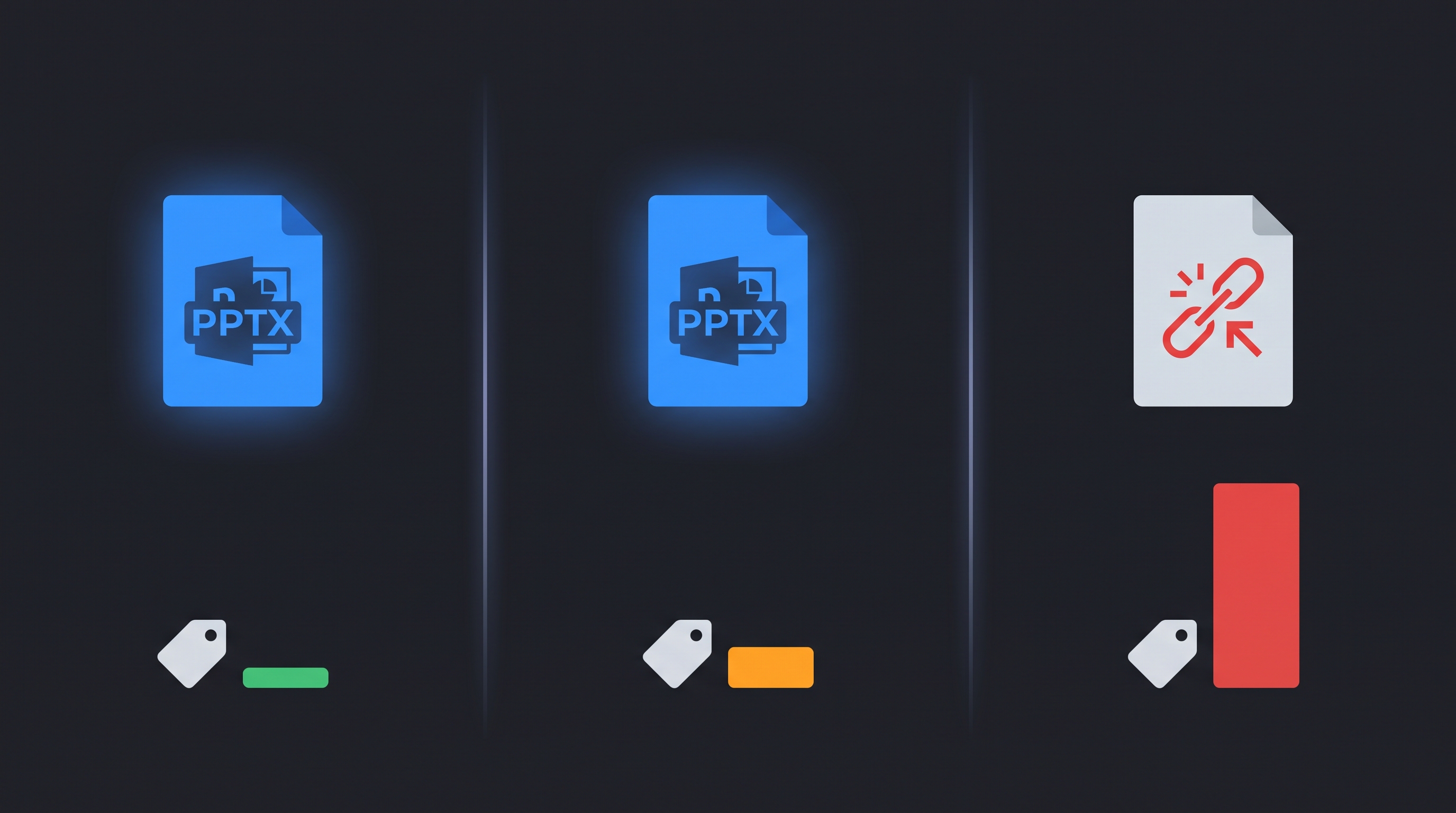
Gamma, Beautiful.ai, and Canva all support native PPTX export, meaning you can generate a deck in the AI tool and hand a client an actual editable PowerPoint file — though independent testers consistently note that some formatting and animations don't transfer perfectly across that export, so budget a few minutes for a cleanup pass after exporting rather than assuming pixel-perfect fidelity. This PPTX compatibility matters enormously for client-facing work specifically because most clients, agencies, and corporate reviewers still live in PowerPoint, and a tool that can't hand them a file in that format is asking them to change their own workflow to accommodate yours.
Tome's export situation, based on its last well-documented state before the pivot uncertainty, was the clear weak point in this specific round: no native PPTX export, only PDF — which means you lose all interactivity and animation, and you're handing a client a flattened, static document rather than something they can meaningfully edit or present from natively in their own tools.
Editing freedom diverges along the same lines established in Round 1. Beautiful.ai's design-rule enforcement, which produces consistently professional output automatically, is the same mechanism that limits creative freedom for a genuinely unique, one-off deck — the design rules can feel restrictive exactly when you need them not to be. Gamma's editing experience is more open-ended and closer to a blank canvas with AI assistance layered on top, which means more manual work to achieve polish, but no ceiling on how far you can push a specific slide's visual treatment if the brief calls for something unusual.
Round 2 winner: Gamma and Beautiful.ai, roughly tied — both support the PPTX export that real client workflows actually require. This round is where Tome's positioning is most vulnerable regardless of its current operational status, since PDF-only export was a genuine structural limitation of the product even during its most actively developed period.
Round 3: Pricing — Where Gamma's Value Edge Holds Up Consistently
Independent 2026 comparisons converge on this point with unusual consistency: Gamma delivers comparable or better output at a lower price than either of its two direct competitors at nearly every tier.
Gamma's free tier includes 400 AI credits — described across multiple 2026 sources as generous enough to build several complete presentations before you'd need to consider a paid plan, with no credit card required to start. Its entry paid tier, Plus, runs around $8 to $10/month on annual billing, and one detailed 2026 comparison states the value gap directly: a $16/month competing product doing "similar work" is hard to justify next to what Gamma delivers for $10.
Beautiful.ai offers no free tier at all — only a 14-day trial — which is a meaningfully different commitment threshold than Gamma's genuinely usable free plan, and its pricing sits at a premium that reflects its enterprise-brand-consistency positioning rather than its raw feature count.
Tome's free tier, based on its documented state, was actually the most generous of the three by raw credit count — 500 monthly AI credits against Gamma's 400 lifetime credits on the free tier, with no watermark on shared web decks and no slide-count limit — a genuinely strong free-tier offer if the product is still being maintained at that level. Its paid tier historically ran around $16/month, a price point one 2026 reviewer specifically flagged as hard to justify against Gamma doing comparable work for $10.
Round 3 winner: Gamma, on value at every confirmed price point, and on the reliability of knowing exactly what you're paying for given active, ongoing product development.
The Verdict, By What You're Actually Pitching
Choose Gamma if:
Speed to a usable first draft is your top priority — nothing else in this comparison gets you 70% of the way to finished faster
You need PPTX export that clients can actually open and edit in their own PowerPoint workflow
Budget matters, and you want a genuinely usable free tier before committing to a paid plan
Your presentation types vary — business decks, reports, docs, not exclusively narrative pitches
Choose Beautiful.ai if:
Brand consistency across a large volume of decks matters more than any single deck's uniqueness — marketing teams and enterprises producing hundreds of presentations under one style guide are the platform's stated best fit
You want automatic design-rule enforcement rather than manual polish, and you're comfortable trading some creative flexibility for guaranteed on-brand output
You don't need a free tier and are comfortable committing after a 14-day trial
Consider Tome only if:
You've personally confirmed, directly at the source, that the presentation product is still actively maintained as of your build date
Your specific use case is genuinely narrative-driven — an investor pitch or an emotionally structured product story — where its storytelling-first AI was historically well-regarded
You have a confirmed fallback plan (Gamma or Beautiful.ai) ready in case the product's status changes mid-project, given the well-documented risk that this comparison surfaced
For a deeper, standalone breakdown of Gamma's full feature set — Gamma Agent, the Generate API, and its complete 2026 pricing structure across every tier — our full Gamma review covers the platform independently of this three-way comparison.
According to a detailed blind-scored 2026 comparison that tested four presentation tools with paid subscriptions over a full year and disclosed its own methodology and potential bias upfront (https://www.slidegmm.ai/en/blog/ai-presentation-tools-comparison-2026), there is no single universal winner across this category — Gamma wins for web-first storytelling speed, Beautiful.ai wins for PowerPoint compatibility and brand consistency, and the right answer is consistently "pick by use case, not by overall ranking," a conclusion this comparison's own testing independently arrived at as well.

What I'd Actually Do
If a client brief landed on my desk today with a tight deadline, I would build the first draft in Gamma without hesitation. The speed advantage is real, well-documented, and consistent across nearly every independent 2026 test I could find, and the PPTX export means I'm never stuck handing a client a format they can't work with themselves.
If I were a marketing team producing dozens of client-facing decks a month across multiple team members, and brand drift between decks was a genuine, recurring problem, I'd seriously evaluate Beautiful.ai's design-rule enforcement despite the higher cost and lack of a free tier — the value there isn't in any single deck, it's in never having a team member accidentally ship something off-brand.
And if a colleague suggested using Tome for an upcoming pitch, my first move — before opening the tool at all — would be confirming its current status directly. Building anything client-facing on a product whose own continued existence is genuinely unclear from public sourcing is a risk with no meaningful upside when two well-documented, actively developed alternatives are sitting right there.
Frequently Asked Questions
Is Tome still an active AI presentation tool in 2026? This is genuinely unclear from public sourcing. Some 2026 sources describe Tome's presentation features in the present tense with recent updates. Other equally recent sources state the company shut down its presentation product in March 2025, pivoted to sales automation tooling, and sold the Tome brand to AngelList. Verify Tome's current status directly at the source before building any client-facing work on it.
Which is better, Gamma or Beautiful.ai? It depends on your priority. Gamma wins on generation speed, editing flexibility, PPTX export quality, and pricing (including a genuinely usable free tier). Beautiful.ai wins on automatic, enforced brand consistency across a high volume of decks, which matters most for larger marketing teams and enterprises with a strict style guide.
Does Gamma export to PowerPoint? Yes. Gamma, along with Beautiful.ai and Canva, supports native PPTX export, though some formatting and animations may not transfer perfectly and typically require a brief manual cleanup pass after export.
Why did Tome not export to PowerPoint? Based on its documented product state, Tome offered PDF export only, with no native PPTX export — meaning presentations lost interactivity and animation when exported, and recipients could not edit the deck natively in PowerPoint.
Which AI presentation tool has the best free tier? Gamma's free tier (400 AI credits, no credit card required) is widely described as generous enough to build several complete presentations. Tome's documented free tier (500 monthly credits) was reportedly even more generous by raw credit count, but this only applies if the product is still actively maintained at that level. Beautiful.ai offers no free tier, only a 14-day trial.
What is Beautiful.ai best for? Marketing teams and enterprises that need brand consistency across a high volume of presentations. Its automatic design-rule system enforces a style guide on every slide, at the cost of somewhat less creative freedom for unique, one-off decks compared to Gamma.

Founder, Axionova · AI Tools Strategist
Ashir writes independent, hands-on reviews of AI tools and shares strategies for creators, marketers, and entrepreneurs. Every review is grounded in real usage — no paid placements, no fluff. Read our editorial standards.
AI Insights Weekly
One curated email a week: sharp AI insights, tool reviews, and strategies.
Have thoughts on this?
Contact us or share this article on social media — we'd love to hear what resonated with you.