How to Make Money With a Faceless YouTube Channel in 2026
The complete guide to building and monetizing a faceless YouTube channel in 2026 — covering the best niches by CPM data, the full AI tool stack including Claude, ElevenLabs, and HeyGen, the step-by-step production workflow, and every monetization method that compounds over time.
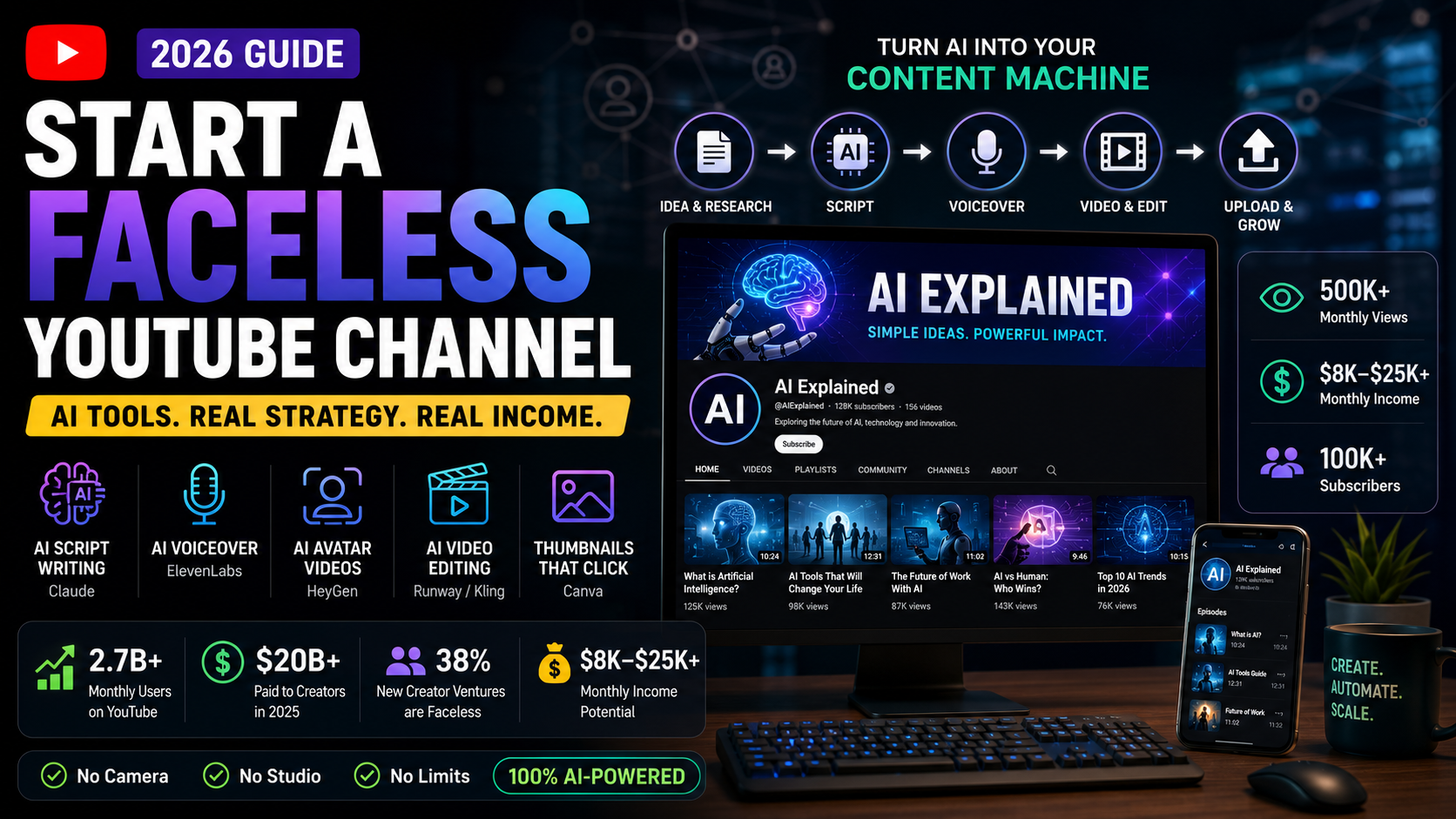
You do not need a camera. You do not need lighting equipment. You do not need to fix your hair, memorize a script on cue, or feel comfortable being recognized on the street by strangers who watch your videos.
What you need is a system — and in 2026, AI has made that system accessible to almost anyone willing to put in the thinking and creative direction required to run a real content operation.
Faceless YouTube channels now account for 38% of all new creator monetization ventures, up from just 12% in 2022. That is a 217% increase in three years, powered almost entirely by AI tools that have collapsed the cost and time required to produce professional-quality video content. YouTube paid out over $20 billion to creators in 2025 alone, and a growing portion of that revenue is flowing to people who have never once shown their face on camera.
This guide covers the complete picture — the best niches, the exact AI tool stack, the step-by-step production workflow, the monetization layers that actually compound, and the mistakes that cause most faceless channels to fail before they ever get a chance to grow.
What Is a Faceless YouTube Channel?
A faceless YouTube channel is exactly what it sounds like: a channel that publishes video content without the creator ever appearing on camera. The content is carried entirely by voiceover narration, visual footage, animations, screen recordings, graphics, and editing — with no talking-head camera presence required at any point.
The format is not new. Channels like The Infographics Show, Lofi Girl, and Kurzgesagt proved years ago that anonymity and audience scale are not mutually exclusive. What changed in 2024 and 2025 is that AI tools made the production workflow — which previously required a team of writers, voice actors, video editors, and motion graphics designers — executable by a single person working part-time.
A 10-minute YouTube video that once required $500 and 3 to 5 days of production time can now be produced for under $3 and a few hours of focused work. That economics shift is why the category has exploded.
The key distinction that separates successful faceless channels from the ones that fail: faceless does not mean low-effort. The channels earning real money are investing in scripting quality, research depth, editing polish, and thumbnail strategy. They are using AI as an efficiency multiplier — not as a replacement for creative direction and editorial judgment.
Why 2026 Is the Right Time to Start
The numbers tell a clear story. YouTube has 2.7 billion monthly users in 2026 with over 1 billion hours of video watched every day. The platform generated $40.4 billion in ad revenue in 2025 — exceeding the combined ad revenue of Disney, NBCUniversal, Paramount, and Warner Bros. Discovery. Goldman Sachs analysts project 2026 YouTube ad revenue between $44.5 billion and $46.2 billion as Shorts monetization expands.
That advertising demand is distributed across every niche, with creators keeping 55% of gross ad revenue on long-form content. For creators in high-CPM categories like personal finance, AI, technology, and business — where advertisers pay $15 to $40 per thousand views — the revenue potential is significant even at relatively modest view counts.
According to Google's Creator Economy research, the top factors driving audience growth on YouTube in 2025 and 2026 are content consistency, niche authority, and production quality — all of which are now more achievable for solo creators thanks to AI production tools.
The window to build a faceless channel before the space becomes oversaturated in every niche is still open — but it is narrowing. The creators who build distribution and subscriber bases now are the ones who will benefit most from YouTube's continued growth over the next three to five years.
The Best Faceless YouTube Niches in 2026 (With Real CPM Data)
Not all niches pay equally. The single highest-leverage decision you make as a faceless creator is your niche — because it determines your CPM ceiling, your audience's advertiser value, and your long-term revenue potential regardless of how many views you get.
Here is the 2026 CPM landscape by niche:
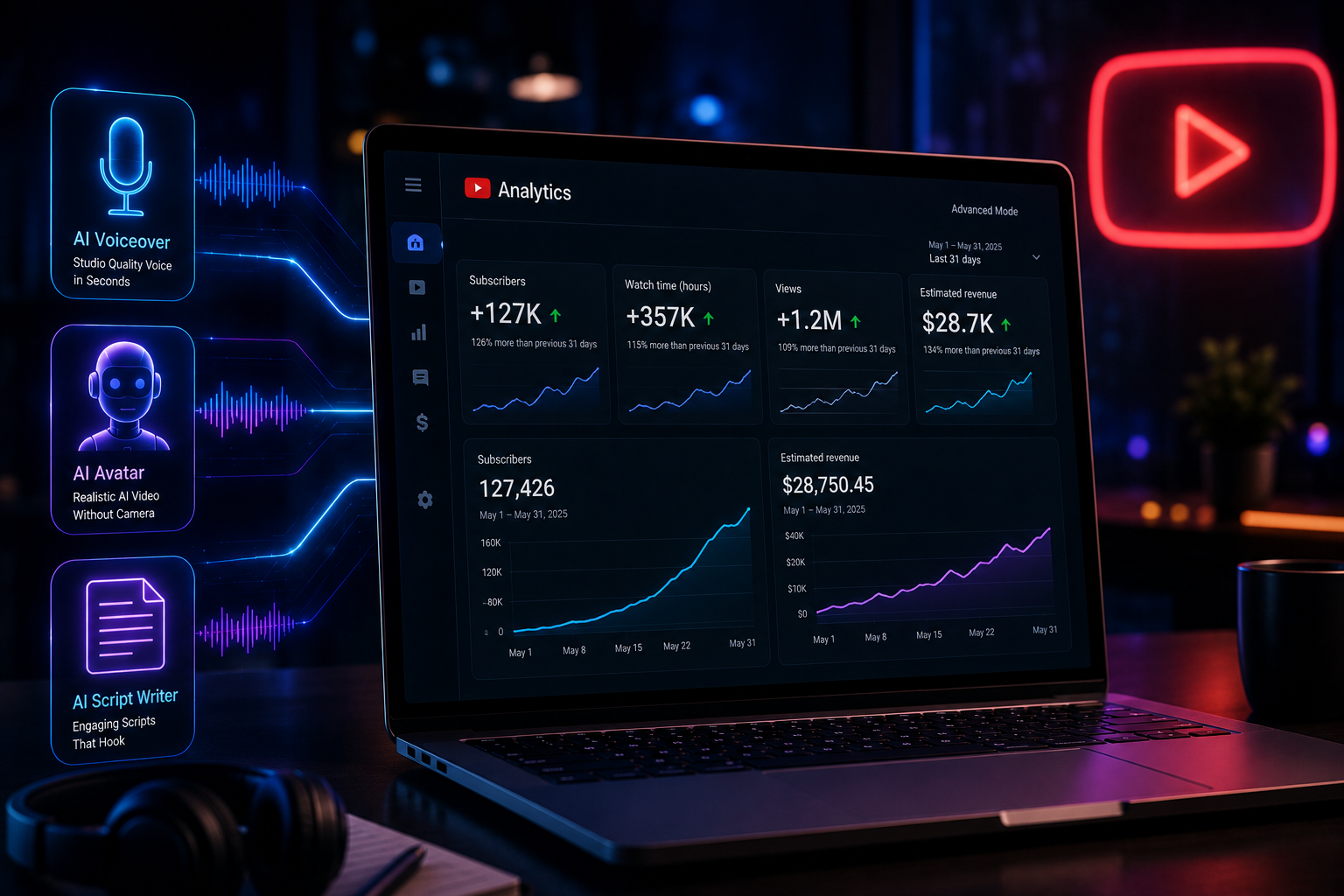
Personal Finance and Investing — $15 to $30+ CPM The king of faceless RPM. Finance channels attract advertisers — banks, fintech apps, brokerages, insurance companies — willing to pay $40+ CPM to reach audiences actively searching for investment and money management content. Animated explainers on index funds, dividend strategies, tax optimization, and wealth building are consistently high performers. At 500,000 monthly views with affiliate income stacked on top of AdSense, established finance channels generate $8,000 to $25,000 per month.
AI and Technology — $8 to $20 CPM One of the fastest-growing and most affiliate-friendly niches. AI tool reviews, software tutorials, tech news explainers, and SaaS breakdowns attract both advertising spend and affiliate commission opportunities. A channel reviewing AI tools can earn AdSense revenue from its videos AND affiliate commissions from every tool it covers — creating two income streams from the same piece of content.
Business Case Studies and Documentaries — $10 to $18 CPM Channels covering brand stories, startup journeys, corporate histories, and business strategy breakdowns attract high-value business audiences. The format works perfectly for faceless production — stock footage, graphics, and narration carry the entire video.
Health and Wellness — $10 to $18 CPM Medical information channels, mental health content, sleep science, and fitness explainers attract health supplement and pharmaceutical advertising — both high-CPM categories. The content requires research accuracy but is highly automatable with AI assistance.
Luxury and Wealth — $12 to $18 CPM Channels covering luxury products, wealth lifestyle, and high-end travel attract premium advertisers and affluent audiences. The format is visually rich using stock footage and requires strong narration — both areas where AI tools excel.
Motivation and Self-Development — $8 to $12 CPM High upload frequency is viable in this niche, with course and coaching affiliate opportunities stacking significantly on top of AdSense.
Nature and Wildlife — $3 to $8 CPM Lower CPM but lowest competition and most abundant stock footage. Ideal for absolute beginners who want to learn production workflow before moving to a higher-CPM niche.
The practical framework: choose a niche where you can produce content consistently for at least 12 months, where there is long-term keyword demand (use YouTube search to validate), and where the RPM ceiling justifies the time investment. Finance, AI, technology, and business consistently meet all three criteria in 2026.
The Complete AI Tool Stack for Faceless YouTube Channels
This is the core of what makes faceless YouTube viable as a solo operation in 2026. Each tool in the stack handles a specific stage of the production workflow, and the combination compresses what used to require a team into a process one person can manage.
Claude — AI Script Writing and Research
Claude is the script writing engine of the entire workflow. For faceless YouTube channels, the script is everything — it determines the quality of the voiceover, the structure of the video, the hook that retains viewers past the first 30 seconds, and the information density that drives watch time and return viewership.
The approach that consistently produces better outputs: give Claude your topic, your target audience profile, your channel's tone and voice guide, your target video length, and the angle you want to take. Ask it to write like an experienced teacher who uses specific examples and clear analogies rather than generic explanations.
For a 10-minute video script, expect 1,400 to 1,800 words. Claude handles the full structure — hook, problem setup, main body with logical section breaks, and CTA — which is the framework that keeps viewers watching through a full video rather than dropping off after two minutes.
The editorial pass after Claude's draft is where quality differentiation happens. Read the script out loud. Cut the AI tells — generic transitions like "moreover," "furthermore," "it's worth noting" — and replace them with specific, content-tied transitions. Add concrete examples, specific numbers, and original observations. The AI does 80% of the structural work. The 20% of human editorial judgment applied on top is what separates a watchable video from one that feels generated.
Claude is available for free with meaningful usage limits, making it accessible as the first tool in any faceless channel stack before monetization kicks in.
You can read more about it, Click HERE
ElevenLabs — AI Voiceover Generation
ElevenLabs is the gold standard for AI voiceover in 2026, and it is not particularly close. The platform's voice cloning and text-to-speech capabilities produce narration that is consistently described by creators as indistinguishable from professional human voiceover when set up correctly.
The free tier provides 10,000 characters per month — enough to test the workflow. The Starter plan at $5 per month provides 30,000 characters, covering two to three 10-minute video scripts. The Creator plan at $22 per month provides enough for consistent weekly publishing.
For educational and documentary-style faceless content, voices tagged as "narrative" or "informative" in the ElevenLabs Voice Library perform best on YouTube. The settings that produce natural narration without sounding flat or over-processed: Stability at 0.45, Similarity Boost at 0.75, Style at 0.3. These settings introduce natural pace variation and emphasis without the robotic flatness that causes viewers to disengage.
ElevenLabs' voice cloning feature allows creators to build a consistent channel voice over time — using a cloned version of their own voice or a licensed voice identity — which strengthens channel brand recognition as subscriber counts grow.
According to research from Reuters on AI audio technology, voice synthesis quality reached a critical threshold in 2024 where human listeners could not reliably distinguish AI-generated speech from professional voice actor recordings at controlled listening conditions — which is the technical foundation for why ElevenLabs-powered channels are now competitive with traditionally produced YouTube content.
You can read more about it, Click HERE
HeyGen — AI Avatar Video and Visual Assembly
HeyGen handles the visual layer of the production workflow. For faceless channels that want a consistent presenter identity without appearing on camera, HeyGen's AI avatar technology generates talking-head video of a digital presenter delivering the script — with lip sync, body language, and natural presenter movement — without requiring any filming.
The workflow: write and approve the script in Claude, generate the final voiceover audio in ElevenLabs, upload that audio file to HeyGen, and render the avatar presentation around the audio. Locking the audio before rendering prevents timing issues and avoids wasting generation credits on videos that need to be re-rendered.
HeyGen also supports script-to-video generation directly for channels that want the fastest possible pipeline, and includes B-roll integration and auto-captioning — making it possible to go from finished script to publishable video within a single tool for most straightforward educational content formats.
For channels where a consistent human-like presenter is central to the brand identity, HeyGen is the most complete solution. For channels that run narration over stock footage or graphics — which is actually the dominant format for high-RPM faceless niches like finance and business — the avatar layer can be skipped entirely, with ElevenLabs audio paired directly with footage in a video editor.
Runway and Kling — AI Video Generation for B-Roll
Stock footage has limitations. For topics that require specific visual scenarios — abstract concepts, historical recreations, futuristic environments, or any scene that stock libraries simply do not cover — AI video generation fills the gap.
Runway Gen-4 and Kling are the two leading options in 2026 for generative video quality. Both produce short AI-generated video clips from text prompts or reference images, which can be used as B-roll to illustrate narration points that stock footage cannot cover.
The cost of AI video generation is still significant for high-volume use — budget $50 to $100 per month if AI-generated footage is a core element of the visual style rather than an occasional supplement. For most beginners, combining ElevenLabs voiceover with stock footage from Pexels, Pixabay, or Storyblocks provides a functional and cost-effective visual layer without AI video generation costs.
Canva — Thumbnail Design
Thumbnails determine whether your video gets clicked. YouTube's algorithm surfaces videos to potential viewers, but the thumbnail and title combination determines whether those impressions convert to views. A strong thumbnail on a weaker video consistently outperforms a weak thumbnail on excellent content.
Canva's Magic Studio integrates AI design capabilities into the thumbnail creation process — generating layout suggestions, background removal, text placement, and brand consistency across a channel's visual identity. The free tier covers most thumbnail creation needs. The Pro plan at $15 per month adds the Brand Kit feature, which ensures visual consistency across every thumbnail without rebuilding brand elements from scratch each time.
vidIQ — YouTube SEO and Topic Research
Content production without SEO is a waste of production effort. vidIQ surfaces keyword opportunities, tracks competitor channel performance, identifies trending topics within a niche before they peak, and provides search volume and competition data for potential video titles.
The research workflow: use vidIQ to find a keyword with meaningful search volume and low-to-moderate competition in your niche, validate the angle by reviewing what existing top-ranking videos cover and where the gaps are, then feed the validated topic and angle to Claude for script generation. This ensures every video is built around a keyword that people are actually searching for — not just a topic the creator found interesting.
According to Ahrefs research on YouTube SEO, videos optimized with clear keyword-focused titles, strong retention in the first 30 seconds, and high click-through rate thumbnails consistently outrank higher-production-quality videos that lack keyword intent alignment. For faceless creators, where production quality is already competitive through AI tools, SEO becomes the primary competitive lever.
InVideo AI — All-in-One Beginner Pipeline
For creators who want the fastest possible path from idea to published video before investing in the full AI stack above, InVideo AI provides a complete prompt-to-video pipeline in a single tool. Type a topic or script, and InVideo assembles footage, voiceover, captions, and basic editing automatically.
The quality ceiling is lower than a purpose-built stack with Claude, ElevenLabs, and HeyGen working separately — but for beginners validating niche selection or learning publishing rhythm before production quality becomes the priority, InVideo AI is the most accessible entry point.
The Step-by-Step Faceless Channel Production Workflow
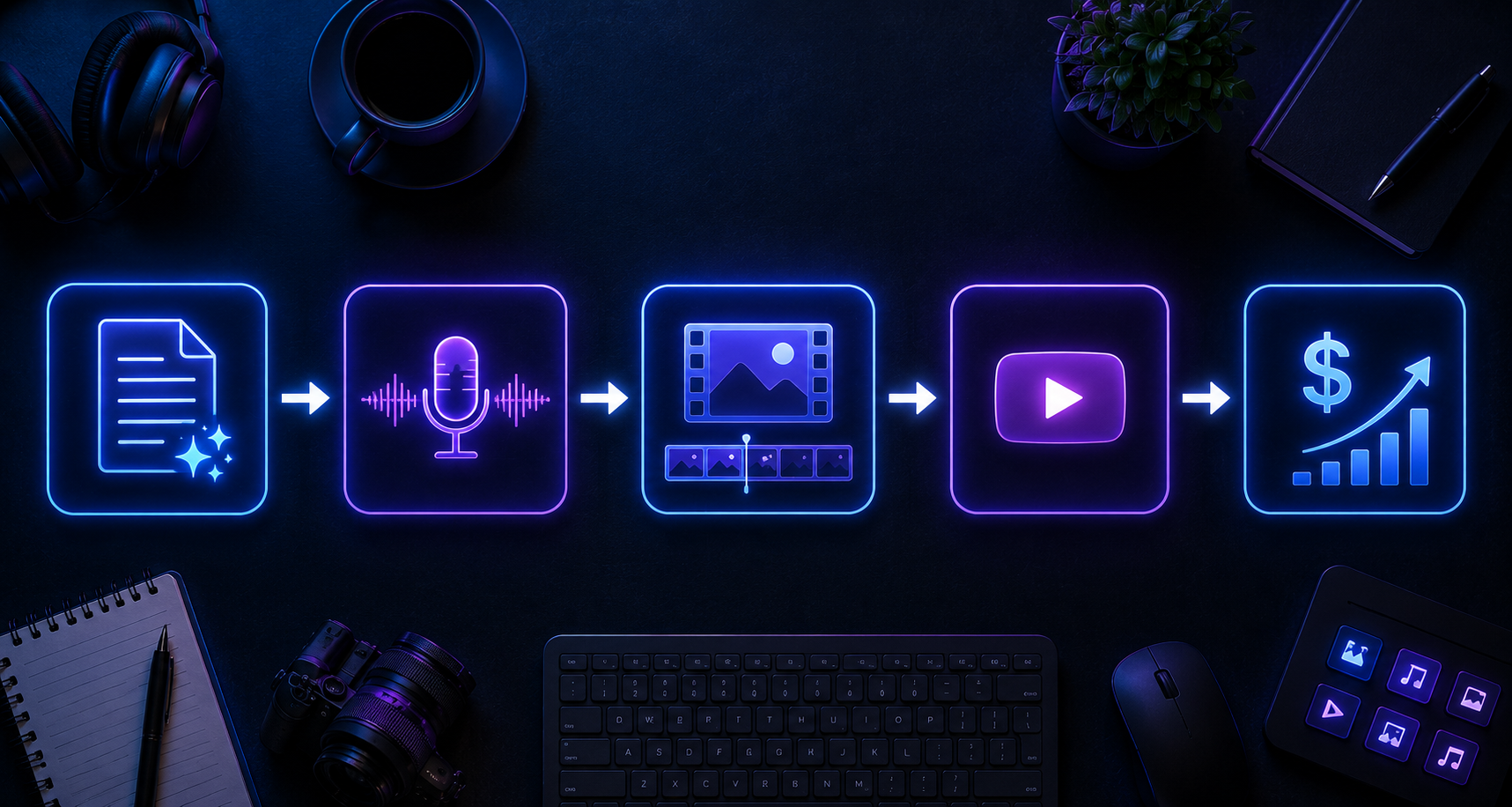
Here is the exact production sequence that experienced faceless creators use in 2026 to take a video from topic idea to published upload.
Step 1 — Topic Research and Keyword Validation (30 minutes)
Open vidIQ and search within your niche for keywords with meaningful monthly search volume (minimum 1,000 to 5,000 searches depending on niche competitiveness) and a competition score that leaves room for a new channel to rank. Review the top 5 to 10 existing videos on that keyword. Identify the angle none of them have taken — the specific framing, perspective, or depth of coverage that your video will do better.
Step 2 — Script Writing With Claude (30 to 45 minutes)
Open Claude and feed it: the topic, your validated keyword, your target audience profile, your channel's voice and tone guide, the desired video length, and the specific angle you identified in research. Ask for a structured script with a hook (first 30 seconds designed to retain viewers), a clear problem statement, a logical body with defined section breaks, and a CTA at the end.
Review the output. Read it aloud. Cut any AI-sounding language. Add specific numbers, concrete examples, and original observations that the AI cannot generate from general knowledge. The goal is a script that feels written by a knowledgeable person, not generated by a machine.
Step 3 — Voiceover Generation With ElevenLabs (20 to 30 minutes)
Paste the finalized script into ElevenLabs. Select your channel voice. Apply the recommended settings — Stability at 0.45, Similarity Boost at 0.75, Style at 0.3. Preview the output and adjust settings if the pacing or emphasis feels off on specific sentences. Download the final audio file.
Step 4 — Visual Assembly (1 to 2 hours)
For avatar-led content: upload the ElevenLabs audio to HeyGen, configure your avatar and background, render the video, then add B-roll cutaways and captions in a video editor (CapCut or DaVinci Resolve both work well at no cost for basic editing).
For narration-over-footage content: import the ElevenLabs audio into your video editor, lay stock footage clips from Pexels or Storyblocks underneath the narration, time visual cuts to audio transitions, add captions, add any AI-generated B-roll clips for concepts stock footage cannot illustrate, and export.
Step 5 — Thumbnail Creation in Canva (15 to 20 minutes)
Design the thumbnail with a single clear focal point, minimal text (three to five words maximum), high contrast between text and background, and a visual element that creates curiosity or signals the video's value. Maintain consistent visual branding — same fonts, same color palette, same style — across every thumbnail to build channel recognition.
Step 6 — Upload and SEO Optimization (20 minutes)
Write an SEO-optimized video title with the target keyword in the first 50 characters. Write a description that includes the keyword in the first two sentences, then expands with related terms and a channel CTA. Add relevant tags. Select the strongest thumbnail. Set the end screen and cards. Publish.
Total workflow time for an experienced creator running this stack: approximately two to four hours per video. A beginner will take longer initially, but the workflow compresses significantly with repetition.

How to Monetize a Faceless YouTube Channel
The highest-earning faceless channels do not rely on AdSense alone. They build multiple income layers that compound simultaneously.
YouTube Partner Program (AdSense)
The entry point for monetization. To qualify in 2026, a channel needs either 1,000 subscribers and 4,000 watch hours in the past 12 months (long-form path) or 1,000 subscribers and 10 million Shorts views in 90 days (Shorts path).
Once in the YouTube Partner Program, creators keep 55% of gross ad revenue on long-form content. RPM — the per-thousand-views earnings after YouTube's share — ranges from $2 in entertainment niches to $18 or more in finance and technology niches in 2026.
Realistically: a channel earning $5 RPM in a mid-tier niche at 100,000 monthly views earns $500 per month from AdSense. The same view count in a finance niche at $18 RPM earns $1,800 per month. Niche selection multiplies AdSense revenue more than view count alone.
Affiliate Marketing
Affiliate marketing is consistently described by established faceless creators as the primary driver of revenue beyond AdSense — often contributing 30% to 50% of total income or more in tool and software niches.
The model is simple: include affiliate links in video descriptions for tools, software, books, or products relevant to the video topic. When a viewer clicks the link and makes a purchase, the creator earns a commission. For AI tool channels, software affiliate programs typically pay 20% to 40% recurring commissions on SaaS subscriptions — meaning a single successful referral compounds monthly for as long as that customer stays subscribed.
For a technology or AI channel reviewing tools relevant to its audience, affiliate income and AdSense revenue create a powerful combination: the same video generates both income streams simultaneously.
According to the Performance Marketing Association's research on affiliate marketing, affiliate marketing spending in the United States reached over $10 billion annually in 2025, with content-driven channels representing one of the highest-converting traffic sources for software and SaaS products — which is precisely the intersection that AI tool channels occupy.
Brand Sponsorships
Once a channel reaches consistent viewership — typically 10,000 to 50,000 subscribers depending on niche — brands begin paying for dedicated mentions or sponsored video segments. Sponsorship rates in 2026 range from $500 for smaller channels to over $10,000 for channels with millions of subscribers in high-value niches.
For faceless channels in AI, technology, and business niches, sponsorship opportunities compound particularly well because the audience profile — professionals, entrepreneurs, and digital-first users — aligns with what software companies want to reach.
Digital Products
Channels with established audiences can sell their own digital products — templates, guides, prompts, courses, or tool stacks — without requiring a publisher, distributor, or retail partner. A faceless AI tools channel could sell a "Faceless Channel Starter Kit" including Claude prompt templates, ElevenLabs settings guides, and production workflow checklists.
The economics of digital products are attractive because the product is created once and sold indefinitely with no inventory cost.
Channel Memberships and Community
The YouTube Partner Program also enables channel memberships, where subscribers pay a monthly fee for exclusive content, early access, or community access. For channels with highly engaged audiences in specific niches, memberships add a predictable recurring revenue layer that stabilizes total channel income against the month-to-month variability of AdSense.
YouTube's AI Content Policy — What You Need to Know in 2026
In early 2026, YouTube suspended monetization for thousands of faceless AI channels under its inauthentic content policy. This was widely misreported as a "ban on AI YouTube channels." It was not.
YouTube officially clarified that faceless channels are not banned, and that AI-assisted production is explicitly permitted. What is targeted is mass-produced content with no original thought, research, or creative direction — videos where a human couldn't tell whether the content was made by a person or an automated system running on a template.
The practical implication is straightforward: use AI as a production tool, not as a replacement for editorial judgment. AI writes the draft — the creator provides the topic selection, the research angle, the editorial refinement, and the quality review. AI generates the voiceover — the creator selects the voice, reviews the output, and adjusts pacing and emphasis. AI assembles visuals — the creator makes the creative decisions about what footage reinforces each content point.
Channels that follow this model — AI-assisted but human-directed — are not at risk under YouTube's current policies. Channels that submit unreviewed AI outputs with no original creative contribution are the ones being suspended.
The YouTube Creator Academy provides up-to-date guidance on content policies including AI disclosure requirements — which now require creators to disclose when realistic AI-generated voices or video are used in content that could be mistaken for documentary footage. Building this disclosure habit from the start protects channels as policy enforcement matures.
Common Mistakes That Kill Faceless Channels Before They Grow
Understanding what causes most faceless channels to fail is as valuable as understanding what drives success.
Choosing a niche based on interest rather than data. Personal interest in a topic is a starting point, not a business decision. Validate niche selection with CPM data, keyword demand, and competitive analysis before producing a single video.
Publishing inconsistently and expecting algorithmic reward. YouTube's recommendation algorithm rewards channels that publish consistently to an engaged audience. The channels that grow fastest publish on a reliable schedule — weekly at minimum — and maintain that schedule regardless of early performance.
Treating AdSense as the entire revenue model. The data consistently shows that top faceless creators earn 50% to 70% of their income from affiliate marketing, sponsorships, and digital products. Building only for AdSense caps revenue potential dramatically.
Skipping the editorial pass on AI-generated scripts. Unedited AI output is detectable — both to human viewers and to YouTube's content review systems. The editorial pass where human judgment is applied to the AI draft is non-negotiable for channel quality.
Optimizing for views before optimizing for watch time. YouTube's algorithm prioritizes videos that hold viewer attention — average view duration and audience retention percentage matter more than click volume. A video with 10,000 views and 60% average view duration outperforms one with 50,000 views and 15% average view duration in terms of algorithm favorability and future recommendation reach.
Giving up between videos 20 and 50. Research on faceless channel performance shows that the algorithm typically begins favoring channels after 50 to 100 consistent, quality uploads. Most creators quit between videos 20 and 50, which is precisely before the compounding effects of consistent publishing start to materialize.
Realistic Revenue Timeline
Setting accurate expectations matters. Here is a realistic performance timeline for a faceless channel in a mid-to-high CPM niche (AI, technology, or finance) with consistent weekly publishing and proper SEO:
Months 1 to 3 — Foundation building. Most channels see 0 to 500 subscribers and minimal views. This phase is about workflow optimization, niche validation, and building the content volume that gives the algorithm enough material to evaluate. Earnings: $0 to $50 per month from any early AdSense if the channel reaches monetization quickly; more likely $0.
Months 4 to 6 — Early traction signals. Channels in well-researched niches with optimized titles and thumbnails typically begin seeing 1,000 to 5,000 monthly views and hit the 1,000-subscriber threshold in this window. First affiliate commissions from video descriptions. Earnings: $50 to $300 per month.
Months 7 to 12 — Algorithm momentum builds. Consistent publishers in quality niches typically see 10,000 to 50,000 monthly views, meaningful affiliate income, and first sponsorship inquiries. Earnings: $500 to $3,000 per month across AdSense and affiliate.
Year 2 — Compounding effects. Channels that maintain consistency through the first year typically see substantial growth as older videos compound in search rankings and recommendations. Earnings: $2,000 to $15,000 per month for channels in high-CPM niches with diversified monetization.
These are realistic ranges, not guarantees. Top performers exceed them significantly. Many channels underperform them due to inconsistency, poor niche selection, or inadequate SEO.
SEO Keyword Strategy for Faceless YouTube Channels
Ranking on YouTube requires treating video titles, descriptions, and tags as SEO assets, not afterthoughts.
Primary keywords to target for this niche:
"faceless YouTube channel" (high volume, moderate competition)
"how to start a faceless YouTube channel" (high intent, beginner audience)
"AI YouTube automation" (growing search volume, tech-savvy audience)
"YouTube automation channel" (established search demand)
"make money on YouTube without showing face" (conversion-intent query)
"ElevenLabs voiceover YouTube" (tool-specific intent)
"HeyGen faceless channel" (tool-specific intent)
"Claude AI YouTube script" (growing intent as adoption expands)
"best AI tools for YouTube" (high affiliate conversion potential)
The research principle: use vidIQ to identify the specific keyword variant with the best combination of search volume and competition score within your niche. Target long-tail variations ("how to make money from faceless YouTube channel in 2026") for early videos when the channel has no authority to compete for head terms, then build toward higher-volume keywords as the channel grows.
According to Backlinko's YouTube SEO research, video titles that contain the exact search keyword as the first phrase in the title consistently outrank those where the keyword appears mid-title — a simple optimization that most beginner creators miss.
Final Verdict: Is a Faceless YouTube Channel Worth Starting in 2026?
The data says yes — with conditions.
The conditions: choose a high-CPM niche based on data not just interest, commit to consistent weekly publishing for at least 12 months, build the AI tool stack gradually (start with Claude, ElevenLabs, and Canva before adding more tools), diversify monetization from day one through affiliate links in every description, and treat the AI tools as production assistants not replacement for creative direction.
The opportunity is real and well-documented. Channels like Fern generate $80,000 or more per month from ad revenue on 3D documentary content. Finance channels at 500,000 monthly views combined with affiliate income reach $8,000 to $25,000 per month. AI and technology channels reviewing tools like ElevenLabs, HeyGen, and Claude have the unusual advantage of earning affiliate commissions from the very tools that power their production workflow — a natural alignment that makes the niche particularly well-suited for the strategy in this guide.
The faceless YouTube model is not passive income in the first year. It is an active content business that happens to be powered by AI tools, run without camera presence, and positioned to compound over time in a way that almost no other online income model does.
If you are willing to put in the thinking, the consistency, and the creative direction — the AI tools handle the rest.
Start Building Your Faceless Channel Today
The best time to start was 12 months ago. The second best time is today — before the niches you could own become crowded and before the algorithmic head start you could be building starts accumulating for someone else.
Pick your niche. Open Claude. Write your first script. Generate your voiceover in ElevenLabs. Publish your first video.
The system works. The data proves it. The only variable is whether you start.
Frequently Asked Questions
Do faceless YouTube channels make real money? Yes. Faceless channels in high-CPM niches like personal finance ($15 to $30 CPM), AI and technology ($8 to $20 CPM), and business ($10 to $18 CPM) generate meaningful income through a combination of AdSense, affiliate marketing, sponsorships, and digital products. Top performers like Fern earn $80,000 or more per month from ad revenue alone.
Is AI content allowed on YouTube in 2026? Yes, with conditions. YouTube explicitly permits AI-assisted content creation including AI voiceover and AI video. What is targeted under YouTube's inauthentic content policy is mass-produced content with no original creative direction or human editorial judgment. AI-assisted but human-directed channels are not at risk.
What is the best AI tool for faceless YouTube scripts? Claude is widely used and recommended by experienced faceless creators for its strong narrative pacing, voice consistency, and ability to maintain structured long-form scripts that retain viewer attention through a full 10-minute video.
What is the best AI voiceover for YouTube? ElevenLabs is the gold standard in 2026. Its voice quality at the Creator plan ($22/month) is consistently rated as the most natural-sounding AI voiceover for long-form YouTube narration, with voice cloning capability for channel brand consistency.
How long does it take to monetize a faceless channel? Most channels in quality niches with consistent weekly publishing reach the 1,000 subscriber and 4,000 watch hour threshold within 4 to 8 months. Affiliate income can begin from day one by including affiliate links in descriptions. Sponsorship inquiries typically begin arriving around 10,000 subscribers.
How much does it cost to start a faceless YouTube channel? The minimum viable stack — Claude (free tier), ElevenLabs Starter ($5/month), Canva free, and stock footage from Pexels (free) — costs $5 per month. The full production stack with ElevenLabs Creator ($22/month), HeyGen Creator ($29/month), vidIQ ($16.58/month), and Canva Pro ($15/month) costs approximately $83 per month.
What niches work best for faceless channels? The highest CPM niches in 2026 are personal finance, legal and business, AI and technology, health and wellness, and luxury lifestyle. For beginners, nature and wildlife offers the lowest competition with abundant free stock footage.
Founder, Axionova · AI Tools Strategist
Ashir writes independent, hands-on reviews of AI tools and shares strategies for creators, marketers, and entrepreneurs. Every review is grounded in real usage — no paid placements, no fluff. Read our editorial standards.
AI Insights Weekly
One curated email a week: sharp AI insights, tool reviews, and strategies.
Have thoughts on this?
Contact us or share this article on social media — we'd love to hear what resonated with you.