Manus AI Review 2026: The $2 Billion Autonomous Agent That Meta Bought — And China Blocked
A comprehensive Manus AI review for 2026 covering the autonomous sandboxed-browser agent architecture, Wide Research parallel multi-agent execution, the complete credit-based pricing structure, honest reliability data, the unresolved Meta acquisition blocked by Chinese regulators, and comparisons with ChatGPT, Claude, Taskade Genesis, and Lindy AI.
Most AI products get one dramatic moment, if they are lucky. Manus has had three.
The first came in March 2025, when an invite-only demo of an AI agent booking flights and building spreadsheets without step-by-step instructions went viral so fast that the waitlist crossed six figures within 72 hours. The team behind it publicly admitted they had "underestimated the enthusiasm of the public response." Western press called it a "DeepSeek moment for AI agents" — a signal that a Chinese AI startup had leapfrogged expectations about what autonomous agents could actually do.
The second came at the end of December 2025, when Meta announced it was acquiring Manus for a reported $2 to $3 billion — instantly making it Meta's third-largest acquisition ever, and validating the entire autonomous agent category at the highest level of Silicon Valley conviction.
The third came on April 27, 2026 — four months later — when China's National Development and Reform Commission officially blocked the deal, ordering the transaction unwound. No detailed public explanation was given. The founder, who had been slated to become a Meta Vice President, saw that path close overnight. As of publication, the acquisition's outcome remains unresolved, and Manus continues operating independently from Singapore.
Set aside the geopolitics for a moment, because the underlying product is genuinely interesting regardless of who owns it. Manus is not a chatbot. Give it a goal — "research the top 10 CRM tools for startups, compare their pricing and features, and build a formatted comparison spreadsheet" — and it independently plans the work, opens a real browser inside a sandboxed virtual computer, navigates websites, extracts data, writes code when needed, and delivers a finished document. No step-by-step prompting required.
This Manus AI review covers what the product actually does today, the honest reliability picture behind the impressive demos, the complete pricing structure, how it compares to ChatGPT, Claude, and dedicated agent platforms like Taskade, and whether the ongoing ownership uncertainty should factor into your decision to use it.
What Is Manus AI?
Manus is a general-purpose autonomous AI agent built by Butterfly Effect (also known by its earlier product name, Monica), a startup founded in China and headquartered in Singapore since mid-2025. Before Manus, the company was best known for Monica.im, a browser-based AI assistant with a large existing user base.
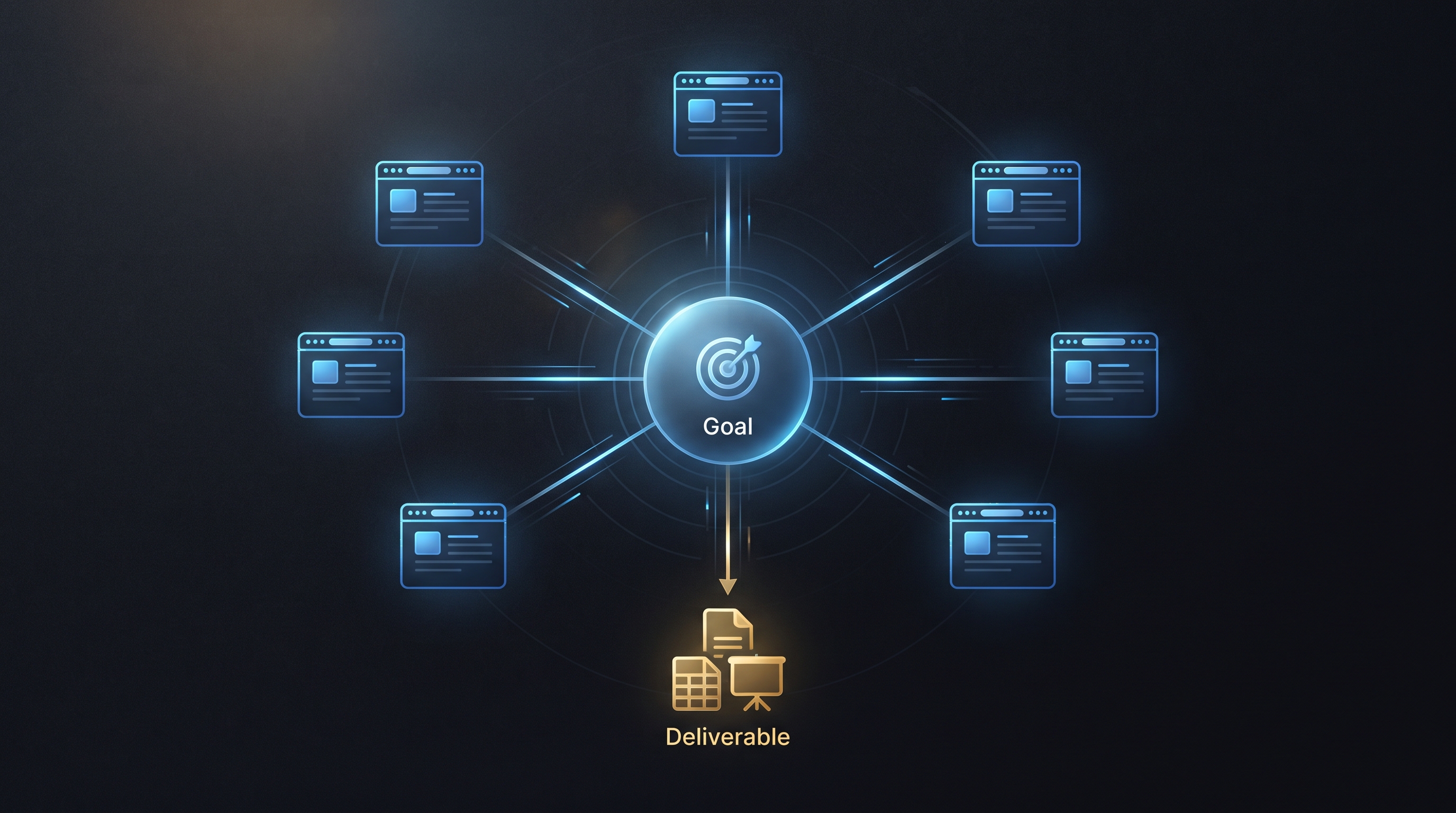
The fundamental distinction that separates Manus from a standard AI chatbot is architectural, not stylistic. A regular assistant like ChatGPT answers the question you ask and waits for your next instruction. Manus takes a high-level goal, independently breaks it into a sequence of steps, executes those steps inside a sandboxed virtual computer — with a real browser, terminal, and file system — checks its own work along the way, and delivers a finished result: a report, a spreadsheet, a slide deck, or a working web application.
It launched in invitation-only beta on March 6, 2025, posting state-of-the-art scores on the GAIA benchmark at launch — a widely used measure of general AI agent capability. It reached open signup with free daily credits by May 2025, and hit a reported $100 million-plus revenue run rate within roughly eight months of launch. By April 2025, Benchmark had led a $75 million Series B at a $500 million valuation, with Tencent and HSG (formerly Sequoia China) also participating. Manus 1.5 shipped October 16, 2025. A desktop app followed on March 16, 2026.
The product today has evolved well beyond its original research-agent identity. According to current official documentation, the platform now includes Wide Research (parallel multi-agent task execution), Manus Slides, scheduled recurring tasks, Mail Manus, Manus Collab, a growing set of integrations, a Browser Operator, a cloud browser, the desktop app, and a developer API.
Why Manus AI Is the Trending Story Right Now
Manus occupies a specific, unusual position in the September 2026 AI landscape: it is simultaneously one of the most technically interesting autonomous agent products available and the subject of one of the most significant unresolved corporate stories in the entire AI industry.
The technical interest is straightforward. Autonomous agents that can genuinely operate a browser, write and execute code, and deliver a finished deliverable from a single high-level instruction — rather than requiring a human to break the task into individual prompts — represent the frontier of what AI agents are being built to do in 2026. Manus was among the first products to demonstrate this convincingly at consumer scale, and its Wide Research feature, which spins up multiple parallel sub-agents to research different facets of a question simultaneously, remains one of the more genuinely novel capabilities in the agent category.
The corporate story is equally significant for anyone evaluating whether to build workflows around the platform. Meta's planned $2 billion-plus acquisition, announced December 29–30, 2025, was framed publicly with the specific assurance that "no continuing Chinese ownership interests in Manus AI" would remain post-close. China's NDRC opened a formal probe in January 2026 and, on April 27, 2026, blocked the deal outright and ordered it unwound — reportedly connected to the fact that the Manus team had relocated its operating entity to Singapore and the founder was slated to become a Meta executive. As of this writing, the situation remains unresolved, and the product continues to operate independently.
This unresolved ownership status is precisely why "Manus AI review 2026," "is Manus still owned by Meta," and "Manus AI alternatives" have become persistently high-volume search queries throughout 2026 — the story genuinely has not concluded, and anyone evaluating the platform for serious use reasonably wants a current, accurate picture before committing.
According to Reuters' coverage of cross-border technology acquisitions and regulatory review (https://www.reuters.com/technology/), national security-driven blocks on cross-border AI acquisitions have become an increasingly common feature of the global AI competition in 2025 and 2026, with regulators in multiple jurisdictions scrutinizing deals involving AI talent, infrastructure, and data — a trend the Manus-Meta situation exemplifies directly.
Core Features of Manus AI in 2026
The Sandboxed Virtual Computer — Manus's Foundational Architecture
Manus's core technical differentiator is that it does not simply generate text responses — it operates inside a genuine sandboxed virtual machine environment with a real browser, a terminal, and a file system. When you give Manus a task, it is not simulating web browsing from memory; it is actually navigating to real websites, reading their content, clicking through interfaces, and extracting live data.
This architecture is what allows Manus to complete tasks that require genuine interaction with the live web — checking current prices, filling out forms, comparing options across multiple real websites — rather than being limited to synthesizing an answer from training data. The trade-off, which matters for honest evaluation, is that this live-browsing approach introduces the same fragility that any browser automation faces: sessions can hang when they encounter bot walls, CAPTCHAs, or unusual site structures, and reliability drops noticeably on tasks with many sequential dependent steps.
Wide Research — Parallel Multi-Agent Execution
Wide Research is Manus's most distinctive capability and the feature most frequently cited by power users as genuinely valuable rather than merely impressive in a demo. Instead of researching a question sequentially — checking one source, then the next, then the next — Wide Research spins up multiple sub-agents simultaneously, each investigating a different facet of the question in parallel, then synthesizes their findings into a single coherent output.
For a task like comparing ten competitor products across pricing, features, and customer reviews, Wide Research can have ten sub-agents each researching one competitor at the same time rather than working through the list one item at a time — producing a genuinely faster result for the specific category of task where breadth matters more than sequential depth. The honest caveat: Wide Research is also the single most credit-intensive feature on the platform, reportedly consuming as much as 4,000 credits in a single run, which is a meaningful portion of even the higher subscription tiers' monthly allocation.
Manus Slides, Reports, and Structured Deliverables
Beyond raw research, Manus can generate finished, formatted deliverables directly from a task description: presentation slide decks through Manus Slides, structured written reports, spreadsheets with organized and labeled data, and simple working web applications built from a natural language description.
This deliverable-generation capability is what distinguishes Manus from a research-only tool — the output is not just a synthesized answer in a chat window but something closer to a finished work product, reducing the manual formatting and assembly work that would otherwise follow a research task.
Scheduled Tasks and Mail Manus
Scheduled Tasks allow a Manus workflow to run automatically on a recurring basis — a weekly competitive monitoring report, a daily news digest on a specific topic, a recurring data pull from a set of sources — without requiring the user to re-initiate the task manually each time.
Mail Manus extends the agent's operation into email-based interaction, allowing tasks to be triggered or results delivered via email rather than requiring the user to be actively logged into the Manus interface.
Browser Operator and Cloud Browser
Browser Operator and the cloud browser feature give Manus direct, persistent browser control for tasks that require ongoing interaction with web-based tools and interfaces — extending its capability beyond one-off research tasks into more sustained browser-based workflows, such as managing an ongoing process across a web application over multiple steps.
Manus Collab and Integrations
Manus Collab is the platform's move toward shared, collaborative agent workflows rather than purely solo use — though independent reviews consistently note that Manus's team collaboration and shared-memory capabilities remain considerably less mature than dedicated multi-agent orchestration platforms built specifically for team use.
The integrations library, while expanding, is described by multiple 2026 reviews as still a relatively small set of connectors compared to more established automation platforms — a real limitation for users hoping to plug Manus directly into an existing complex tool stack.
Desktop App and API
The desktop app, which shipped March 16, 2026, brings Manus out of the browser-only interface into a native application experience, and the developer API allows programmatic task submission and result retrieval for teams building Manus's agentic capability into their own applications and workflows.
Real-World Use Cases
Consultants, Analysts, and Content Researchers
The use case where Manus most consistently earns its subscription cost, according to independent reviewers, is multi-source research and comparison work. A consultant who needs to research ten competitor tools, extract their pricing and feature sets, and compile the results into a structured comparison table can hand that entire task to Manus as a single instruction rather than manually visiting each website and building the table by hand.
For analysts and content researchers who regularly spend hours on exactly this kind of multi-source data gathering, several reviewers note that Manus can pay for itself quickly at the $20/month Standard tier specifically because of the time this single use case saves on a recurring basis.
Operators and Founders Automating Recurring Workflows
Founders and operations-focused professionals use Manus's Scheduled Tasks capability to automate recurring reporting and monitoring workflows — a weekly competitive landscape check, a recurring data pull from a set of sources, an automated summary of a specific news category — reducing manual recurring work without requiring a dedicated automation engineer to build the workflow in a more technical platform.
Marketers and Consultants Producing Structured Outputs
Marketers and consultants use Manus to generate slide decks, summarize data sets, support research phases of a project, and coordinate the compilation of information from multiple sources into a presentation-ready format — leveraging the platform's ability to move from a research task directly into a formatted deliverable without a separate manual assembly step.
Solo Researchers Testing Autonomous Agent Capability
A significant portion of Manus's active user base, based on independent review commentary, consists of individual researchers and technically curious professionals who use the platform on its free daily credit allowance specifically to run one-off exploratory tasks and evaluate what current autonomous agent technology can genuinely accomplish — treating it as much as a capability benchmark for the category as a production tool for daily work.
How Manus AI Compares to the Competition
Manus AI vs ChatGPT and Claude
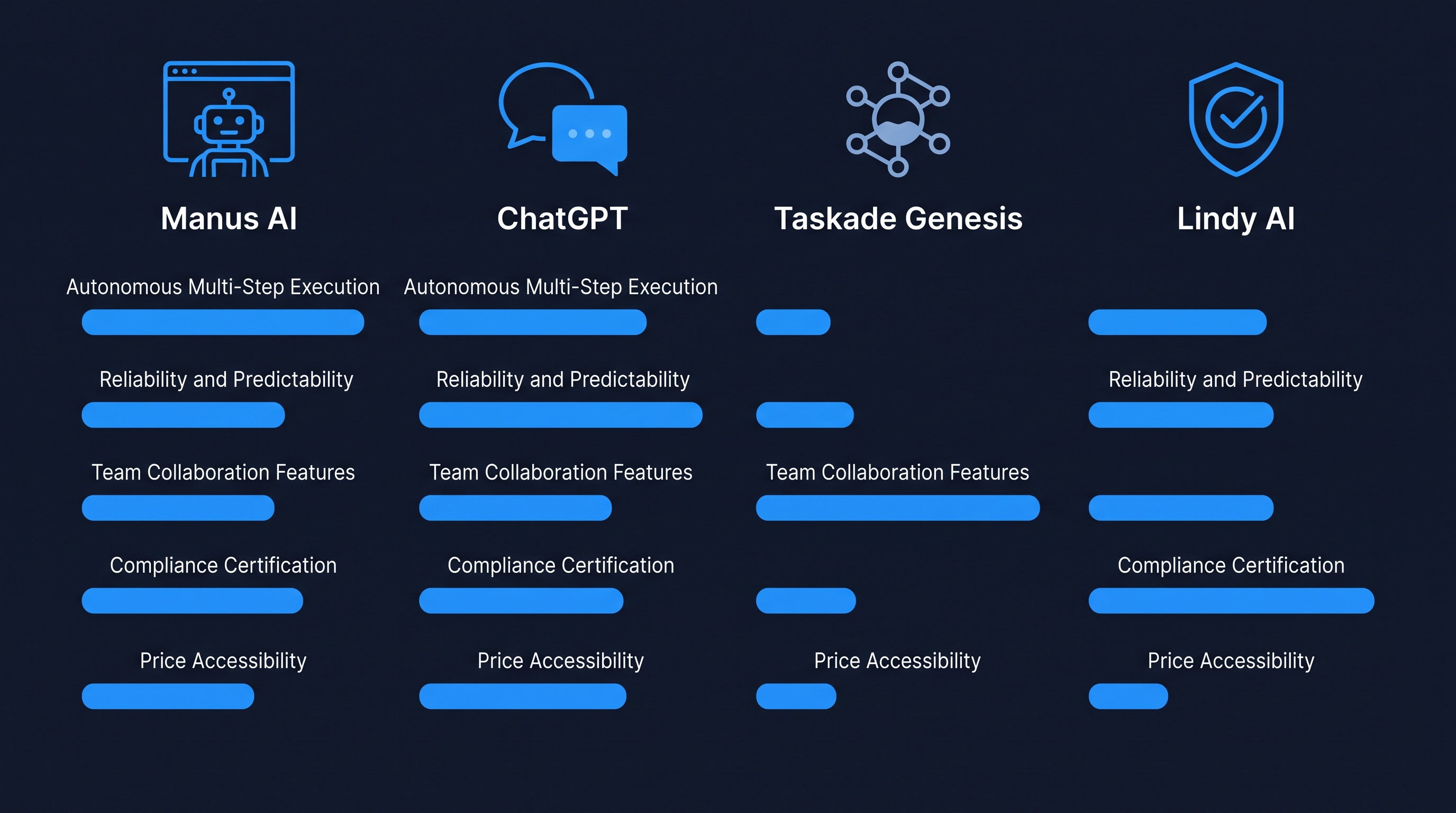
The most consistent, honest verdict across independent 2026 reviews is direct: for most users and most tasks, ChatGPT Plus at $20/month remains the better value. It is faster, more reliable, handles a broader range of tasks well, and benefits from a substantially larger plugin and integration ecosystem. Claude, similarly, offers stronger and more predictable output for tasks that can be broken into individual, well-specified prompts.
Manus earns its distinct value specifically for the category of task that genuinely requires autonomous multi-step execution without human intervention at each stage — independently researching ten competitors and compiling a formatted spreadsheet, for example — where breaking the work into individual ChatGPT or Claude prompts would require significantly more manual orchestration from the user. If your tasks can be cleanly broken into individual prompts, ChatGPT or Claude will handle them better and more predictably. If your task specifically benefits from autonomous, unsupervised multi-step execution across many sources, Manus's architecture is purpose-built for exactly that job.
Manus AI vs Taskade Genesis
Taskade Genesis is positioned by several 2026 reviews as the stronger choice specifically for teams rather than solo users. Where Manus lacks a shared team workspace, persistent cross-session memory, and a broad integrations library, Taskade offers a free tier, more than 100 integrations, and — as of mid-2026 — over 500,000 deployed agents on its platform, reflecting a product built from the outset around multi-agent orchestration and team-based workflows rather than primarily solo autonomous task execution.
The practical distinction: Manus for a solo researcher who wants to run individual, well-defined autonomous tasks on flexible daily credits. Taskade for a team that needs shared memory, persistent context across multiple team members, and production-grade workflow automation at scale.
Manus AI vs Lindy AI
Lindy AI takes a more structured workflow-automation approach with enterprise compliance credentials — SOC 2 and HIPAA certifications — compared to Manus's emphasis on flexible, autonomous task execution. Lindy starts at $49/month, making Manus meaningfully more affordable for individual users who do not require Lindy's specific compliance certifications.
For regulated industries or enterprise procurement processes where compliance documentation is a hard requirement, Manus's current lack of published SOC 2, ISO 27001, or HIPAA certifications as of the most recent review data is a real disqualifying gap that Lindy directly addresses.
Manus AI vs Deep Research Tools (OpenAI, Perplexity)
Benchmark comparisons place Manus's research reliability in a similar general range to OpenAI's Deep Research feature, though independent reviewers caution that self-reported benchmark numbers from any vendor — Manus included — should be treated as directional rather than precise, and that real-world reliability on research tasks sits at roughly 70 to 80%, with a sharp drop-off in reliability once a task chain exceeds approximately five dependent sequential steps.
For research tasks specifically requiring live web citation and current information synthesis without full task automation, Perplexity's more narrowly scoped and consistently reliable research-and-citation model may be a better fit than Manus's broader but less predictable autonomous execution approach.
According to McKinsey's research on generative AI and enterprise value creation (https://www.mckinsey.com/capabilities/mckinsey-digital/our-insights/the-economic-potential-of-generative-ai), the organizations extracting the most reliable value from autonomous AI agents in 2026 are those that scope agent deployment specifically to well-bounded, verifiable task categories rather than open-ended general-purpose automation — a finding directly relevant to how Manus is most successfully used in practice today, per independent reviewer consensus.

Manus AI Pricing — The Complete and Honest 2026 Breakdown
Manus operates on a credit-based subscription model with open signup, meaning any user can create an account without an invitation, though the credit mechanics require careful attention to understand actual usable capacity at each tier.
Free Tier — $0/month 1,000 starter credits plus a 300-credit daily refresh. Sufficient for occasional, lightweight exploratory tasks and for genuinely evaluating whether the platform's autonomous execution model fits a specific use case before committing to a paid plan. Not sufficient for regular production use, particularly given how quickly credit-intensive features like Wide Research can consume a daily allowance.
Standard — $20/month The entry-level paid tier, positioned by multiple reviewers as the practical starting point for individual users — consultants, analysts, and researchers — who have identified specific recurring tasks Manus handles well. Several reviews specifically frame this tier as "affordable enough to experiment," with the caveat that heavy users of credit-intensive features will exhaust the monthly allocation faster than the price point might suggest.
Higher Tiers — up to $200/month (40,000 credits) Manus's pricing scales up through additional tiers to a top consumer tier around $200/month providing 40,000 credits, appropriate for power users running frequent, credit-intensive tasks including regular Wide Research queries.
The honest credit-consumption reality: Wide Research alone can reportedly consume as much as 4,000 credits in a single run — meaning even a $200/month, 40,000-credit allocation supports only about ten Wide Research sessions per month if that feature is used at that intensity, alongside whatever other tasks are run on the platform. Credits are widely reported across independent reviews to "burn unpredictably," and this unpredictability is consistently cited as one of the platform's most significant practical frustrations for budget-conscious users.
The pricing verification note that matters specifically for this platform: Given the rapid pace of change around both Manus's product roadmap and its unresolved ownership situation, multiple recent reviews explicitly recommend verifying current pricing, credit allocations, and benchmark figures directly against Manus's official pricing page rather than relying on any single review — including this one — given how quickly the underlying figures have moved throughout 2026.
Pros and Cons
Pros
Genuine autonomous multi-step task execution inside a real sandboxed browser, terminal, and file system — not simulated from training data alone
Wide Research's parallel multi-agent execution is a genuinely novel and useful capability for broad comparison and research tasks
Delivers finished, formatted outputs — slide decks, spreadsheets, reports, simple web apps — not just chat responses
Scheduled Tasks enable recurring automated research and monitoring workflows without manual re-initiation
$20/month Standard tier is significantly more affordable than several enterprise-focused competitors like Lindy AI ($49/month)
Free tier with daily credit refresh allows genuine evaluation before any financial commitment
State-of-the-art GAIA benchmark performance at its original March 2025 launch demonstrated genuine technical capability, not just marketing
$100 million-plus revenue run rate within roughly eight months of launch reflects real, sustained user demand
Desktop app (March 2026) and developer API extend the platform beyond the original browser-only interface
Actively continuing product development — Manus 1.5, Manus 1.6, and expanding feature set (Slides, Mail Manus, Collab, Browser Operator) show ongoing investment despite the corporate uncertainty
Cons
Reliability is genuinely uneven — tasks fail mid-stream, sessions can hang on bot walls and CAPTCHAs, and reliability drops sharply past roughly five sequential dependent steps
Credits burn unpredictably, and Wide Research specifically can consume up to 4,000 credits in a single run — a significant share of even higher-tier monthly allocations
No shared team workspace or persistent cross-session memory comparable to dedicated multi-agent platforms — a real limitation for team-based use
Relatively small integrations library compared to established automation platforms, limiting how deeply Manus can be embedded in an existing tool stack
No published SOC 2, ISO 27001, or HIPAA compliance certifications as of the most recent review data — a disqualifying gap for regulated-industry enterprise procurement
Code generation output is described as not yet production-grade, requiring human review before serious use
Server reliability during peak usage hours has been reported as poor in multiple independent reviews
The Meta acquisition being blocked by Chinese regulators in April 2026 creates genuine, unresolved uncertainty about long-term product direction, data privacy practices, and platform continuity — a real procurement risk factor for any organization considering long-horizon dependency on the platform
Founder relocation and corporate structure questions (Singapore headquarters, blocked Meta VP role) add a layer of organizational uncertainty that most competing AI products do not carry
Who Should Use Manus AI?
Manus AI delivers the strongest value for:
Consultants and analysts who regularly perform multi-source research and comparison work that benefits from parallel autonomous investigation rather than sequential manual research
Content researchers who need structured comparison tables, summaries, or reports compiled from many web sources without manually visiting and extracting data from each one
Founders and operators who want to automate recurring monitoring and reporting workflows through Scheduled Tasks
Individual users specifically curious about current autonomous agent capability who want to evaluate the frontier of what agents can accomplish, using the free tier or Standard plan without heavy financial commitment
Marketers and consultants producing structured presentation and summary deliverables from research-heavy source material
Who Should Consider Alternatives
Teams needing shared workspace, persistent memory, and broad integrations — Taskade Genesis is the more mature choice for team-based, production-grade agent deployment
Regulated industries and enterprise procurement requiring compliance certification — Lindy AI's SOC 2 and HIPAA credentials, despite the higher $49/month starting price, are likely a hard requirement that Manus currently cannot satisfy
Users whose tasks can be cleanly broken into individual prompts — ChatGPT Plus or Claude Pro at the same or lower price point will handle these tasks faster and more predictably
Organizations evaluating long-horizon platform dependency — the unresolved Meta acquisition and Chinese regulatory situation is a legitimate risk factor worth weighing before building critical workflows around the platform
Users needing reliable execution on complex, many-step task chains — the sharp reliability drop-off past roughly five dependent steps means Manus is best suited to tasks that are broad rather than deeply sequential

Getting the Most Out of Manus AI — Practical Tips
Scope tasks to be broad rather than deeply sequential. Given the documented reliability drop-off past roughly five dependent steps, Manus performs most reliably on tasks like "research these ten sources and compile a comparison" — where each sub-task is largely independent — rather than tasks requiring a long, tightly sequential chain of dependent actions.
Reserve Wide Research for genuinely broad comparison tasks, not routine queries. Given its steep credit cost (up to 4,000 credits per run), Wide Research is best deployed specifically for tasks where parallel investigation across many sources provides a real speed advantage — not as a default mode for every research query.
Review code output before relying on it in production. Multiple independent reviews consistently note that Manus's code generation is not yet production-grade. Treating any generated code as a draft requiring human review, rather than a finished deliverable, is the appropriate posture for any serious use.
Monitor credit consumption closely, especially in your first month. Given the widely reported unpredictability of credit burn rates, checking your usage dashboard after each significant task in your first few weeks on any paid tier will give you a realistic picture of your actual monthly cost before committing to a higher tier or annual billing, if available.
Treat the current ownership situation as an active variable, not settled fact. Given that the Meta acquisition's outcome remains unresolved as of the most recent reporting, checking for updates on Manus's corporate status before making any significant long-term workflow investment in the platform is a reasonable diligence step.
The Honest Limitations Worth Understanding
The gap between Manus's viral demo moment and its day-to-day production reliability is the single most important thing for any prospective user to understand honestly. The March 2025 demo that generated six-figure waitlist growth within 72 hours showed impressive capability in a controlled scenario. The lived reality reported by independent reviewers throughout 2026 — tasks failing mid-stream, sessions hanging on bot walls, unpredictable credit consumption, poor server reliability during peak hours — reflects the genuine difficulty of building consistently reliable autonomous agents that operate real browsers across the unpredictable diversity of the actual internet.
This is not a reason to dismiss the platform. It is a reason to set expectations accurately: Manus in 2026 is a genuinely capable but still maturing product, appropriate for the specific category of task it handles well, and not yet a fully dependable replacement for more predictable prompt-by-prompt interaction with tools like ChatGPT or Claude for tasks that do not specifically require autonomous multi-step execution.
The unresolved corporate situation deserves equally direct treatment. An acquisition worth $2 billion or more being blocked by a national regulator four months after announcement, with the specific data privacy assurance behind the deal ("no continuing Chinese ownership interests") now in question, is not a minor footnote. It is a material consideration for any organization weighing whether to build meaningful workflow dependency on the platform, particularly regarding data handling practices and long-term product continuity. The company states it will continue operating and iterating regardless of the acquisition's outcome — and the continued shipping of Manus 1.5, Manus 1.6, and new features through 2026 supports that claim — but "continues to operate" and "settled, stable ownership" are not the same assurance.
Final Verdict: Is Manus AI Worth It in 2026?
For the specific job it does well — autonomous, broad, multi-source research and comparison tasks delivered as finished, formatted output — Manus AI in 2026 remains one of the more genuinely innovative products in the autonomous agent category, and the $20/month Standard tier is affordable enough to test against your own real workflow without significant financial risk.
The honest caveat that deserves equal emphasis in any final judgment: reliability is uneven, credit costs are unpredictable, the platform lacks compliance certifications that regulated industries require, and the underlying corporate ownership situation is genuinely unresolved in a way that most competing AI products simply do not carry as a risk factor.
The most sensible path for anyone evaluating Manus: start on the free tier with a real task from your own work — not a demo scenario — and evaluate honestly whether the autonomous execution model saves you meaningful time on that specific task category. If it does, the Standard plan is a low-risk next step. If your tasks are better served by breaking work into individual, well-specified prompts, ChatGPT or Claude will likely serve you better, more predictably, and at comparable or lower cost.
For teams specifically needing production-grade, multi-agent orchestration with shared memory and broader integrations, evaluating Taskade Genesis or a dedicated enterprise agent platform alongside Manus — rather than assuming Manus is the default choice simply because it is the most publicly famous agent product — is the responsible comparison to make before committing budget.
Try Manus AI
The free tier includes 1,000 starter credits plus a 300-credit daily refresh — enough to genuinely test the autonomous agent model against a real task from your own work before deciding whether a paid tier is worth the investment.
Try Manus AI free at manus.im — Free tier available. Standard plan from $20/month. Verify current pricing and corporate status directly before committing to long-term use.
Frequently Asked Questions
What is Manus AI? Manus is a general-purpose autonomous AI agent built by Butterfly Effect (Monica), a China-founded startup headquartered in Singapore. It operates inside a sandboxed virtual computer with a real browser, terminal, and file system, taking a high-level goal and independently planning, executing, and delivering finished results like reports, spreadsheets, and slide decks — without requiring step-by-step human instructions.
Was Manus AI acquired by Meta? Meta announced a planned acquisition of Manus for a reported $2 to $3 billion in late December 2025. China's National Development and Reform Commission blocked the deal on April 27, 2026, and ordered it unwound. The situation remains unresolved, and Manus continues to operate independently from Singapore as of the most recent reporting.
How much does Manus AI cost in 2026? Manus offers a free tier with 1,000 starter credits plus a 300-credit daily refresh. Paid tiers start at $20/month (Standard) and scale up to approximately $200/month for 40,000 credits at the highest consumer tier. Credit consumption varies significantly by feature — Wide Research alone can consume up to 4,000 credits in a single run.
What is Wide Research in Manus AI? Wide Research is a Manus feature that spins up multiple parallel sub-agents to investigate different facets of a research question simultaneously, rather than researching sequentially. It is significantly faster for broad comparison tasks but is also the platform's most credit-intensive feature.
Is Manus AI reliable? Reliability is genuinely mixed according to independent 2026 reviews. Real-world reliability on research tasks sits at roughly 70 to 80%, with a sharp drop-off in tasks requiring more than approximately five sequential dependent steps. Tasks can fail mid-stream, and sessions can hang on bot walls or CAPTCHAs.
Is Manus AI better than ChatGPT? For most general tasks, ChatGPT Plus is considered the better value by most independent reviewers — faster, more reliable, and with a larger integration ecosystem. Manus specifically excels at autonomous, multi-step tasks that would otherwise require significant manual prompt orchestration, such as independently researching multiple sources and compiling a structured comparison.
Is Manus AI safe for enterprise or regulated industry use? Caution is warranted. As of the most recent review data, Manus has not published SOC 2, ISO 27001, or HIPAA compliance certifications, and the unresolved Meta acquisition situation raises additional data privacy and long-term continuity questions. Enterprise users in regulated industries should carefully evaluate compliance requirements before deploying Manus for sensitive workflows.

Founder, Axionova · AI Tools Strategist
Ashir writes independent, hands-on reviews of AI tools and shares strategies for creators, marketers, and entrepreneurs. Every review is grounded in real usage — no paid placements, no fluff. Read our editorial standards.
AI Insights Weekly
One curated email a week: sharp AI insights, tool reviews, and strategies.
Have thoughts on this?
Contact us or share this article on social media — we'd love to hear what resonated with you.