n8n Review 2026: The $5.2 Billion AI Workflow Automation Platform That SAP Just Bet Its Enterprise Future On
A comprehensive n8n review for 2026 covering the $5.2B SAP investment and Joule Studio integration, native AI agent nodes with Lang Chain, 500-plus integrations, self-hosted free Community Edition, honest cloud pricing, Git version control, Evaluations for AI workflow testing, approval gates, competitor comparisons with Zapier and Make, and who should and should not use n8n in 2026.

Most automation tools give you a recipe. You pick a trigger. You pick an action. The tool connects them and executes the recipe on schedule.
That is useful. It is also the limit. Real business operations do not run on recipes. They run on judgment — reading a support ticket and deciding whether it needs escalation or a template response, scanning a lead form and deciding which rep to route it to, analyzing an anomaly in your data pipeline and deciding whether it is noise or a fire to put out.
For four years, the automation market pretended judgment was a human problem and left it there. n8n decided it was an engineering problem — and solved it.
n8n is a workflow automation platform where you build visual pipelines that mix deterministic rule-based logic, inline code (JavaScript or Python), and native AI agent steps in the same workflow. You do not choose between automation and AI. You wire them together, step by step, on a canvas, until the workflow does exactly what a smart human would do if they were watching the data flow by.
That architecture is why n8n crossed $100 million in annual recurring revenue in 2026, earned a $5.2 billion valuation backed by SAP, and now powers 1.7 million monthly active builders worldwide. It is why more than 80% of workflows built on the platform today involve AI agents. And it is why SAP is embedding n8n directly inside Joule Studio — its enterprise AI orchestration environment — going generally available in Q3 2026.
This n8n review covers everything: the full feature set including the 2026 AI agent capabilities, the honest pricing picture across self-hosted and cloud tiers, the real-world use cases where n8n outperforms every alternative, competitor comparisons with Make and Zapier, and the genuine limitations that determine who should and should not use it.
What Is n8n?
n8n — pronounced "n-eight-n," short for "nodemation" — is an open-source workflow automation platform founded in Berlin in 2019 by Jan Oberhauser, a VFX engineer who spent years as the technical person everyone depended on because workflows were too complex for anyone else to manage. He built n8n to solve that specific frustration: giving smart non-developers the power to automate complex workflows without permanently depending on the one person who could write the code.
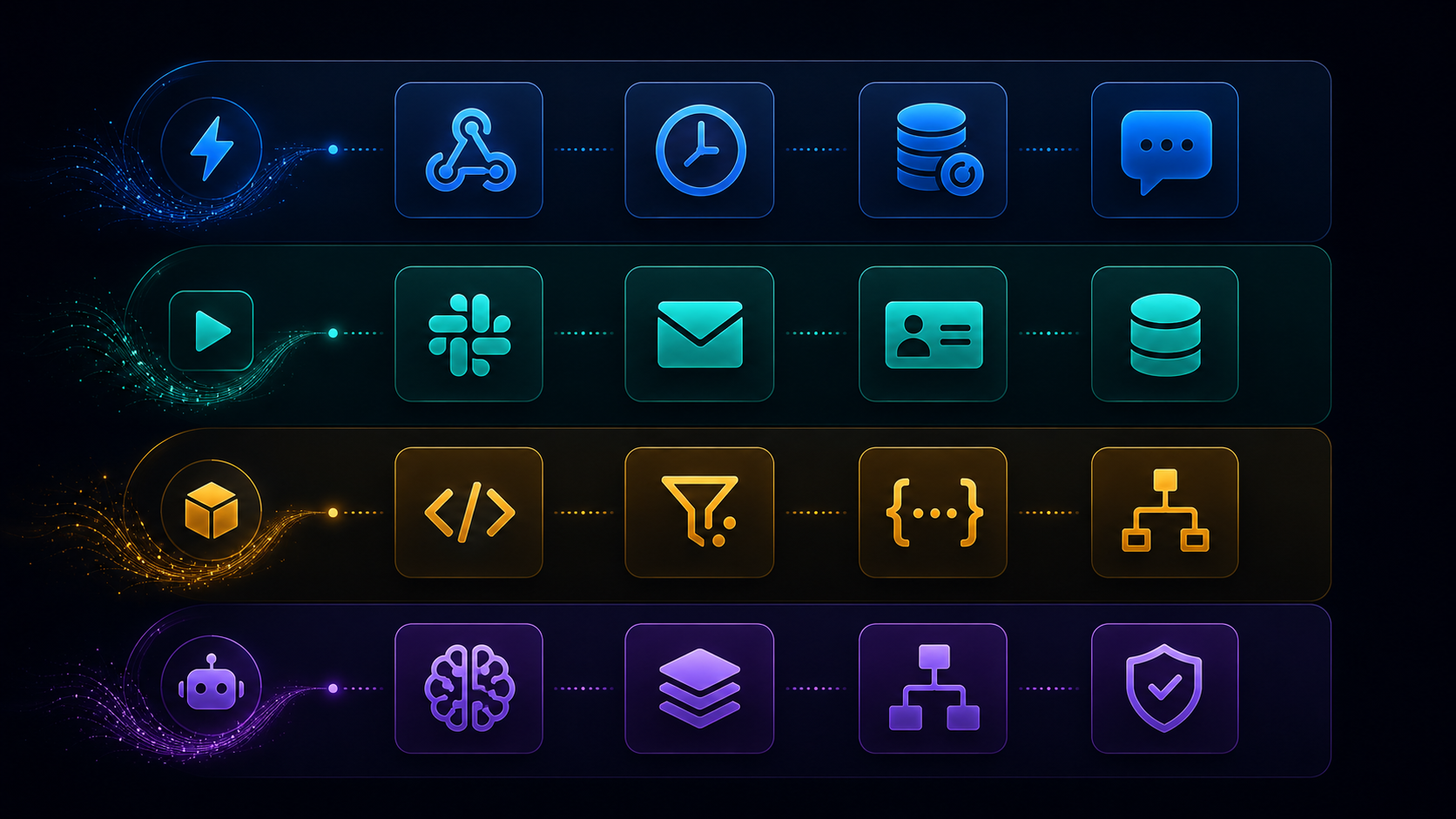
The platform is built around a node-based visual canvas. Every workflow starts with a trigger — a webhook, a schedule, a database event, a chat input, an email arrival — and flows through action nodes, transformation nodes, conditional logic nodes, and AI agent nodes, all connected on a drag-and-drop grid. Between nodes, you can drop inline JavaScript or Python when the visual builder hits a ceiling, without leaving the workflow editor or switching to a separate development environment.
The fair-code licensing model is the characteristic that most distinguishes n8n from every commercial automation alternative. The Community Edition — the full platform, all 500-plus integrations, all AI agent capabilities, unlimited workflows — is free to self-host on Docker or Kubernetes. Organizations that do not want to manage infrastructure subscribe to the cloud-hosted plans starting at €20 per month. Organizations that need enterprise security, SSO, audit logs, and dedicated support move to the Enterprise tier with custom pricing.
The growth metrics validate the approach: $40 million ARR in July 2025, over $100 million ARR in 2026, $5.2 billion valuation with SAP as a strategic investor, 1.7 million monthly active builders, 3,000-plus enterprise customers including Vodafone, SoftBank, Delivery Hero, and Microsoft, and gross margins exceeding 75%.
Why n8n Is the Trending AI Tool That Every Technical Builder Is Talking About
Every Q3 2026 AI tool ranking that covers the automation category — DataNorth, PrimeAICenter, Codevally, Stackademic — lists n8n as the category leader for technical workflow automation. The DataNorth Q3 2026 ranking published three weeks ago specifically named n8n alongside Cursor, Perplexity, and ElevenLabs as the tools that "shipped material change in the last three months" and are defining their respective categories.
Two developments in 2026 explain the acceleration.
The first is the AI agent pivot. In 2025, n8n rebuilt its core platform in six weeks to natively integrate AI agent capabilities — LangChain integration, LLM node support for OpenAI, Anthropic, and local models, vector memory, tool definition, and multi-agent orchestration — directly into the same visual workflow editor that handles deterministic automation. The decision not to build a separate AI product but to embed AI as a native step type inside existing workflows produced a capability that no other automation platform offers: true hybrid workflows where code, rules, and AI judgment mix in the same pipeline.
The second is the SAP strategic partnership. SAP invested at the $5.2 billion valuation and is embedding n8n inside Joule Studio — its enterprise AI orchestration platform — going generally available in Q3 2026. For an open-source workflow tool founded six years ago in Berlin, being chosen as the orchestration layer for the world's largest enterprise software company's AI product is a validation that no competitor in the automation category has received.
According to McKinsey's research on business process automation ROI, organizations that combine deterministic process automation with AI judgment in the same workflow achieve 2 to 3 times greater productivity improvement than those deploying either approach independently. n8n's hybrid architecture is built precisely for this outcome.
Core Features of n8n in 2026
The Visual Workflow Canvas — Where Everything Starts
The workflow editor is a node-based visual canvas where every automation is built by connecting trigger nodes to action nodes, with transformation, logic, and AI nodes wired between them. The canvas scales from simple two-node automations — webhook fires, sends a Slack message — to complex multi-branch workflows with conditional routing, error handling, retry logic, sub-workflows, and parallel execution paths running simultaneously.
The user experience of the canvas is intentionally technical. This is not a simplified visual interface designed for users who have never connected an API. The canvas rewards users who understand data structures, can read JSON, know when to apply a transformation versus when to write a code node, and want the precision that visual builders with simplified UX abstractions trade away. That precision is n8n's defining characteristic and its primary limitation for non-technical users simultaneously.
Every node on the canvas shows input and output data in a JSON panel during execution — making debugging transparent in a way that no-code platforms like Zapier and Make cannot match. Seeing exactly what data entered a node and what left it, at every step of a workflow, is the feature that enterprise development teams consistently cite as the reason they chose n8n over commercial alternatives.
AI Agent Nodes — Native LLM Integration in Every Workflow
The AI subsystem is n8n's most significant 2026 differentiator. Native LangChain integration means AI agent steps are built directly on the same visual canvas as deterministic workflow steps — not bolted on through a separate interface or accessed through an external API call.
The AI node types available in 2026: an LLM Chat node for direct language model interaction with any connected provider (OpenAI, Anthropic Claude, Google Gemini, Mistral, Ollama for local models), an AI Agent node for multi-step reasoning with tool access, a Vector Store node for semantic memory that persists across workflow runs, a Text Classifier node for routing decisions based on content classification, a Summarizer node for document and conversation summarization, and a Sentiment Analyzer node for emotional tone detection in customer communications.
The architectural philosophy behind these nodes reflects what n8n's founder Jan Oberhauser calls "the production AI playbook — deterministic steps and AI steps." The core principle: use AI where it adds value and rule-based logic where it does not. A compliance check that has one correct answer runs deterministic. A support ticket triage that requires reading context and making a judgment call runs through the AI agent node. The workflow mixes both in the appropriate sequence without requiring the builder to choose one mode for the entire workflow.
More than 80% of workflows built on n8n in 2026 now include at least one AI agent step. That statistic reflects not just the capability's availability but its practical adoption at scale across the platform's 1.7 million active builders.
500-Plus Native Integrations — The Connectivity Layer
n8n ships with over 500 native integration nodes covering the applications most businesses actually run: Google Workspace, Microsoft 365, Slack, HubSpot, Salesforce, Airtable, Notion, GitHub, Jira, Stripe, Shopify, PostgreSQL, MySQL, MongoDB, Redis, S3, Twilio, SendGrid, and hundreds more.
The critical distinction between n8n's integration model and Zapier's is data flow transparency. In Zapier, data moves through a simplified trigger-action pathway where the user sees inputs and outputs at a high level. In n8n, the raw JSON data at every node input and output is visible and directly manipulable — which makes complex transformations, custom field mappings, and edge case handling possible that Zapier's abstraction layer cannot accommodate.
For integrations where no native node exists, n8n provides an HTTP Request node — a fully configurable REST API caller that can reach any API endpoint, pass custom headers, handle authentication, parse response bodies, and feed the response into subsequent nodes. This means n8n's effective integration reach extends well beyond its 500 native nodes to any HTTP-accessible service.
Self-Hosting — Complete Infrastructure Control
Self-hosting on Docker or Kubernetes using n8n's Community Edition is the deployment path that most technical users choose as their starting point, and for good reason: the full platform, all integrations, unlimited workflows, and all AI agent capabilities are free with no execution limits, no seat limits, and no subscription cost beyond the infrastructure you choose to run it on.
A realistic self-hosted production setup — a cloud server with adequate compute for the workflow volumes a small to mid-sized organization runs — costs approximately $400 to $800 per year in hosting fees. Compare that to equivalent workflow execution volumes on Zapier or Make, where the same operations would cost substantially more on monthly subscription tiers that charge per task or per operation.
For organizations whose workflows handle sensitive data — customer PII, financial records, proprietary business logic — self-hosting addresses the data residency and privacy concerns that cloud-only platforms cannot resolve. The data never leaves your infrastructure.
Self-hosting does require someone who is comfortable with Docker and Linux administration to set up, maintain, and update the instance. This is the practical barrier that routes non-technical organizations toward the cloud plans.
Cloud Plans — Managed Infrastructure Without Self-Hosting
For organizations that want n8n's capabilities without managing infrastructure, the cloud plans provide the same platform as the Community Edition on n8n-managed infrastructure with automatic updates, uptime monitoring, and support.
Cloud Starter begins at €20 per month and is appropriate for individuals and small teams evaluating n8n at production scale before committing to a larger plan or self-hosting investment. Cloud Pro and Business tiers scale with execution volume and add team collaboration features, SSO, and audit log capabilities.
All cloud plans include unlimited users and unlimited active workflows — seat-based pricing is not a factor on any n8n tier. The variable that determines plan selection is monthly workflow execution volume, not headcount.
Evaluations — AI Workflow Quality Testing
Evaluations is a 2025-2026 feature specifically built for AI workflow testing — a capability that does not exist in any competing automation platform at comparable depth. The Evaluations feature allows builders to test AI agent workflows against real production data samples, measuring output quality, classification accuracy, and reasoning consistency across a defined evaluation set before deploying an AI workflow to production.
For organizations where AI workflow errors have real consequences — a customer service agent that misclassifies tickets, a document processor that extracts fields incorrectly, a lead qualification agent that routes to the wrong rep — Evaluations provides the quality assurance framework that production AI deployment requires. Building and testing a workflow is one thing. Knowing that the AI steps perform reliably across the full distribution of real inputs before turning it on is what Evaluations makes possible.
Version Control and Git Integration
n8n workflows are stored as JSON and integrate natively with Git. Development teams can version-control their workflows in Git repositories, implement PR review processes before production deployment, roll back to previous versions when a workflow change introduces errors, and maintain separate development, staging, and production environments with branched workflow versions.
This Git-native workflow management is the feature that enterprise engineering teams consistently cite as the reason n8n is viable for production use in large organizations where workflow changes have operational consequences. It is also the feature that has no equivalent in Zapier or Make — which store workflows in proprietary cloud systems that do not integrate with standard software development toolchains.
Human-in-the-Loop Approval Gates
The AI governance feature that distinguishes serious AI workflow deployments from reckless ones: n8n's approval gate node pauses a workflow at a defined step and waits for a human to review and approve before proceeding.
An AI agent that drafts a customer email response can pause for human review before sending. An agent that proposes a CRM record update can wait for a sales rep to confirm before the update executes. A financial data processing workflow that detects an anomaly can hold for a finance manager to inspect before continuing.
Approval gates transform fully autonomous automation into supervised automation — capturing the efficiency benefit of AI-driven processing while maintaining the human judgment checkpoint that risk management, compliance requirements, or quality standards demand at specific decision points.
Real-World Use Cases
Building AI-Powered Customer Support Workflows
Customer support is the single most common n8n AI workflow deployment across the platform's user base. A production customer support workflow built in n8n might: receive an incoming support ticket via webhook from a helpdesk platform, classify the ticket's intent and urgency using a Text Classifier AI node, retrieve relevant customer history from a CRM via API, pass the ticket content and customer context to an LLM node with a system prompt that instructs it to draft an appropriate response, route high-confidence responses directly to the helpdesk for sending, and pause complex or sensitive tickets at an approval gate for human agent review before responding.
The entire workflow runs in seconds from ticket arrival to response draft or human escalation — without a support agent touching every ticket. The AI handles the volume. The approval gate protects the exceptions. The deterministic routing ensures the right tickets reach the right destination.
Automating SEO and Content Operations
The GetApp review data from n8n users includes a specific real-world case: a builder running an affiliate content site with 31 automated agents on n8n covering content generation, email sequences, social media distribution, API health monitoring, and security checks. This use case — a complete digital media operation running largely autonomously on n8n — is representative of how content-focused businesses are deploying the platform in 2026.
A content operations workflow in n8n might: scrape defined keyword research sources on a schedule, pass the retrieved data to an AI agent that identifies trending topics matching defined criteria, generate a content brief for each qualifying topic using an LLM node, create a draft database entry in Airtable or Notion, send a Slack notification to the editorial team with the brief for review, and publish approved content to a CMS via API after a human approves the brief in the workflow's approval gate step.
Data Pipeline Automation for Engineering Teams
Engineering and data teams use n8n as a workflow orchestration layer for data pipelines — moving, transforming, enriching, and routing data between systems at scheduled intervals or triggered by defined events.
A data engineering workflow might: poll a production database on a schedule for new records, transform the raw records through multiple data normalization nodes, enrich records with external API lookups (company data, location validation, email verification), route enriched records to different destinations based on classification rules, and send exception reports for records that fail validation to a defined Slack channel for human review.
The inline code node capability — dropping Python or JavaScript at any step where the visual transformation nodes hit their ceiling — makes n8n's data pipeline capabilities significantly more flexible than Zapier or Make for complex transformation requirements.
Sales Automation and Lead Qualification
Sales teams and revenue operations teams use n8n to build lead qualification and routing workflows that combine rule-based scoring with AI judgment for edge cases.
A lead qualification workflow: a new form submission triggers the workflow via webhook, deterministic scoring rules assign a lead score based on company size, industry, and job title fields, leads above a threshold are enriched via a Clay or Apollo API call for additional contact and company data, an AI Agent node analyzes the enriched lead against the ICP criteria and generates a qualification summary, high-score leads are created in Salesforce with the qualification summary attached and the appropriate rep notified in Slack, medium-score leads enter an automated nurture sequence, and low-score leads are disqualified and logged with the reason.
Enterprise-Scale AI Agent Orchestration
For organizations deploying multiple AI agents across different business processes, n8n's sub-workflow architecture allows individual agent workflows to be developed, tested, and maintained independently while being orchestrated from a parent workflow that coordinates their inputs, outputs, and handoff logic.
This multi-agent orchestration capability is directly relevant to the SAP Joule Studio integration. SAP's enterprise customers using Joule Studio in Q3 2026 will access n8n as the underlying orchestration layer for coordinating AI agents across their business processes — validating n8n's architecture for the scale and complexity that enterprise AI deployment demands.
How n8n Compares to the Competition
n8n vs Zapier
Zapier is the most widely used automation platform globally with over 7,000 native app integrations — a connectivity breadth that n8n's 500-plus nodes does not currently match. Zapier's strength is accessibility: the simplified trigger-action interface requires no technical knowledge to use, and the platform's reliability and support quality for common business integrations are excellent.
n8n's advantages over Zapier are significant for technical use cases. Self-hosting at zero cost with unlimited operations is unavailable on Zapier. Inline code execution within workflows is not possible in Zapier. Native AI agent integration within the visual workflow is not natively available in Zapier at comparable depth. Git-based version control for workflow management does not exist in Zapier. Execution cost economics at high volume strongly favor n8n — the same workflow run 10,000 times per month costs dramatically less in n8n than in Zapier's task-based pricing.
The practical recommendation that experienced automation practitioners consistently make: Zapier for non-technical teams running straightforward integrations where the 7,000-app library breadth and simplified UX justify the per-task cost. n8n for technical teams running complex workflows with code steps, AI agents, high execution volumes, or data privacy requirements that mandate self-hosting.
n8n vs Make (Integromat)
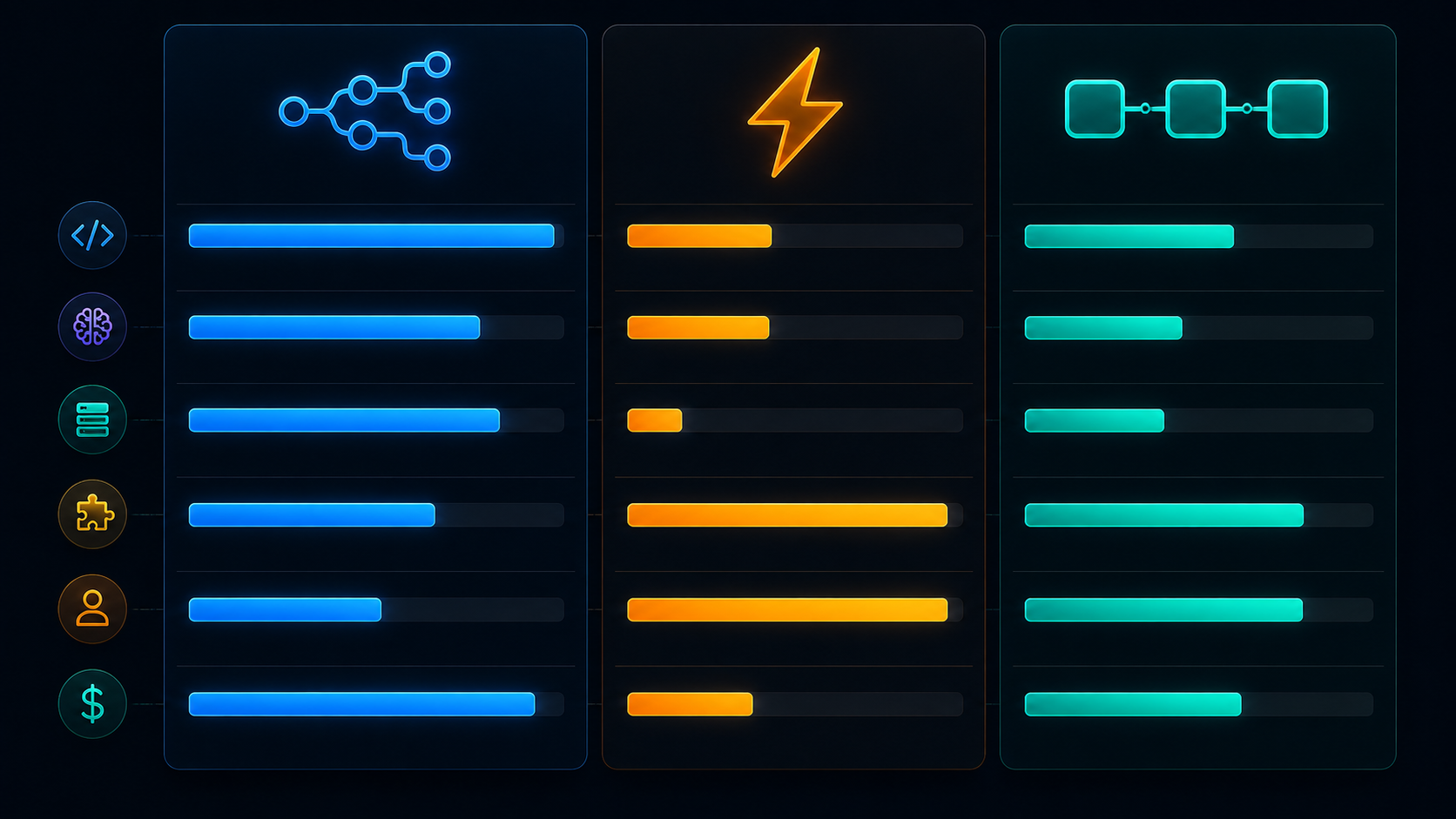
Make is the strongest direct competitor for n8n in the visual workflow automation category. Both platforms use visual node-based editors, both support complex multi-branch workflows with conditional logic, and both have moved to incorporate AI capabilities in their recent roadmaps. Make's G2 rating is 4.6/5 versus n8n's 4.8/5 — the closest head-to-head quality rating between any two automation platforms in the category.
Make's advantages: a larger native integration library than n8n's 500-plus nodes, a more polished UI that balances flexibility and accessibility for mixed technical/non-technical teams, and a longer track record in mid-market enterprise automation deployments.
n8n's advantages: self-hosting at zero cost, inline code execution at any workflow step, deeper native AI agent integration, Git version control, human-in-the-loop approval gates as a built-in node type, and the Evaluations feature for AI workflow quality testing. For teams choosing between Make and n8n, the deciding factor is consistently how much code flexibility and infrastructure control matter relative to UI polish and integration breadth.
n8n vs Zapier Tables and Other AI Workflow Tools
Microsoft Agent 365 (GA May 2026), Copilot Cowork (June 2026), and other enterprise AI orchestration platforms compete with n8n at the top of the enterprise market. Their advantages are deep Microsoft ecosystem integration and enterprise distribution scale. Their disadvantages are vendor lock-in, opacity in how workflows are actually executing, and the absence of the open-source transparency and self-hosting control that n8n's model provides.
For organizations that want to understand, audit, and control exactly how their AI workflows operate — rather than accepting a black-box enterprise platform's representation of what is happening — n8n's open-source codebase and self-hosting capability provide a transparency level that closed-source enterprise alternatives cannot match.
According to Gartner's research on enterprise AI governance, the primary concern holding enterprise technology leaders back from expanding AI agent deployments in 2026 is auditability and governance — knowing what AI agents are doing, what decisions they are making, and being able to review the record when something goes wrong. n8n's workflow transparency, Git version control, approval gates, and execution history logging directly address this concern in ways that less transparent platforms cannot.
n8n Pricing — The Complete and Honest 2026 Breakdown
n8n's pricing structure is more nuanced than most reviews convey, because the self-hosting option fundamentally changes the cost calculation for technical organizations.
Community Edition (Self-Hosted) — Free The complete n8n platform, all 500-plus integrations, all AI agent capabilities, unlimited workflows, unlimited executions, unlimited users, and unlimited active automations — free to run on your own infrastructure. The only cost is the hosting environment: approximately €400 to €800 per year for a cloud server sized appropriately for a small to mid-sized organization's workflow execution volume. For high-volume automations, the total cost of ownership of self-hosted n8n compared to Zapier or Make at equivalent execution volumes typically favors n8n by a factor of 5 to 10 or more.
The self-hosting requirement — comfortable with Docker and Linux administration — is the ceiling that routes non-technical users toward the cloud tiers.
Cloud Starter — €20/month n8n-managed infrastructure with automatic updates and uptime monitoring. The Starter tier is execution-volume capped for the cost — verify the current execution limits at n8n.io/pricing before committing, as the specific limits are not publicly listed in full detail and are subject to update. Appropriate for individuals and small teams evaluating n8n at production scale before investing in self-hosting infrastructure.
Cloud Pro — Price not publicly listed (verify at n8n.io/pricing) Increased execution volume, full cloud hosting, team collaboration features, and access to n8n's support team. Pro is the tier most small-to-mid-sized business teams using n8n cloud operate on for their primary automation infrastructure.
Cloud Business — Price not publicly listed (verify at n8n.io/pricing) Adds SSO, audit logs, advanced permissions, and higher execution volumes. Business is the tier for organizations with enterprise security requirements who prefer managed hosting over self-hosting.
Enterprise — Custom pricing Custom execution volumes, SLA guarantees, dedicated infrastructure options, on-premises deployment support, and dedicated account management. Enterprise covers the 3,000-plus customers including Vodafone, SoftBank, and Microsoft operating n8n at scale with governance requirements.
All plans include: unlimited users, unlimited active workflows, and unlimited workflow steps. The pricing variable is execution volume, not seats or workflow counts — a fundamentally different economics model from Zapier (per-task) and Make (per-operation-per-module).
The honest cost context: n8n's cloud plans are priced competitively at the Starter tier but are not cheap at high cloud execution volumes. The economic advantage of n8n over Zapier and Make is most pronounced when self-hosted — where execution costs are effectively zero — and least pronounced when comparing cloud-to-cloud at high automation volumes. Organizations making a purely cloud-to-cloud comparison at high execution scale should model the actual execution costs at their anticipated volume before selecting a tier.
Pros and Cons
Pros
Community Edition is completely free to self-host with unlimited workflows, executions, and users — zero per-task or per-operation billing at any volume
Native AI agent integration in the visual workflow editor — mix deterministic rules, code, and AI reasoning in the same pipeline
LangChain native integration supporting OpenAI, Anthropic, Google Gemini, Mistral, and local models via Ollama
500-plus native integrations plus an HTTP Request node for any REST API — effective connectivity is nearly unlimited
Inline JavaScript and Python execution at any workflow step — no ceiling on what transformations and logic are possible
Git-native workflow versioning with PR review workflows for enterprise-grade change management
Human-in-the-loop approval gates as a built-in node type for supervised automation
Evaluations feature for AI workflow quality testing against real data before production deployment
$5.2 billion valuation with SAP as strategic investor and embedding n8n in Joule Studio Q3 2026
1.7 million monthly active builders — largest technical automation builder community
4.8/5 G2 rating — highest in the automation category
75%+ gross margins — platform economics support continued product investment
GDPR-compliant and CCPA-compliant — data residency fully controllable via self-hosting
Model-agnostic AI architecture — no vendor lock-in to any single LLM provider
Fair-code license (Sustainable Use License) — open-source transparency for full auditability
Cons
Steep learning curve for non-technical users — understanding JSON data structures, node input/output mapping, and API authentication is prerequisite knowledge that Zapier and Make do not require
Self-hosting requires Docker and Linux administration comfort — non-technical users must use cloud plans, where the economic advantage over alternatives is reduced
Native integration count (500-plus) is significantly lower than Zapier (7,000-plus) — organizations with integrations to less common business software may find n8n's library insufficient without custom HTTP Request node configuration
Cloud plan pricing details are not fully publicly listed — execution limits and exact pricing require verification at n8n.io/pricing before budgeting
AI node outputs require testing and validation — the Evaluations feature addresses this but adds workflow development time that simpler automation tools do not require
Debugging complex multi-branch workflows with AI steps requires patience and systematic troubleshooting — the transparency is there but the volume of execution data to review can be overwhelming in large workflows
Community support quality varies — the free tier relies on community forums rather than dedicated support staff
Error handling and retry logic must be explicitly configured — n8n does not automatically handle API failures without the builder setting up error handling nodes
Who Should Use n8n?
n8n delivers the strongest value for:
Technical teams and developers who need the maximum flexibility, inline code capability, and Git integration that no-code platforms cannot provide
Agencies and freelancers building automation infrastructure for clients who want a self-hosted solution at zero per-execution cost
Startups and bootstrapped businesses that want enterprise-grade workflow automation without enterprise-grade per-task pricing
AI-first organizations building hybrid workflows that mix deterministic automation with AI agent judgment in the same pipeline
Enterprise engineering teams with data privacy requirements that mandate self-hosted infrastructure for workflows touching sensitive data
Revenue operations teams building complex lead qualification, routing, and nurture workflows that combine rule-based scoring with AI classification
Data engineers building transformation and enrichment pipelines that require inline code and complex data structure manipulation
Organizations in the SAP ecosystem who will access n8n through Joule Studio in Q3 2026
Who Should Consider Alternatives
Non-technical business users who need to build automations independently without development support — Zapier's simplified UX and 7,000-app library is more accessible and will produce working automations faster without technical knowledge
Teams whose primary need is connecting common business apps through simple trigger-action workflows without complex logic or AI steps — Make's mid-range position between Zapier and n8n may be the better fit
Organizations with very short implementation timelines who cannot invest in the learning curve — n8n rewards technical depth and punishes impatience at the beginning of implementation
Teams with no one comfortable with Docker who also cannot justify the economic case for n8n cloud over the alternative's pricing — self-hosting's advantage disappears if the cloud plan prices are comparable

Getting the Most Out of n8n — Practical Implementation Tips
Start with a well-defined workflow, not an experiment. n8n's complexity produces the most frustration when users approach it exploratorily — connecting nodes without a clear workflow specification. Before opening the editor, document the workflow you want to build: every step, every input, every output, every branch condition, every error case. The canvas reflects your thinking. Fuzzy thinking produces broken workflows.
Master the HTTP Request node early. The HTTP Request node is the key that unlocks connectivity to any system that n8n does not have a native node for. Learning to configure authentication, construct request bodies, parse response JSON, and handle error responses in the HTTP Request node turns n8n's 500 native integrations into effectively unlimited connectivity.
Use Evaluations before every AI workflow goes to production. AI nodes that perform acceptably on the five examples you tested during development can behave unexpectedly across the full distribution of real production inputs. The Evaluations feature exists specifically to catch this gap. Build an evaluation set from real data before deploying any AI classification, routing, or generation node in a consequential workflow.
Implement error handling from workflow day one, not as an afterthought. n8n's execution transparency makes debugging possible — but only if errors are captured and surfaced rather than causing silent workflow failures. Adding an error workflow — a separate workflow triggered when any step in a primary workflow fails — from the first version of any production automation is the habit that separates reliable production deployments from brittle ones.
Use sub-workflows for AI agent steps that will be reused. If an AI classification step — ticket categorization, lead scoring, content quality assessment — appears in multiple primary workflows, build it once as a sub-workflow and call it from each parent workflow. Changes to the AI prompt, the model, or the evaluation criteria propagate to every workflow that calls the sub-workflow without requiring individual workflow edits.
The Honest Limitations That Most n8n Reviews Understate
The technical sophistication that makes n8n the strongest automation platform for capable users is the same characteristic that makes it the wrong tool for incapable ones. This is worth stating clearly because n8n's impressive growth metrics and awards can create the impression that it is universally appropriate — it is not.
The learning curve is real and steep for users without technical backgrounds. Understanding what JSON is, how API authentication works, what a webhook is and why the URL matters, and how data transforms between nodes is prerequisite knowledge for using n8n productively. Users who lack this foundation will find n8n more frustrating than empowering.
The self-hosted free tier's true cost is not zero — it is the ongoing time investment of a person capable of managing a Docker deployment, applying version updates, monitoring uptime, and debugging infrastructure issues when they occur. For small teams without a technical member who can absorb this overhead comfortably, the "free" self-hosted tier has a real hidden cost in someone's time.
The AI agent steps, while genuinely powerful, are not plug-and-play for production use. Prompt engineering, evaluation against real data, output validation, and edge case handling all require significant investment before an AI workflow is reliable enough to run unsupervised. Teams that underinvest in this process will deploy AI workflows that fail in production in ways that are harder to diagnose than deterministic automation failures.
Finally, n8n's cloud plan pricing transparency is genuinely limited. The exact execution limits and specific pricing for Pro, Business, and Enterprise cloud tiers are not fully disclosed on the public pricing page. Building a budget for cloud n8n at scale requires a direct conversation with the sales team rather than a public pricing page calculation — which is an inconvenience that well-funded alternatives like Zapier do not impose.
Final Verdict: Is n8n Worth It in 2026?
For technical teams, developers, and technically capable organizations that want the most flexible, powerful, and cost-efficient workflow automation platform available in 2026 — n8n is the unambiguous choice.
The self-hosted Community Edition is the most valuable free software in the automation category. Unlimited workflows, unlimited executions, 500-plus integrations, native AI agent capabilities, inline code, Git versioning, and human-in-the-loop approval gates — all at zero subscription cost, with infrastructure overhead of $400 to $800 per year and the one-time learning investment of getting comfortable with the platform.
The SAP partnership and $5.2 billion valuation represent the strongest possible external validation of the platform's enterprise viability. When the world's largest enterprise software company embeds your tool as the orchestration layer of its AI product, the question of whether the platform will be maintained and developed for the long term is answered.
For non-technical teams, n8n is the wrong choice and Zapier or Make are the right ones. That is not a criticism — it is an accurate categorization that saves significant implementation frustration.
For the technical teams who fit the profile: start with the Community Edition on a small cloud server. Build your first production workflow. Evaluate the Evaluations feature on any AI step before it goes live. Let the platform's capabilities expand gradually as your familiarity with the canvas deepens.
n8n does not meet you where you are. It rewards you for rising to meet it — and the reward, for teams that do, is automation capability that no other platform in the category can match.
Start Building With n8n
The Community Edition is free to self-host with no execution limits, no seat limits, and no time restriction. The cloud Starter plan at €20/month provides managed infrastructure without self-hosting requirements.
Get started with n8n free → — Community Edition free forever. Cloud plans from €20/month. No seat-based pricing. Unlimited workflows on all plans.
Frequently Asked Questions
What is n8n used for? n8n is a workflow automation platform used to build automated pipelines that connect business applications, APIs, and databases with rule-based logic, inline code, and native AI agent steps in the same visual workflow. It is used for customer support automation, lead qualification, data pipeline processing, content operations, sales automation, and AI agent orchestration.
Is n8n really free? The Community Edition of n8n is free to self-host with unlimited workflows, unlimited executions, unlimited users, and full AI agent capabilities. Hosting costs approximately €400 to €800 per year depending on the server configuration. Cloud-hosted plans start at €20/month for users who prefer managed infrastructure.
How does n8n compare to Zapier? n8n offers significantly more flexibility — inline code execution, native AI agent integration, self-hosting at zero cost, Git version control — than Zapier's simplified trigger-action model. Zapier offers broader native app integration (7,000-plus vs n8n's 500-plus) and a more accessible UI for non-technical users. n8n is the better choice for technical teams. Zapier is the better choice for non-technical teams.
What is n8n's valuation in 2026? n8n reached a $5.2 billion valuation in 2026 following SAP's strategic investment. The company previously raised $180 million in a Series C at a $2.5 billion valuation in October 2025 led by Accel with Nvidia NVentures participating.
Does n8n support AI agents? Yes. n8n has native LangChain integration and AI agent node types including LLM Chat, AI Agent with tool access, Vector Store for semantic memory, Text Classifier, Summarizer, and Sentiment Analyzer. More than 80% of workflows built on n8n in 2026 include at least one AI agent step.
What is the SAP n8n partnership? SAP invested in n8n at the $5.2 billion valuation and is embedding n8n as the workflow orchestration layer inside Joule Studio — SAP's enterprise AI orchestration platform — which goes generally available in Q3 2026. This makes n8n the automation backbone for AI workflows deployed by SAP's enterprise customer base.
Can non-technical users use n8n? Non-technical users can use n8n's cloud plans through the visual canvas interface, but the platform's JSON data structure, node configuration, and API concepts create a steep learning curve for users without technical backgrounds. Zapier and Make are more appropriate for teams without technical members who need to build automations independently.

Founder, Axionova · AI Tools Strategist
Ashir writes independent, hands-on reviews of AI tools and shares strategies for creators, marketers, and entrepreneurs. Every review is grounded in real usage — no paid placements, no fluff. Read our editorial standards.
AI Insights Weekly
One curated email a week: sharp AI insights, tool reviews, and strategies.
Have thoughts on this?
Contact us or share this article on social media — we'd love to hear what resonated with you.