n8n vs Make vs Zapier: The Real Cost of 10,000 Automation Runs a Month
A run-by-run cost breakdown of n8n, Make, and Zapier at 1,000, 10,000, and 100,000 monthly automation executions — how each platform actually bills (per task, per operation, per execution), the hidden costs that inflate real invoices, what self-hosting n8n genuinely saves at scale, and which platform fits which team.

Here's the number that should worry anyone budgeting for automation in 2026: the exact same 8-step workflow, run 10,000 times a month, can cost you $50, $200, or $400 — depending purely on which of these three platforms you happened to pick when you built it. Not because one platform is 8x more powerful. Because of how each one counts what you owe.
That gap is not a rounding error, and it is not theoretical. Multiple independent 2026 cost analyses that modeled this exact scenario — 10,000 monthly executions, 8 steps deep — landed within the same range: n8n Cloud around $50/month, Make somewhere between $150 and $200/month once you account for the operations an 8-step workflow actually consumes, and Zapier at $250 to $400-plus depending on plan tier and how many of those steps are billable actions. One analysis modeling a slightly different 8-step scenario put Zapier at roughly 70,000 to 80,000 tasks for that same 10,000 runs — because triggers are usually free, but every downstream action step bills separately, and an 8-step Zap doesn't cost 10,000 tasks at 10,000 runs. It costs closer to 70,000 or 80,000.
That's the entire story of why "n8n vs Make vs Zapier" comparisons that just list feature checkboxes are missing the point. The deciding factor is rarely features. It's how each platform counts what you owe — and that counting method is different enough between the three that picking wrong doesn't just cost you a little more. It can cost you 5 to 8 times more for identical output.
This is the run-by-run math: what 1,000, 10,000, and 100,000 monthly executions actually cost on each platform, what self-hosting n8n genuinely saves you, and the hidden billing traps — polling triggers, multi-step chains, extended runtime fees — that inflate real invoices well past what the pricing page implies.
First, Understand What You're Actually Being Billed For
Before any dollar figure means anything, you need to know what unit each platform bills against, because this single difference explains almost the entire cost gap between them.
Zapier bills per task. Every action step in a Zap — not the trigger, which is usually free, but every downstream step that does something — consumes one task. A 5-step Zap run once consumes 5 tasks. Run it 1,000 times, and you've burned 5,000 tasks. An 8-step Zap run 10,000 times is not 10,000 tasks. It's roughly 70,000 to 80,000, because each of those 8 steps bills separately every single time the automation fires.
Make bills per operation, and each module — a trigger, an action, a filter, a router — consumes one operation when it executes. The logic is similar to Zapier's task model but slightly more forgiving in places: filter and router steps that don't produce output sometimes cost less, and Make's per-operation rate is generally more generous than Zapier's per-task rate at comparable plan tiers. An 8-step workflow run 10,000 times lands around 60,000 to 80,000 operations depending on the specific steps involved — still a lot, but at a meaningfully lower price per unit than Zapier charges for the equivalent task volume.
n8n bills per workflow execution, not per step. This is the detail that changes everything. An 8-step workflow with unlimited internal complexity, run 10,000 times, is 10,000 executions — full stop. It does not matter whether your workflow has 3 steps or 30. You are billed for the run, not for what happens inside it. And if you self-host the Community Edition, you're not billed per execution at all — you're paying for server capacity, which barely moves regardless of how many workflows you run through it.
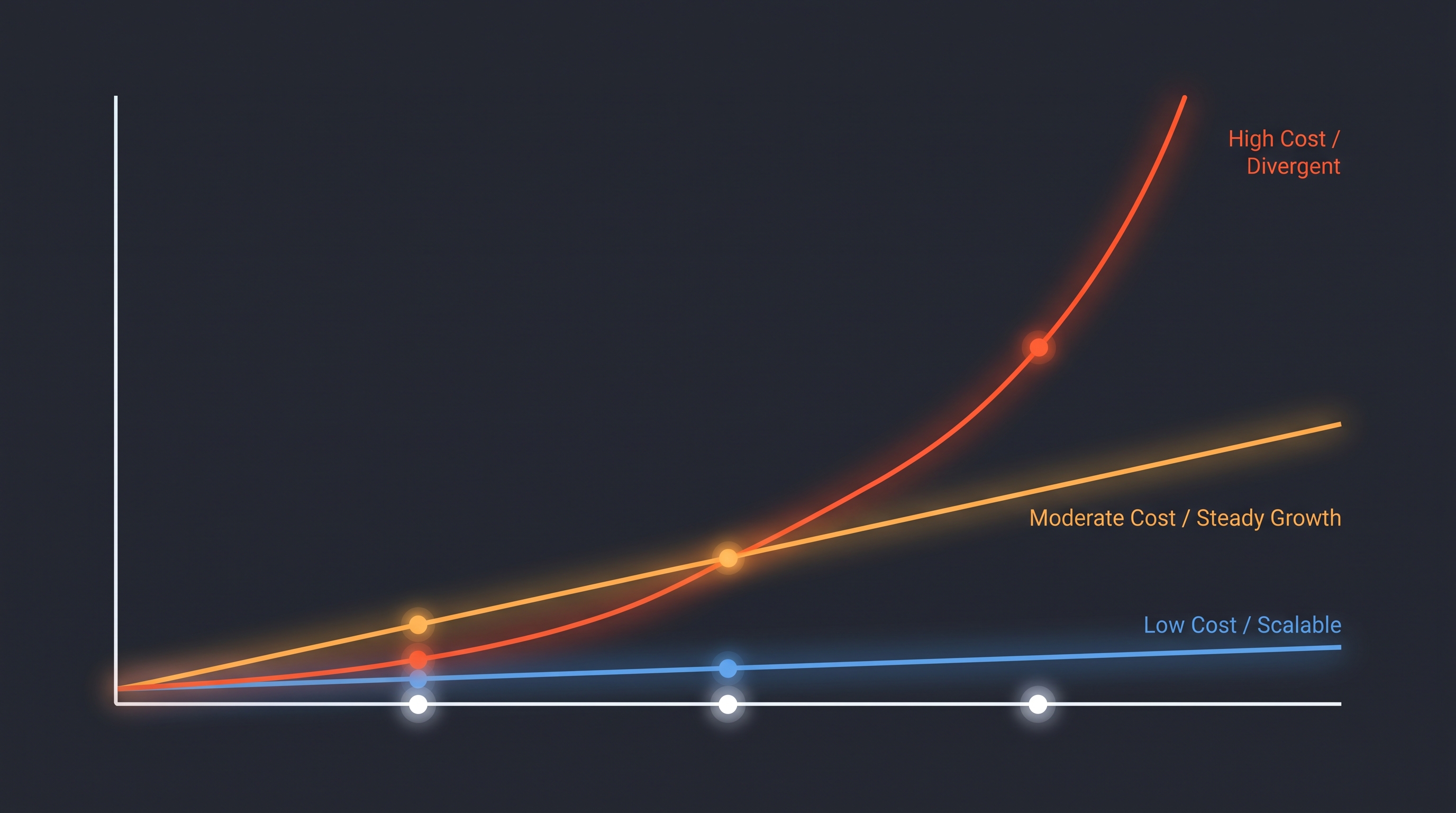
That one architectural difference — per-step billing versus per-run billing — is the entire reason the cost curves in this article diverge as sharply as they do once volume climbs.
The Real Numbers: 1,000, 10,000, and 100,000 Monthly Executions
Using an 8-step workflow as the consistent baseline across all three platforms — a realistic mid-complexity automation, not a toy example — here is what independent 2026 cost analyses converge on at three volume tiers.
At 1,000 Monthly Runs (Light Usage)
At this volume, the gap exists but isn't yet painful. An 8-step workflow running 1,000 times a month generates roughly 8,000 Zapier tasks, which fits on Zapier's $73/month Professional plan without much headroom to spare. The same volume on Make lands around 8,000 to 10,000 operations, comfortably inside Make's $9 to $12/month Core plan. On n8n Cloud, 1,000 executions sits well within the $20/month entry tier, with room to grow before you'd need to upgrade.
At this stage, Zapier's simplicity genuinely earns its higher price for a lot of teams — you can build a working automation in 15 to 20 minutes with zero technical background, and the cost difference in absolute dollars is still small enough that many businesses reasonably decide it isn't worth the engineering time to save $50 a month.
At 10,000 Monthly Runs (The Inflection Point)
This is where the spread becomes genuinely dramatic, and it's the volume where most growing businesses first feel real budget pain from their automation stack.
Multiple 2026 cost models converge tightly here. One detailed breakdown puts Zapier at 80,000 tasks needed for that volume, landing at $250 to $400-plus a month depending on plan tier. Make requires spanning multiple credit tiers to cover roughly 80,000 operations, landing around $150 to $200/month. n8n Cloud handles the same 10,000 executions at a flat $50/month — because, again, it's billing the run count, not the step count. Self-hosted n8n at this volume runs on infrastructure costing $20 to $40/month regardless of execution count, with margin to spare.
Do the comparison directly: Zapier to n8n Cloud is a 5 to 8x price difference for identical output at this volume. Zapier to self-hosted n8n is closer to 10x. This is not a marginal optimization. This is the difference between an automation stack that's a rounding error in your operating budget and one that's a genuine line item your finance team is asking questions about.
At 100,000 Monthly Runs (Enterprise Scale)
At this volume, the gap stops being dramatic and starts being structural. One detailed 2026 analysis modeling 100,000 records a month through a 5-step workflow found the annual cost difference between Zapier ($8,400/year) and self-hosted n8n ($240/year) exceeds $8,000 — for the same output. Zapier's task-based pricing scales so steeply above 10,000 tasks that moving from 10K to 100K tasks can add $500-plus to the monthly bill on its own, independent of how many workflow steps you're running.
Make holds up better at this scale than Zapier does — its operations-based pricing has been independently measured as delivering roughly 10x more automation capacity per dollar than Zapier's task model — but it still cannot compete with n8n's flat, execution-count-independent economics once you're running enterprise-scale volume, especially self-hosted, where infrastructure cost barely moves whether you're running 50,000 or 500,000 executions a month.
The Hidden Costs Nobody Puts on the Pricing Page
The headline numbers above are the clean version. Real invoices get inflated by billing behaviors that don't show up until you're already committed to a platform.
Polling triggers burn quota even when nothing happens. If your Zapier or Make automation polls a Google Sheet or database every 5 minutes to check for new data, that's 8,640 trigger checks a month before a single row of actual new data has been processed. Depending on the platform, some of that polling activity consumes billable quota regardless of whether anything actually changed — a cost that's invisible on the pricing page and easy to miss until you're reviewing an unexpectedly high invoice.
Multi-step chains multiply faster than intuition suggests. Zapier's task model means complex branching logic often forces you to chain multiple Zaps together with webhooks to work around what a single tool can't express natively. Each additional chain link is more billable tasks and more operational complexity — a workaround cost that Make's native router/branch logic and n8n's unlimited-steps-per-execution model largely avoid.
Data-heavy operations cost more than simple ones. On Make specifically, large payloads consume additional operations beyond a simple API call — a 10 MB file download can count as significantly more than one operation, a detail that catches teams processing media files or large datasets off guard.
Extended runtime billing is new in 2026. Zapier introduced extended runtime billing this year for workflows that run longer than the platform's default execution window — a real cost that didn't exist in earlier pricing models and specifically penalizes longer-running or more complex automations.
n8n Cloud has fair-use limits too. Self-hosting removes per-execution billing, but n8n's cloud plans still include fair-use limits on execution time and data transfer that can apply to very long-running or data-heavy workflows — not unlimited in every dimension, just unlimited in the specific dimension (per-step cost) that matters most for the volume calculations above.
AI agent activities are billed separately, on every platform. Zapier prices its AI Agents at $33.33/month for 1,500 agent activities, entirely separate from standard task billing. Make's AI capabilities (branded Maia) similarly sit outside the standard operations count. n8n's native LangChain integration and AI-specific nodes are the one place where AI workflow cost is folded into the same execution-based model as everything else — a meaningful advantage if AI agents are a growing part of your automation stack, not a side feature.
Which Tool Actually Fits Your Team — Not Just Your Budget
The cost math above tells you what you'll pay. It doesn't tell you whether you can actually build and maintain the automation in the first place, and that's the variable most cost-focused comparisons skip entirely.
Zapier fits non-technical teams who need speed over savings. The step-based builder presents a genuinely simple linear sequence — "when this happens, do this, then this" — and a new user can build a working automation in 15 to 20 minutes with zero technical background. The constraint is that complex branching and looping either aren't supported natively or require the multi-Zap workarounds described above, which is exactly where the cost curve starts working against you. For low-volume automation owned entirely by a business team with no engineering support, Zapier's higher price is often a fair trade for its near-zero learning curve.
Make fits operations teams that need real logic without an engineer. It holds genuine branching logic on a visual canvas that a non-engineer can actually read and modify, and critically, it bills per module rather than per completed action — so building the logic properly doesn't multiply your bill the way chaining workarounds does on Zapier. For most mid-sized companies with an operations team that owns automation but doesn't have dedicated engineering time, Make is frequently the default recommendation across independent 2026 comparisons, and it's the platform with the best price-to-power ratio of the three at moderate-to-high volume.
n8n fits engineering-owned automation at any real volume. The condition attached to this recommendation is not negotiable: n8n's cost advantage is largest specifically when someone on your team is comfortable with APIs, can read a little JSON, and has a few hours a month to maintain the self-hosted instance for as long as the workflows keep running. Given that, one 2026 cost model found self-hosted n8n is 80 to 95% cheaper than Zapier and 50 to 70% cheaper than Make for any workload above roughly 2,000 executions a month — at 50,000 executions specifically, that's approximately $20/month on self-hosted n8n against roughly $399/month on Zapier's equivalent tier, a 95% cost reduction for identical automation output.
n8n also currently leads clearly on AI agent workflows specifically — its native LangChain support and 70-plus AI-specific nodes give it technical depth that Zapier's Agents and Make's Maia haven't matched as of 2026, particularly relevant for any team that doesn't want customer data routed through a third-party AI API as part of the automation pipeline.
For the deepest breakdown of n8n's self-hosted Community Edition, its native AI agent capabilities, and its full 2026 pricing across cloud and self-hosted deployment, our full n8n review covers the platform independently of this cost-focused comparison.
According to a detailed 2026 field analysis published after shipping 80-plus client automation projects across all three platforms (https://dev.to/2pizza/make-vs-zapier-vs-n8n-in-2026-honest-comparison-from-80-shipped-projects-321j), n8n self-hosted has been run reliably on a single $40/month VPS processing 200,000-plus workflow runs a month with margin to spare — a real-world data point that confirms the theoretical cost-per-execution advantage actually holds up in production, not just in a pricing-page comparison.
The Decision Framework, Without the Spreadsheet
Stay on Zapier if: your monthly execution volume is genuinely low (under roughly 1,000 to 2,000 runs), nobody on your team can spare engineering hours for setup or maintenance, and the absolute dollar gap between platforms is small enough at your volume that it isn't worth the switching cost.
Move to Make if: you've outgrown Zapier's cost curve or its branching limitations, your automation is owned by an operations team rather than engineers, and you want meaningfully better price-to-power without taking on self-hosting responsibility.
Move to n8n Cloud if: you want n8n's execution-based billing advantage and native AI capabilities without managing your own infrastructure — a reasonable middle ground between Make's pricing and full self-hosted control.
Move to self-hosted n8n if: your monthly volume is comfortably above 2,000 to 10,000 executions, someone on your team can own a few hours a month of infrastructure maintenance, and the cost gap at your specific volume — which the numbers above show growing from meaningful to enormous as you scale — is large enough to justify the setup investment. For any business running real automation volume in 2026, this is consistently where the math points, provided the technical capability exists on your team to support it.
None of these platforms offer an automated migration tool between them as of 2026 — plan for roughly 2 to 4 hours per workflow to manually rebuild automations if you switch platforms, more for complex ones. That migration cost is real and worth weighing against the ongoing savings before you commit to a switch, though at any meaningful volume, the payback period is typically measured in weeks, not months.
Frequently Asked Questions
How much does it cost to run 10,000 automation executions a month on n8n, Make, and Zapier? For an 8-step workflow run 10,000 times a month, independent 2026 cost models converge around: n8n Cloud roughly $50/month, Make roughly $150–200/month (spanning multiple credit tiers), and Zapier roughly $250–400-plus/month depending on plan tier — a 5 to 8x cost difference across the three platforms for identical output.
Why is Zapier so much more expensive than n8n at the same volume? Zapier bills per action step (task), not per workflow run. An 8-step Zap run 10,000 times consumes roughly 70,000 to 80,000 tasks, not 10,000. n8n bills per workflow execution regardless of how many steps are inside it, so the same 8-step workflow run 10,000 times is simply 10,000 executions on n8n.
Does self-hosting n8n actually save money, or is it just a hassle? It genuinely saves money at meaningful volume — one 2026 analysis found self-hosted n8n 80 to 95% cheaper than Zapier and 50 to 70% cheaper than Make above roughly 2,000 monthly executions, with real production examples running 200,000-plus monthly workflow runs on a single $40/month server. The trade-off is that someone on your team needs basic comfort with server maintenance and, ideally, some JSON/API familiarity.
What's the cheapest platform for high-volume automation in 2026? Self-hosted n8n, by a wide and consistently documented margin, for any team with the technical capability to maintain it. At 50,000 monthly executions, one 2026 cost model found self-hosted n8n at roughly $20/month against roughly $399/month for the equivalent Zapier tier — a 95% cost reduction for identical output.
Which platform is easiest to learn, regardless of cost? Zapier, without much competition. Its linear "when this happens, do this" builder lets a non-technical user build a working automation in 15 to 20 minutes. Make requires understanding a visual canvas with modules and connections — more capable, moderately more complex. n8n requires the most technical comfort of the three, particularly for self-hosted deployment.
Do hidden costs like polling triggers really add up? Yes. A Google Sheet polled every 5 minutes for new data generates roughly 8,640 trigger checks a month before any actual new data has been processed — and on some billing models, that polling activity itself consumes quota. This is a genuinely underestimated cost across all three platforms, not specific to one.

Founder, Axionova · AI Tools Strategist
Ashir writes independent, hands-on reviews of AI tools and shares strategies for creators, marketers, and entrepreneurs. Every review is grounded in real usage — no paid placements, no fluff. Read our editorial standards.
AI Insights Weekly
One curated email a week: sharp AI insights, tool reviews, and strategies.
Have thoughts on this?
Contact us or share this article on social media — we'd love to hear what resonated with you.