Google NotebookLM Review 2026: 30 Million Users, a Viral AI Podcast Feature, and a Brand New Name — Everything You Need to Know About Gemini Notebook
A comprehensive Google NotebookLM review for September 2026 — covering the July 16 rename to Gemini Notebook, Audio Overview and Cinematic Video Overviews powered by Veo 3, code execution, the full pricing structure after Google's May 2026 restructure, NotebookLM Enterprise general availability, competitor comparisons with Perplexity and ChatGPT Deep Research, and who each tier is genuinely built for.

There is a reason 30 million people now use a tool that was launched with almost no advertising budget, no influencer campaign, and no viral social media moment planned by a marketing team.
The viral moment happened on its own. Someone discovered that NotebookLM could transform any document — a dense academic paper, a 200-page corporate strategy deck, a stack of research reports — into a realistic-sounding podcast where two AI hosts discuss the material as if they have actually read and understood it. The hosts interrupt each other. They express genuine surprise at interesting findings. They use the specific language of the domain they are discussing. And the output sounds, to most listeners, like a real podcast produced by knowledgeable human hosts.
The Audio Overview feature exploded across social media in late 2024. By 2025 it was a meme. By mid-2026, NotebookLM had 30 million individual users and over 600,000 organizations on the platform — up from 17 million monthly active users at the end of 2025. A 76% growth in under eight months. Not through advertising. Through people sharing outputs that impressed them enough to make them want to show someone else.
On July 16, 2026 — seven weeks ago — Google renamed NotebookLM to Gemini Notebook. The features stayed the same. The pricing stayed the same. The core value proposition stayed the same. Only the name changed, reflecting the product's deeper integration into the Gemini AI ecosystem and Google's broader AI strategy.
In the seven weeks since the rename, search volume for "NotebookLM review," "Gemini Notebook," and "NotebookLM pricing 2026" has surged — a spike driven by 30 million existing users searching to understand what changed, and millions of new potential users encountering the product for the first time under its new name.
This review covers everything: every core feature including the latest Cinematic Video Overviews and code execution capability, the full pricing picture after Google's May 2026 restructure, every real-world use case, honest comparisons with Perplexity and ChatGPT Deep Research, and the genuine limitations worth understanding before committing to any paid tier.
What Is Google NotebookLM (Now Gemini Notebook)?
NotebookLM — now called Gemini Notebook as of July 16, 2026 — is Google's AI-powered research and knowledge synthesis platform. It is not a general-purpose AI chatbot. It is not a web search tool. It is a document-grounded AI research environment where you bring your own sources and the AI synthesizes, explains, summarizes, and transforms only from those sources — not from the open internet.
The core premise: upload your documents — PDFs, Google Docs, web pages, YouTube videos, audio files, Slides presentations, spreadsheets — into a Notebook. The AI reads everything you upload. Then ask it anything about those documents and receive answers that cite the specific passages in your sources where the information came from. Every answer is traceable back to the exact source that supports it.
This source-grounding model is the architectural decision that distinguishes NotebookLM from every general-purpose AI assistant. ChatGPT, Claude, and Gemini in chat mode draw from their training data and the open web. NotebookLM draws only from what you give it. The answers are narrower in scope and more reliable in accuracy for the specific domain of your uploaded sources.
The product was originally developed by Google Labs and launched in July 2023 as an experimental product accessible by invitation. It opened to the public in September 2024, reached 1 million users within three months of its 2023 launch, hit 10 million by April 2024, and reached 30 million individual users and 600,000-plus organizations by July 2026.
Google formally integrated the product into the Gemini product family and renamed it Gemini Notebook on July 16, 2026 — though the name NotebookLM remains far more widely recognized and is expected to continue as the primary search term for the product through at least 2027.
Why NotebookLM Is the Trending AI Tool of September 2026
The July 16, 2026 rename to Gemini Notebook is the primary driver of the search volume spike that makes this the right topic for September 2026. When a product with 30 million users changes its name, every one of those users has a question. "What is Gemini Notebook?" "Did NotebookLM shut down?" "What changed when NotebookLM became Gemini Notebook?" These queries are generating millions of searches per week — and the content gap answering them in depth is still largely unfilled seven weeks after the rename.
The DataNorth Q3 2026 AI Tools ranking specifically names "Gemini Notebook" (published as NotebookLM) alongside Cursor, n8n, Perplexity, ElevenLabs, and HeyGen as the tools that "shipped material change in the last three months." The September 2026 AI Tool of the Month Newsletter published two hours before this article was researched names NotebookLM and Perplexity alongside ChatGPT as the tools that "solve a defined job" most effectively for the startup founder audience.
PrimeAICenter's Best AI Tools 2026 ranking specifically calls out NotebookLM as "best for research" — placing it above Perplexity for document-grounded research and above ChatGPT for knowledge synthesis from personal document libraries.
Three specific feature additions in 2026 have also expanded the product's relevance beyond its original research audience. Cinematic Video Overviews — fully animated video content built with Google's Veo 3 model — arrived on the Ultra tier in 2026, transforming NotebookLM from an audio-first output tool into a complete content transformation platform. Code execution capability launched in 2026, allowing NotebookLM to run Python code within a notebook session and produce data visualizations from uploaded data files. And the NotebookLM Enterprise tier reached general availability in 2026, bringing the product from individual research tool into enterprise knowledge management infrastructure at the Fortune 500 scale.
According to Google's own research on AI productivity tools, the usage pattern that generates the highest user satisfaction ratings in NotebookLM is the combination of multiple document sources with the Audio Overview feature — with users reporting that hearing information synthesized in conversational form produces higher comprehension and retention than reading the same synthesis as text.
Core Features of NotebookLM in 2026
Source-Grounded AI — The Foundational Capability
Every feature in NotebookLM is built on the same foundational capability: AI that only answers from the sources you give it. Upload your documents. Ask anything. Receive answers with citations pointing to the exact passages that support each claim.
The source types NotebookLM accepts: PDFs, Google Docs, Google Slides, Google Sheets, web pages (pasted URLs that NotebookLM crawls and ingests), YouTube video URLs (it processes the transcript), audio files, plain text files, and copied text. The free tier supports up to 50 sources per notebook and up to 50 notebooks. Paid tiers expand these limits significantly — up to 500 sources per notebook on Plus and above.
The citation model is not decorative. When NotebookLM provides an answer, it displays numbered inline citations that link directly to the specific passage in the source document. Click the citation and you are taken to the exact location in the source where the information originates. For professional research, legal analysis, medical literature review, and any knowledge work where the provenance of a claim matters, this citation infrastructure is the defining quality advantage over general-purpose AI assistants that provide answers without source attribution.
Audio Overview — The Feature That Made NotebookLM Famous
Audio Overview is the feature that turned NotebookLM from a useful research tool into a product people share on social media. Select any notebook, click "Generate Audio Overview," and NotebookLM produces a 10 to 20-minute podcast-style conversation between two AI hosts who discuss, debate, explain, and analyze the content of your uploaded sources.
The audio quality is the detail that consistently surprises first-time users. The hosts speak naturally, use domain-appropriate language, express genuine intellectual curiosity about interesting findings in the source material, interrupt each other at appropriate moments, and produce an output that most listeners describe as indistinguishable from a human-produced podcast on first hearing.
The practical applications that NotebookLM's user community has developed around Audio Overview: turning academic papers into commute-length audio discussions, transforming dense corporate reports into briefings teams can listen to during travel, converting research materials into audio study guides, producing explainer podcasts from technical documentation for non-technical audiences, and creating audio summaries of meeting notes and project updates for asynchronous team consumption.
The user control update added in 2025 allows users to provide instructions to the Audio Overview hosts before generation — directing them to focus on specific aspects of the material, maintain a specific tone, address a specific audience, or include specific analytical angles. This customization significantly expanded the professional usefulness of Audio Overview beyond its initial demo-impressive but editorially uncontrollable first version.
Cinematic Video Overviews — Veo 3-Powered Video Content from Documents
Cinematic Video Overviews are the most significant new feature added to NotebookLM in 2026 — and the one that changes what category the product competes in.
Available on the Google AI Ultra tier ($99.99/month and $199.99/month), Cinematic Video Overviews take the Audio Overview concept further: they produce fully animated video content from your document sources, combining AI-generated visuals built with Google's Veo 3 model with the Audio Overview narration to create a complete audiovisual presentation of your source material.
The output quality has surprised users who expected basic slide-deck style video: the Veo 3 integration produces cinematically styled footage — animated data visualizations, illustrative scenes, abstract visual metaphors for key concepts — rather than the static text-on-background approach that most AI video presentation tools produce.
For organizations producing thought leadership content, educational video, or knowledge-sharing materials from existing document libraries, Cinematic Video Overviews represent a workflow compression from days of manual video production to minutes of automated generation. The editorial input is the source documents. The output is a polished video suitable for YouTube, internal training platforms, or client presentations.
Study Guide and FAQ Generation
NotebookLM generates structured study guides — organized summaries with key concepts, definitions, and hierarchical topic organization — from any set of uploaded sources. For students preparing for exams from lecture notes and textbooks, for onboarding professionals navigating a new domain's documentation, or for any knowledge worker who needs a fast orientation to an unfamiliar subject area, the Study Guide output condenses what would have been hours of manual organization into a structured reference document generated in under a minute.
The FAQ generation feature identifies the questions that the uploaded material implicitly answers and presents them in a question-and-answer format. For product managers turning user research into structured insight documents, for customer success teams extracting FAQ content from support documentation, or for trainers developing knowledge-check materials from training content, FAQ generation converts raw source material into a presentation-ready format with minimal manual effort.
Briefing Document Generation
The Briefing Document feature is specifically designed for executive and stakeholder communications — producing structured, professional-format summaries of complex or voluminous source material in the language and format appropriate for audience-adapted presentation.
For professionals who regularly need to distill large document sets into executive summaries, board presentations, or client briefings, Briefing Document generation addresses the most time-consuming part of knowledge work: not gathering information, but organizing and adapting it for the specific audience who needs to act on it.
Timeline and Table of Contents Generation
Timeline generation identifies chronological sequences within uploaded documents and presents them as structured timelines — useful for understanding the development of a technical field from a library of research papers, for tracking the progression of a project from meeting notes and status reports, or for building historical context from a set of news articles and company documents.
Table of Contents generation produces a navigable structural overview of a multi-source notebook — particularly valuable when a notebook contains many documents covering related but distinct aspects of a topic.
Code Execution — Data Analysis Inside Notebooks
Code execution is the 2026 feature that most significantly expands NotebookLM's professional user base beyond researchers and students into data analysts and business intelligence professionals.
With code execution enabled, NotebookLM can run Python within a notebook session — reading uploaded data files, performing calculations, generating visualizations, and producing analysis outputs that are grounded in the specific data the user provides rather than in general statistical knowledge.
A market analyst can upload a dataset alongside industry reports, ask NotebookLM to calculate specific metrics, generate charts, and produce a synthesis that combines the quantitative analysis with the qualitative context from the uploaded research documents — all within a single notebook session without switching to a separate data analysis tool.
NotebookLM for Teams and Enterprise
The 2026 general availability of NotebookLM Business and Enterprise tiers transformed the product from an individual research tool into enterprise knowledge management infrastructure.
The team capabilities: secure notebook sharing with role-based access control using Google Workspace's IAM system, centralized organizational knowledge repositories accessible to defined team members, admin controls over data handling and sharing policies, VPC-SC compliance for organizations with data residency requirements, and full audit trails for enterprise governance.
The enterprise use cases that 600,000-plus organizations are actively deploying in 2026: new employee onboarding notebooks that contain all relevant company policies, procedures, and context in a queryable AI-powered format; legal document analysis notebooks that allow teams to query across large contract libraries; competitive intelligence notebooks that synthesize analyst reports, news coverage, and market data into queryable briefing environments; and customer success knowledge bases where support teams can query across product documentation, past case histories, and technical specifications simultaneously.

Real-World Use Cases
Students and Academic Researchers
NotebookLM was originally designed primarily for student and academic use — and this remains its strongest single user segment. The upload-and-query model maps perfectly onto academic research workflows: gather relevant papers, upload them to a notebook, query across them to identify the consensus view, the contested claims, and the methodological gaps that a new research contribution should address.
Audio Overview transforms the experience of literature review — instead of reading through twenty papers sequentially, researchers can listen to a synthesized discussion of the entire corpus while walking, commuting, or exercising, then return to the notebook to query specific claims with citations when something in the audio prompts a need for verification.
The free tier — 50 notebooks, 50 sources per notebook — covers the full scope of most individual academic research projects without any subscription cost.
Corporate Research and Strategy Teams
Business research and strategy teams are among the fastest-growing user segments in NotebookLM's 2026 user base. The specific workflow: assemble a notebook with analyst reports, competitor filings, market data, internal research memos, and relevant news coverage. Query the notebook to synthesize the competitive landscape, identify the key market dynamics, and generate a briefing document formatted for executive presentation.
The source-grounding model is particularly valuable for business research because the citation infrastructure makes every claim in a synthesized output traceable to the specific source document that supports it — which is the professional standard that business intelligence outputs require.
Legal and Compliance Professionals
Law firms and corporate legal teams use NotebookLM for contract review, regulatory landscape analysis, and precedent research. A notebook containing a large contract library can be queried for specific clause types, liability provisions, and jurisdiction-specific terms — producing a synthesis that would have required days of manual review in hours.
The VPC-SC compliance and enterprise data handling controls available on the Enterprise tier make NotebookLM viable for legal workflows involving sensitive client materials in ways that consumer-tier AI tools cannot satisfy.
Content Creators and Educators
The Audio Overview and Cinematic Video Overview features position NotebookLM as a content transformation tool for creators who work with complex source material. A science communicator can upload the papers behind a research finding and generate an Audio Overview that serves as the research basis for a podcast episode. An educator can transform a dense academic text into a Cinematic Video Overview accessible to an introductory-level audience. A course creator can generate structured study guides from lecture materials that students can query interactively.
Product Teams and Customer Success
Product teams use NotebookLM notebooks to maintain living repositories of user research, product specifications, competitive intelligence, and stakeholder feedback that any team member can query for specific context without reading through the entire source library.
Customer success teams build knowledge bases from product documentation, support ticket archives, and technical specifications — allowing team members to query across the full knowledge library with source citations rather than conducting manual documentation searches or relying on the institutional memory of individual team members.
How NotebookLM Compares to the Competition
NotebookLM vs Perplexity AI
Perplexity AI and NotebookLM are frequently compared because both are research-oriented AI tools that emphasize source citation. The architectural difference is fundamental: Perplexity searches the live web and synthesizes from external sources. NotebookLM synthesizes exclusively from the sources you upload.
For research questions about current events, recent developments, and publicly available information, Perplexity is significantly stronger — it has access to real-time web information that NotebookLM's document-only model cannot reach. For research questions about your specific document library — your organization's internal knowledge, your personal research collection, your client's proprietary materials — NotebookLM is significantly stronger, because Perplexity cannot access documents that are not publicly available on the internet.
The practical workflow that experienced researchers use in 2026: Perplexity for external research and current information synthesis, NotebookLM for internal document synthesis and personal knowledge management. The tools are complementary across different knowledge domains, not competing for the same use case.
NotebookLM vs ChatGPT Deep Research
ChatGPT's Deep Research feature and NotebookLM's source-grounded synthesis address the same core user problem from different architectural approaches. ChatGPT Deep Research autonomously searches the web, reads sources, and produces a long-form research report. NotebookLM synthesizes from documents you provide.
ChatGPT Deep Research is stronger for research questions where the answer requires discovering and synthesizing sources the user has not yet identified. NotebookLM is stronger for research questions where the user already has the relevant sources and needs to synthesize meaning from them with citation fidelity.
For professional use cases where document confidentiality means the sources cannot be submitted to a public AI system, NotebookLM's Google Enterprise tier with VPC-SC compliance provides a data-handling guarantee that ChatGPT's standard API cannot match.
According to Harvard Business Review's research on knowledge worker productivity, the highest-value AI productivity gains in knowledge work come from tools that help workers extract meaning from existing document libraries — not from tools that generate generic answers from training data. NotebookLM's source-grounding architecture is directly aligned with this finding.
NotebookLM vs Microsoft Copilot in Microsoft 365
For enterprise users in the Microsoft ecosystem, Microsoft Copilot in Microsoft 365 offers the most directly comparable functionality — AI that synthesizes from organizational documents stored in SharePoint, OneDrive, and Teams with organization-specific source grounding rather than general internet knowledge.
Microsoft Copilot's advantage: deeper integration with the Microsoft productivity suite (Word, Excel, PowerPoint, Outlook, Teams), a more mature enterprise governance framework, and native access to documents stored in the Microsoft 365 organizational data layer without manual upload.
NotebookLM's advantage: the Audio Overview and Cinematic Video Overview features have no equivalent in Microsoft Copilot, the free tier provides individual access to the core functionality without enterprise procurement, and the product's user experience for document-grounded Q&A is more refined and immediately accessible than Copilot's document synthesis capabilities.
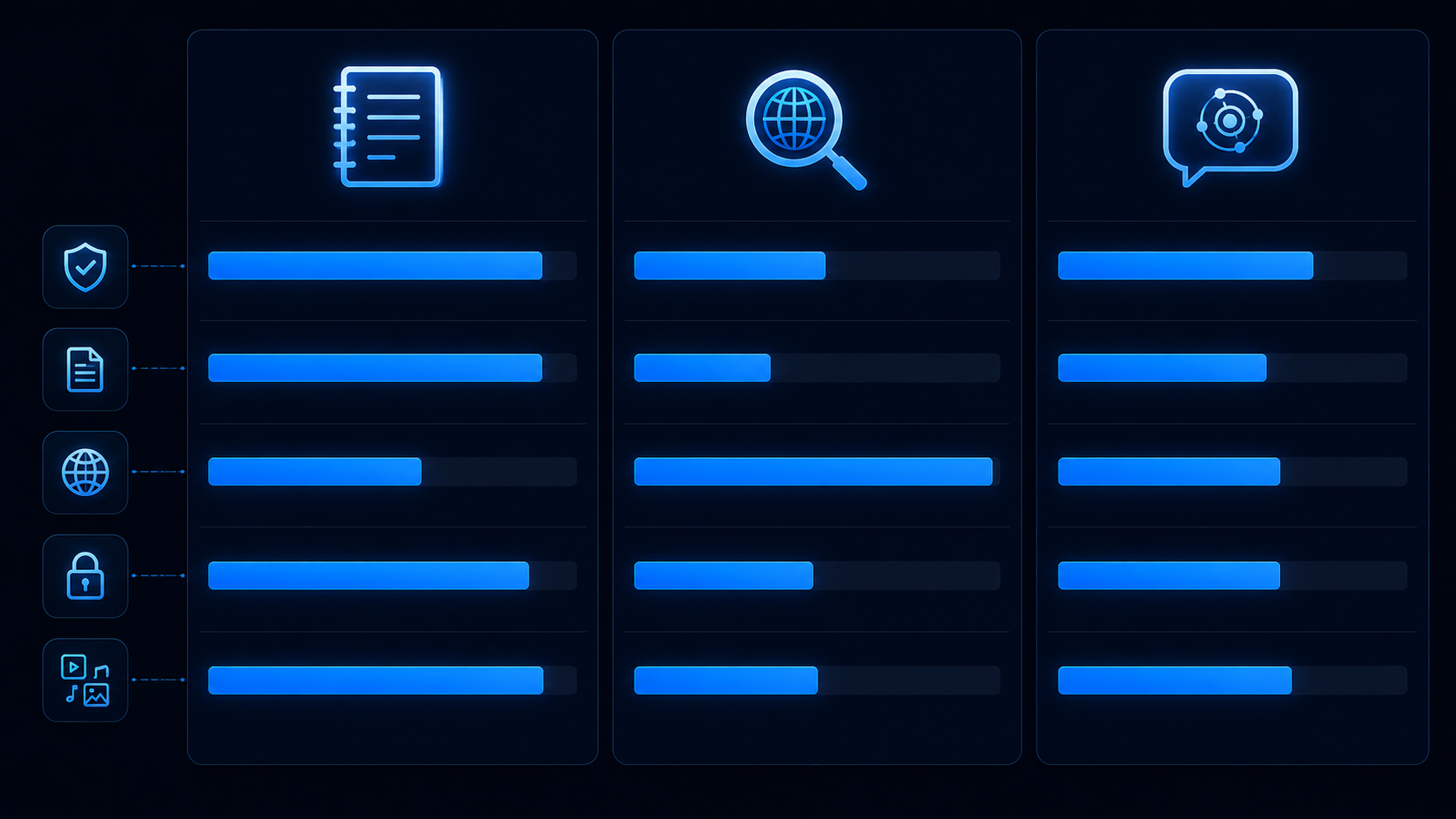
NotebookLM Pricing — The Complete 2026 Breakdown
NotebookLM's pricing restructured significantly in May 2026 alongside Google's broader Gemini AI subscription consolidation. The most important structural change: there is no standalone NotebookLM subscription. Every paid tier of NotebookLM Plus is bundled into a broader Google AI or Workspace subscription — which means the value calculation depends on how much of the broader Google AI product suite you will use alongside NotebookLM.
Free (Standard) — $0/month The complete core NotebookLM feature set: up to 50 notebooks, up to 50 sources per notebook, Audio Overview generation, Study Guide and FAQ generation, Briefing Document generation, Timeline generation, and the full source-grounded Q&A experience. The free tier is genuinely functional for most individual researchers, students, and casual professional users. It is not artificially crippled to force upgrades — Google designed the free tier to be genuinely useful.
Audio Overview on the free tier has a generation limit per day — the specific limit has not been publicly disclosed but users report hitting it only under heavy generation volume. For standard research workflows, the free tier's Audio Overview access is more than sufficient.
Google AI Plus — $4.99/month to $7.99/month Includes NotebookLM Plus — higher notebook limits, higher sources per notebook, faster audio generation, and access to more advanced AI features within the Gemini ecosystem. The cheapest meaningful upgrade path for individual users who consistently hit free tier limits. Pricing varies by region — verify the current rate at ai.google for your location.
Google AI Pro — $19.99/month NotebookLM Plus at significantly higher limits, 5TB of Google storage, access to Gemini's more advanced model capabilities, and priority access to new features. This is the tier most actively-using individual professional users operate on in 2026.
Google AI Ultra — $99.99/month (20TB) and $199.99/month (30TB) The top individual tier. Includes Cinematic Video Overviews powered by Veo 3 — not available on any lower tier. Substantially higher usage caps across all features. Ultra makes sense for power users and content creators who produce Cinematic Video Overviews regularly. The $99.99/month tier suits most Ultra-level individual users. The $199.99/month tier adds storage capacity for organizations managing very large document libraries.
Google Workspace Business Standard — approximately $14/user/month (historical rate) NotebookLM Plus is included at no extra cost in Google Workspace Business Standard and all higher Workspace tiers. Organizations already running Workspace Business Standard or above should check with their Google Workspace admin — they may already have NotebookLM Plus access without knowing it and without any additional invoice.
NotebookLM Enterprise — approximately $9/license/month via Google Cloud Full NotebookLM Plus capabilities with enterprise data governance: VPC-SC compliance, IAM-based sharing controls, admin access management, full audit trails, and dedicated enterprise support. The most cost-effective path for large organizations relative to individual subscription aggregation.
The honest pricing reality: The free tier is genuinely the right starting point for any individual user who has not yet hit its limits. The most common mistake in evaluating NotebookLM's pricing is treating the paid tiers as necessary upgrades for basic functionality — they are not. Upgrade only when you can specifically identify a limit in the free tier that is blocking your workflow.
For organizations in the Google Workspace ecosystem: audit your current Workspace tier before purchasing any individual NotebookLM subscription. NotebookLM Plus may already be included in your existing Workspace plan.
Pros and Cons
Pros
Free core product with genuinely functional feature set — 50 notebooks, 50 sources each, Audio Overview, Study Guide, FAQ, Briefing Document, Timeline generation
30 million individual users and 600,000-plus organizations — largest verified user base of any dedicated research AI tool
Source-grounded AI with inline citations to specific source passages — the most reliable citation model of any AI research tool available
Audio Overview produces realistic podcast-style discussions of document content — the feature that drives the most organic word-of-mouth sharing
Cinematic Video Overviews powered by Veo 3 on Ultra tier — complete audiovisual content from document sources
Code execution for Python data analysis within notebooks — expands use cases to quantitative research and business intelligence
Accepts 11 source types: PDFs, Google Docs, Google Slides, Sheets, web pages, YouTube URLs, audio files, text, and more
NotebookLM Enterprise with VPC-SC compliance enables deployment for sensitive organizational data in regulated industries
76% user growth in under eight months — fastest-growing research AI tool in 2026
Seamlessly integrated into Google Workspace for enterprise teams already on Business Standard and above
NotebookLM for Teams allows secure organizational notebook sharing with IAM-based access control
Completely free core access with no credit card requirement removes evaluation friction
Renamed Gemini Notebook on July 16, 2026 — deeper Gemini ecosystem integration promises continued model capability upgrades
Cons
Cannot access real-time web information — source-only model means it cannot answer questions about recent events or current developments not included in uploaded sources
No standalone NotebookLM subscription — paid tiers are bundled into broader Google AI plans, meaning users pay for the full Google AI subscription even if they only want NotebookLM Plus features
Cinematic Video Overviews are exclusively on the Ultra tier at $99.99/month or $199.99/month — a significant price commitment for access to one feature
Free tier source limit (50 sources per notebook) can be restrictive for research projects involving large document libraries
Audio Overview hosts are not fully controllable — while user instructions can guide topics and tone, the specific words, examples, and discussion paths the AI hosts take remain partially unpredictable
Not designed for workflow automation or integration into larger data pipelines — n8n, Zapier, and similar tools handle process automation that NotebookLM is not built for
Google's history of product discontinuation creates a non-zero platform risk concern, though the product's deep integration into the Gemini family and its 30 million user base make discontinuation significantly less probable than it was for earlier experimental Google products
Enterprise notebook collaboration features are more limited than dedicated team knowledge management platforms — organizations with complex collaborative annotation and document management needs may find specialist platforms more appropriate
Who Should Use NotebookLM?
NotebookLM delivers the strongest value for:
Students and academic researchers who need to synthesize across personal document libraries with citation fidelity — the free tier covers this use case completely
Business research and strategy professionals who regularly need to extract synthesized intelligence from assembled document sets
Legal and compliance professionals using the Enterprise tier for contract analysis and regulatory landscape synthesis within secure data environments
Content creators and educators who use Audio Overview and Cinematic Video Overviews to transform complex source material into accessible audio and video formats
Product and customer success teams building organizational knowledge repositories queryable by team members with source attribution
Enterprise organizations in the Google Workspace ecosystem who can access NotebookLM Plus through existing Workspace Business Standard and above subscriptions
Who Should Consider Alternatives
Users who need real-time web research with citations — Perplexity is the appropriate tool for current information synthesis from live web sources
Users who need AI to discover and synthesize sources they have not yet identified — ChatGPT Deep Research or Perplexity's Deep Research feature are more appropriate for autonomous multi-source discovery
Workflow automation requirements — NotebookLM is not an automation platform; n8n, Make, or Zapier are the appropriate tools for multi-step workflow orchestration
Users wanting creative generation beyond document synthesis — Claude or ChatGPT are more capable for creative writing, coding, and open-ended reasoning tasks beyond the document-grounded research context

Getting the Most Out of NotebookLM — Practical Tips
Curate your source selection before creating the notebook. The quality of NotebookLM's outputs is directly proportional to the quality and relevance of the sources you upload. A notebook with 20 highly relevant, authoritative sources produces better synthesis than one with 50 loosely related documents. More is not always better — curation before upload is the highest-leverage step in the workflow.
Use Audio Overview for initial synthesis, text Q&A for verification. The Audio Overview is excellent for getting a broad understanding of a document set quickly — it surfaces connections and insights that specific text queries might miss. Follow up with targeted text queries and citation inspection for the specific claims you need to verify or quote.
Give the Audio Overview hosts a custom instruction before generating. The instruction field allows you to direct the hosts toward specific aspects of the material, a specific audience level, or a specific analytical angle. "Focus on the practical business implications rather than the technical mechanisms" or "Discuss this as if explaining to a senior executive who has not read the original reports" consistently produces more useful outputs than the default unguided generation.
Build separate notebooks for separate research contexts rather than one large notebook. NotebookLM's query performance is most precise when a notebook contains sources that are all relevant to the same research question. Mixing unrelated source domains in a single notebook produces less coherent synthesis and more citation noise. A notebook for competitive analysis, a separate notebook for technical product research, a third for customer research — each maintaining clean source relevance — consistently outperforms an everything-in-one approach.
For enterprise users: check your Workspace tier before purchasing a subscription. NotebookLM Plus is included in Google Workspace Business Standard and above. If your organization runs Workspace Business Standard, your team may already have Plus-level access through your existing subscription.
The Honest Limitations Worth Knowing
The source-only architecture that makes NotebookLM reliable for document synthesis is also the boundary of its usefulness. If you need to know what happened in the news last week, what a competitor announced this morning, or what the current consensus is in a fast-moving technical field, NotebookLM cannot help — unless you have already uploaded current source documents that cover those developments.
This is not a flaw to fix. It is a deliberate architectural choice that produces citation reliability by constraining knowledge scope. Users who understand this boundary use NotebookLM and Perplexity as complementary tools — one for their document library, one for the live web. Users who expect NotebookLM to behave like a general-purpose AI assistant will consistently be frustrated by questions it declines to answer because the information is not in the uploaded sources.
The Audio Overview's partial unpredictability is worth understanding before relying on it for high-stakes communications. The hosts will cover the material faithfully, but the specific examples they choose, the emphasis they place on different concepts, and the occasional analytical tangents they pursue are not fully controllable. For exploratory research and learning purposes, this creative variation is often valuable. For communications where specific points must be emphasized in specific ways, the Briefing Document feature with its more structured format is more appropriate than Audio Overview.
The bundled pricing model creates a real decision complexity for users who want NotebookLM Plus but do not need the rest of the Google AI Pro or Ultra subscription. At $19.99/month for Google AI Pro, the price is reasonable for users who will use Gemini Pro's capabilities alongside NotebookLM. For users who specifically want NotebookLM Plus at minimum cost, the $4.99 to $7.99 range for Google AI Plus is the appropriate tier — though the specific limits at this tier are less generous than Pro.
Final Verdict: Is NotebookLM Worth It in 2026?
The free tier verdict is the most important one to give, because it is the decision most people reading this review actually need to make: the free NotebookLM is one of the most genuinely useful AI research tools available at any price, and starting there before evaluating whether any paid tier is necessary is the correct sequence.
30 million users chose this product without being driven there by advertising. They found it because someone shared an Audio Overview that impressed them, because a colleague recommended it for document synthesis, or because they discovered its capability for turning a stack of research papers into a structured knowledge base during a project where that was exactly what they needed.
The rename to Gemini Notebook on July 16, 2026 is the clearest possible signal of the product's trajectory: Google has moved it from an experimental lab project into the core Gemini product family. The product will receive continued model upgrades as Gemini advances, continued feature development as the research and enterprise use cases mature, and continued scale from Google's distribution infrastructure.
For researchers, analysts, students, and knowledge workers who regularly need to extract synthesized, cited understanding from document libraries — NotebookLM is the most reliable and accessible tool for that specific job available in 2026. The free tier is where to start. The upgrade decision follows naturally from the limits you discover through actual use.
Start Using NotebookLM (Gemini Notebook) Today
The free tier requires only a Google account — no credit card, no trial period, no commitment. Upload your first document set, generate your first Audio Overview, and evaluate whether the quality of source-grounded synthesis matches what your research and knowledge work requires.
Try NotebookLM free → — Free with a Google account. 50 notebooks, 50 sources each. Audio Overview included. No credit card required.
Frequently Asked Questions
What happened to NotebookLM — did it shut down? NotebookLM did not shut down. On July 16, 2026, Google renamed NotebookLM to Gemini Notebook, reflecting its deeper integration into the Gemini AI product family. The features, pricing, and functionality remain the same. The original URL notebooklm.google.com redirects to the new Gemini Notebook address.
What is NotebookLM used for? NotebookLM is used for document-grounded research — uploading PDF files, Google Docs, web pages, YouTube videos, and other source materials and querying across them with AI-generated answers that cite specific source passages. Key outputs include Audio Overviews (podcast-style discussions of your sources), Study Guides, FAQ documents, Briefing Documents, Timelines, and Cinematic Video Overviews.
How much does NotebookLM cost in 2026? The core NotebookLM is free with a Google account. Paid tiers are bundled into Google AI subscriptions: Google AI Plus ($4.99 to $7.99/month), Google AI Pro ($19.99/month), Google AI Ultra ($99.99 or $199.99/month). Enterprise access is available through Google Cloud at approximately $9/license/month. Google Workspace Business Standard and above include NotebookLM Plus at no extra cost.
What is the Audio Overview feature in NotebookLM? Audio Overview is a feature that transforms any set of uploaded source documents into a realistic-sounding podcast where two AI hosts discuss, analyze, and synthesize the material. The output sounds like a human-produced podcast and is typically 10 to 20 minutes long. Users can provide custom instructions to guide the hosts' focus, tone, and audience framing before generation.
What are Cinematic Video Overviews? Cinematic Video Overviews are fully animated video outputs generated from NotebookLM source documents, combining Audio Overview narration with AI-generated visuals produced by Google's Veo 3 model. The feature is available exclusively on the Google AI Ultra tier ($99.99/month and above).
How does NotebookLM compare to Perplexity? Perplexity searches the live web and synthesizes from external sources. NotebookLM synthesizes only from documents you upload. Perplexity is stronger for research requiring current, publicly available information. NotebookLM is stronger for research using personal document libraries, proprietary organizational documents, or any source material not publicly available on the internet. Most serious researchers use both.
Does NotebookLM work for enterprise teams? Yes. NotebookLM Enterprise, available through Google Cloud at approximately $9/license/month, provides VPC-SC compliance, IAM-based access controls, audit trails, and admin governance features suitable for enterprise deployment of sensitive organizational materials. Organizations on Google Workspace Business Standard and above can access NotebookLM Plus through their existing Workspace subscription.

Founder, Axionova · AI Tools Strategist
Ashir writes independent, hands-on reviews of AI tools and shares strategies for creators, marketers, and entrepreneurs. Every review is grounded in real usage — no paid placements, no fluff. Read our editorial standards.
AI Insights Weekly
One curated email a week: sharp AI insights, tool reviews, and strategies.
Have thoughts on this?
Contact us or share this article on social media — we'd love to hear what resonated with you.