Parallel AI Review 2026: The Headless GTM Platform Replacing a Dozen Fragmented Sales and Marketing Tools
A comprehensive Parallel AI review for 2026 covering the platform's AI employees, Smart Lists lead generation, content engine, always-on support agents, the headless Executive Assistant, White Label offering, complete pricing breakdown, honest comparisons with n8n and traditional CRM platforms, and who should and should not build their GTM stack around it.

Most growing businesses in 2026 are running on a stack that quietly bleeds money and time: one subscription for the CRM, another for lead enrichment, a third for cold outreach sequences, a fourth for content generation, a fifth for the chatbot on the website, and a sixth just to glue the others together. None of these tools share context. A lead qualified in one system does not automatically know what the content engine published about that same prospect's industry last week. Every handoff between tools is a copy-paste job, and every gap between tools is where deals go cold.
Parallel AI's entire pitch is built around ending that specific pain. Instead of stitching together a dozen point solutions, the platform puts autonomous AI employees to work inside a single connected system — employees that find qualified leads, follow up with prospects across email, LinkedIn, SMS, and WhatsApp, publish a full content calendar, and answer customer calls and chats around the clock, all trained on the same business context and all reporting into the same dashboard.
The traction behind that pitch is real. Parallel AI reported 10x revenue growth since January 2026 and announced SOC 2 compliance in an August 2026 press release, serving more than 5,000 customers across B2B software, real estate, marketing agencies, and e-commerce. On G2, its handful of early reviews sit at a perfect 5.0 average, with users specifically praising the platform for replacing fragmented content and outreach workflows. On Product Hunt, its Executive Assistant — a headless AI layer you can run entirely by text message — has been generating attention as one of the more unusual product launches in the GTM automation category this year.
This review breaks down what Parallel AI actually does across its four core layers — hiring AI employees, generating leads, publishing content, and running always-on support — the full pricing structure, honest use cases by business type, comparisons with adjacent categories like n8n and dedicated CRM tools, and the genuine limitations worth understanding before you commit.
What Is Parallel AI?
Parallel AI, built by Parallel Labs and led by co-founders David and Jane Richards, describes itself as the all-in-one AI platform for business growth. Rather than positioning itself as a single-purpose tool — a chatbot, a CRM add-on, a content generator — it is built around the idea of an "AI workforce": unlimited AI employees that a business can hire, train on its own knowledge base, connect to its existing tools, and set loose on an autonomous schedule to do actual work rather than simply answer questions when prompted.
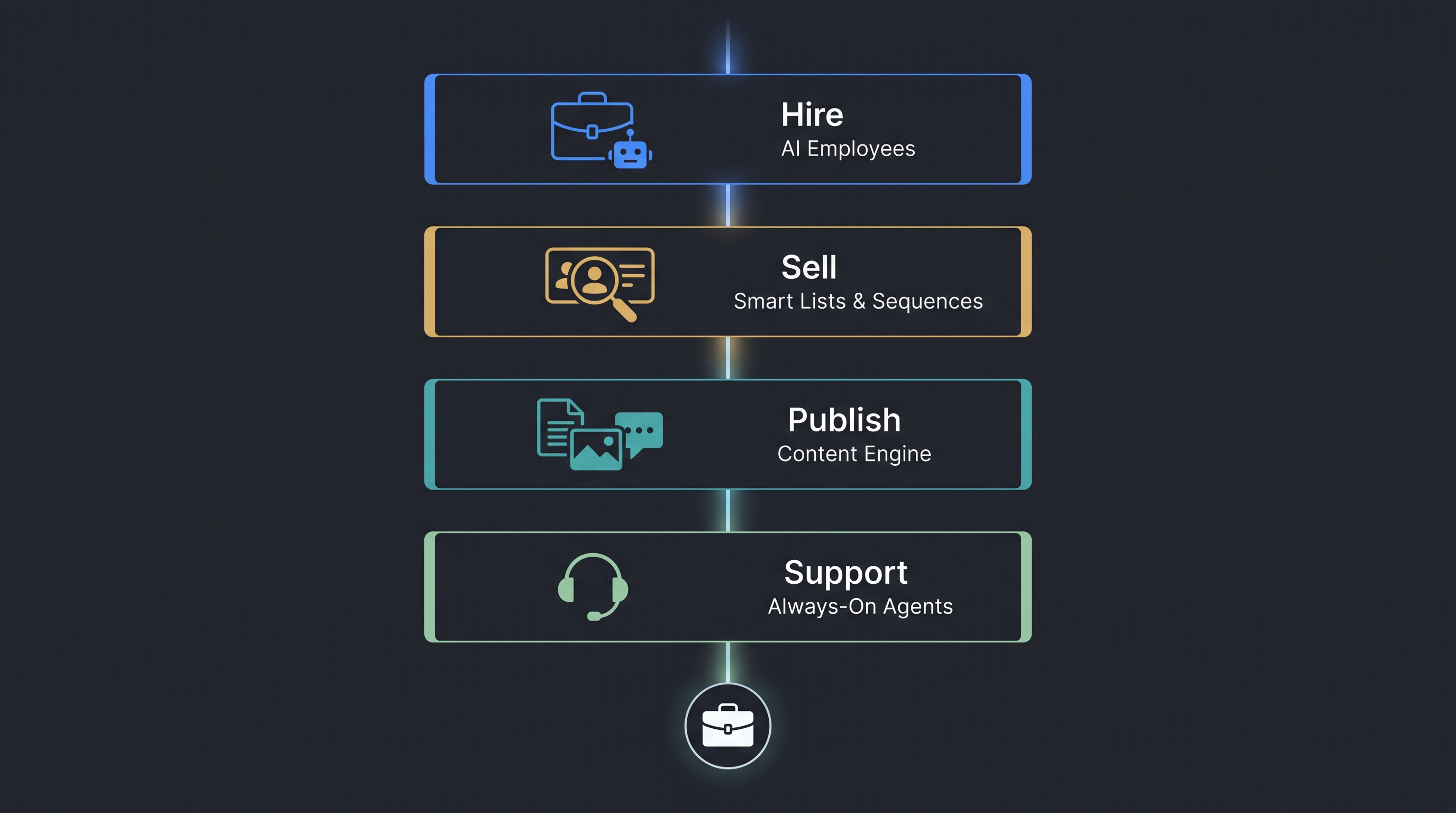
The platform organizes its capability into four connected layers that map directly onto how a revenue team actually operates: Hire (build AI employees trained on your business), Sell (Smart Lists and multi-channel outreach sequences that find and qualify leads), Publish (a content engine that produces blog posts, social content, ad copy, and branded images), and Support (AI receptionists and support agents answering phone, SMS, WhatsApp, web chat, and email around the clock).
Every AI employee can run on any major frontier model — OpenAI, Claude, Gemini, Grok, or DeepSeek — with new models added within days of release at no extra cost to the subscription. The platform connects to more than 1,000 third-party tools including Salesforce, HubSpot, GoHighLevel, Pipedrive, Notion, Google Drive, Slack, Gmail, LinkedIn, Shopify, and Stripe, plus native n8n workflow nodes and a full REST API and MCP (Model Context Protocol) integration for developers who want to build on top of the platform directly.
Why Parallel AI Is Worth Understanding Right Now
Parallel AI sits squarely inside one of the most active AI product categories of 2026: the shift from single-purpose AI tools toward consolidated "AI workforce" platforms that replace an entire stack of disconnected subscriptions with one connected system. This shift mirrors a broader pattern across the AI agent space throughout 2026 — the same underlying trend that has driven the rise of AI agent orchestration platforms more generally, where the value proposition is not a smarter individual feature but fewer seams between the features a business actually needs.
The specific detail that makes Parallel AI notable within that broader trend is its "headless" positioning. Most AI platforms, however capable, still require someone to log into a dashboard, click through a workflow builder, and monitor a queue. Parallel AI's Executive Assistant layer inverts that: every feature on the platform — Smart Lists, sequences, the content engine, AI employees, workflows — is fully executable by text message or through any MCP client, without opening a browser at all. A business owner can text a plain-English instruction from their phone and have the platform execute it, log the action, and report back only when something needs a decision. This "headless GTM" framing is a genuinely distinct product bet relative to most competitors in the category, who are still building toward richer dashboards rather than away from them.
The August 2026 growth and SOC 2 announcement is the second reason this platform merits attention right now. A company reporting 10x revenue growth in eight months, while simultaneously passing a formal security compliance audit, is signaling two things founders and revenue leaders care about together: real customer demand and enterprise-grade readiness — a combination that is less common than either alone in a category still full of early-stage, security-immature tools.
According to McKinsey's research on generative AI and business process automation (https://www.mckinsey.com/capabilities/mckinsey-digital/our-insights/the-economic-potential-of-generative-ai), the organizations capturing the most consistent value from AI investment in 2025 and 2026 are those consolidating fragmented point-solution stacks into fewer, more deeply integrated systems rather than continuing to add specialized tools that each solve one narrow problem in isolation — precisely the consolidation thesis Parallel AI is built around.
Core Features of Parallel AI in 2026
AI Employees — A Workforce on an Autonomous Heartbeat
The foundation of the platform is the AI employee: a persistent, named AI worker — given a role like Sales Development Rep, Account Executive, Content Marketing Manager, or Chief of Staff — trained on a specific business's knowledge and equipped with access to its tools. Unlike a chatbot that only acts when prompted, each AI employee runs on what Parallel AI calls an "autonomous heartbeat": it wakes on its own schedule, picks up where it left off, and keeps working overnight without a human initiating each task.
Training an AI employee on a business happens through embedding Google Drive files, Notion pages, Confluence documents, PDFs, and URLs directly into a searchable knowledge base — a process the platform describes as taking minutes rather than the days or weeks that custom knowledge-base builds have historically required on other platforms. Once trained, an employee is "equipped to do the work" through its connections to the 1,000-plus integration library, meaning it can actually update a CRM record, send an email, or publish a post rather than merely describing what should happen.
The model-agnostic design is a meaningful practical advantage: businesses are not locked into a single AI provider's roadmap, and as frontier models improve, Parallel AI's stated commitment to add new models within days of release means the underlying intelligence powering every AI employee upgrades without requiring a new subscription or migration.
Smart Lists and Sequences — Lead Generation in Plain English
The Sell layer replaces the traditional lead-generation workflow — searching multiple databases, manually enriching contact data, verifying emails, building a sequence, and monitoring replies — with a single plain-English description of a target audience. Smart Lists then search across multiple data sources, enrich each contact with real-time verification (email validity, company data, buying signals), and sync qualified leads directly into a connected CRM continuously, not as a one-time batch export.
Multi-channel sequences extend outreach across email, LinkedIn, SMS, and WhatsApp, personalized per prospect rather than templated identically across an entire list. AI follow-ups handle replies and continue the conversation autonomously, including booking meetings directly onto a calendar without a human touching the exchange — the platform's stated design goal being that leads generated overnight or over a weekend are still followed up with promptly rather than going cold until Monday morning.
The Content Engine — A Week of Content in 30 Minutes
The Publish layer is Parallel AI's content production system, generating blog articles, social posts across multiple platforms, marketing emails, landing pages, ad copy, press releases, and branded images from a single creative brief — all trained on a specific business's brand voice rather than generic templates. The platform's own reported benchmark is that users publish 80-plus pieces of content per month through the system, compared to the 10 to 15 pieces per month typical of a small team working with traditional manual or semi-automated workflows.
A specific and increasingly important detail: Parallel AI explicitly frames its content engine as building for both traditional search ranking and visibility inside AI-generated answers — an acknowledgment of the broader 2026 shift toward Answer Engine Optimization, where content needs to be structured not just for Google's crawler but for the AI assistants increasingly synthesizing answers before a user ever clicks through to a website.
Always-On Support — AI Receptionists and Support Agents
The Support layer deploys AI receptionists and support agents across phone, SMS, WhatsApp, web chat, and email, answering instantly, qualifying leads, booking meetings, and updating the CRM automatically — with smart escalation handing complex issues to a human team member along with full conversational context rather than starting the human's involvement from zero.
For businesses where a missed call or an unanswered after-hours inquiry represents a real, measurable cost — real estate, home services, professional services, hospitality — this always-on layer is explicitly positioned as recovering revenue that would otherwise be lost to response-time gaps, rather than simply automating a task that was already being handled adequately.
Headless GTM — Running the Platform Without the Platform
The Executive Assistant is Parallel AI's most distinctive architectural choice: a layer that makes every other feature on the platform — Smart Lists, sequences, content generation, AI employee management, and workflow execution — controllable through plain-English text or voice, from any device, without logging into a dashboard at all. The same control surface is exposed to any MCP client, meaning developers and technically sophisticated users can drive the entire platform programmatically as well as conversationally.
Every action taken this way is logged and reviewable, which matters directly for trust: a headless system that acts on a business's behalf needs a clear audit trail, and Parallel AI's stated design commits to full action-level logging regardless of whether a task was triggered through the dashboard, by text, or via API.
White Label — A Full Platform Under Your Own Brand
Parallel AI's White Label offering allows agencies to resell the entire platform — multi-model chat, AI employees, content automation, lead generation, and workflow builders — entirely under their own brand, with clients never seeing the Parallel AI name. Agencies set their own pricing tiers and margins, with revenue flowing directly into their own Stripe account rather than through a revenue-share arrangement, and feature controls that let an agency turn capabilities on or off per client package.
The platform's own case studies describe agencies launching a fully branded instance the same morning and onboarding their first client by the end of the day — a meaningfully faster time-to-market than building custom AI infrastructure from scratch, which is the specific alternative this offering is positioned against.
Real-World Use Cases
B2B Software and SaaS Startups
For B2B software companies, Parallel AI's combination of Smart Lists for outbound lead generation and AI employees acting as Sales Development Reps addresses the classic early-stage bottleneck: needing consistent pipeline generation without the budget for a full SDR team. An AI employee qualifying inbound leads every hour and a separate employee running a morning pipeline brief for the founder are the kind of always-on coverage that a two-person founding team cannot otherwise sustain manually.
Marketing Agencies
Marketing agencies use Parallel AI's White Label offering to build an entirely branded AI service line without hiring developers or building infrastructure — reselling AI employees, content generation, and lead generation as their own packaged offering to clients, with the platform's own testimonials describing this as a route to building six-figure AI-driven service practices on top of existing agency relationships.
Real Estate
For real estate professionals, the Support layer's AI receptionist capability directly addresses one of the industry's most consistently cited pain points: leads that go cold because a call or inquiry arrives outside business hours. An AI receptionist that answers instantly, qualifies the inquiry, books a showing, and updates the CRM automatically converts what would otherwise be a missed opportunity into a scheduled meeting before a human agent ever needs to get involved.
E-Commerce Brands
E-commerce businesses use the Content Engine to sustain a much higher publishing cadence across blog, social, and ad copy than a small internal team could manage manually, while Support-layer agents handle customer questions about orders, returns, and product details across chat and email — freeing a lean team to focus on the judgment calls (escalated disputes, VIP customer relationships) that genuinely require a human.
AEO and Brand Monitoring
Parallel AI specifically markets a use case around AEO (Answer Engine Optimization) monitoring — tracking how a brand is represented when AI assistants like ChatGPT, Perplexity, or Gemini answer questions about a category, and adjusting content strategy in response. As more purchase research and discovery moves into AI-generated answers rather than traditional search results, this monitoring-and-response loop is becoming a genuinely distinct discipline from classic SEO, and Parallel AI's content engine being built with citation-worthy content structure in mind is a direct response to that shift.
Virtual Receptionist Services
Beyond in-house use, Parallel AI's Support layer is also positioned as infrastructure for businesses that specifically sell virtual receptionist and call-answering services to other companies — using the platform's omnichannel agent capability as the operational backbone of a service business rather than purely an internal efficiency tool.
How Parallel AI Compares to the Competition
Parallel AI vs n8n and Dedicated Workflow Automation Tools
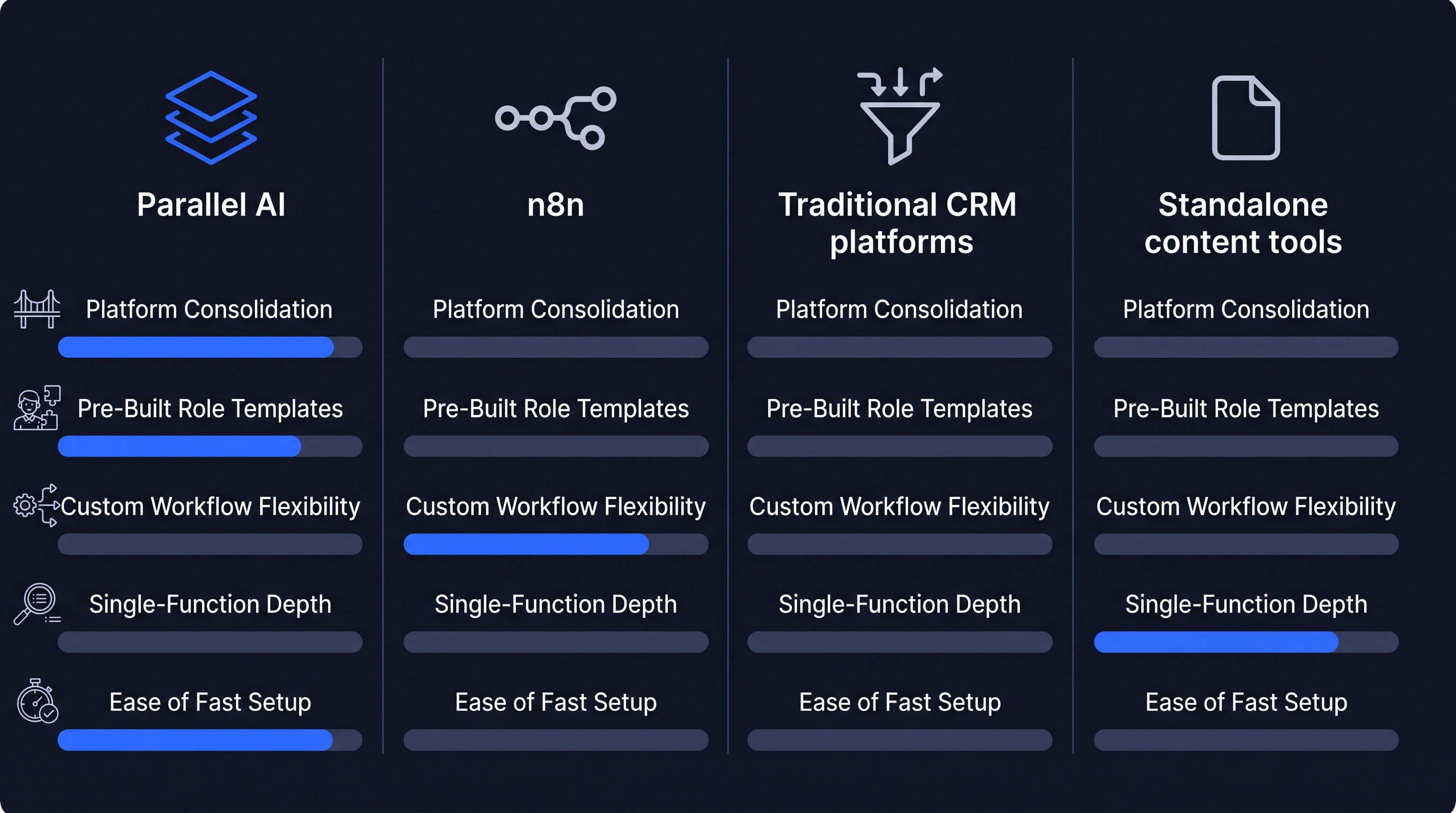
n8n, reviewed at length in prior coverage on this site, is a visual workflow automation platform where technical users build node-based pipelines mixing deterministic logic, code, and AI agent steps. Parallel AI takes a fundamentally different starting point: rather than a blank canvas that a technical user configures from scratch, it ships with pre-built AI employees, Smart Lists, sequences, and a content engine already scoped to specific business functions — sales, marketing, and support — and connects to n8n as one of its native integrations rather than replacing the need for workflow automation entirely.
The practical distinction: n8n for technical teams that want maximum flexibility to build bespoke automations across any business function, including ones far outside sales and marketing. Parallel AI for revenue and marketing teams who want pre-built, role-specific AI employees operational quickly without configuring a workflow from the ground up — while still retaining n8n as an escape hatch for genuinely custom automation needs through the native node integration.
Parallel AI vs Traditional CRM Platforms (HubSpot, Salesforce)
HubSpot and Salesforce remain the dominant systems of record for contact and deal data, and Parallel AI is explicitly designed to sync into these systems rather than replace them — Smart Lists sync qualified leads directly into a connected CRM, and AI employees update CRM records as part of their normal operation. The distinction is that HubSpot and Salesforce are fundamentally data-storage-and-pipeline-visualization systems; they do not natively generate leads, write content, or answer support calls. Parallel AI is the automation and generation layer that sits on top of and feeds into those systems, rather than a competing system of record.
Parallel AI vs Standalone AI Content Tools (Gamma, Jasper)
Compared to a dedicated content generation platform, Parallel AI's content engine is narrower in pure content-design sophistication — it is not attempting to be the most visually polished presentation or document builder in the category, the way a tool built exclusively for that purpose can be. Its advantage is context: content generated inside Parallel AI is informed by the same business knowledge base, brand voice training, and lead data that the platform's sales and support layers already use, meaning a blog post and a follow-up sales email can be generated with genuinely shared context rather than requiring the content and sales tools to be manually kept in sync.
Parallel AI vs Dedicated AI Receptionist Tools
Specialized AI answering-service platforms often compete narrowly on voice quality and call-handling polish for a single channel. Parallel AI's Support layer trades some of that single-channel specialization for breadth — the same underlying AI employee framework answers phone, SMS, WhatsApp, web chat, and email, with a shared customer history across all of them, rather than requiring separate tools and separate customer records per channel.
According to Salesforce's own research on the State of Sales (https://www.salesforce.com/resources/research-reports/state-of-sales/), sales organizations that unify lead data, engagement history, and AI-assisted outreach into fewer connected systems consistently report faster response times and higher win rates than those managing the same functions across disconnected point tools — directly supporting the consolidation thesis that both Parallel AI and its GTM-platform competitors are built around.
Parallel AI Pricing — The Complete 2026 Breakdown
Parallel AI uses a credit-based pricing model across four tiers, with every plan including full API and MCP access regardless of price point — a notable detail, since many platforms reserve developer access for higher tiers exclusively.
Pay As You Go — $0/month No monthly fee. Includes 50 free credits to start, access to every feature on the platform (not a stripped-down trial), and the ability to top up with credit packs that never expire. No credit card is required to begin. This tier is a genuine way to test the full platform's actual capability — not a feature-limited demo — before committing to a subscription.
Entrepreneur — $99/month Includes 2,000 credits per month, 2 companies included under the plan, and a custom-branded white-label instance included even at this entry-level paid tier. This is positioned for individuals looking to amplify personal productivity — a solo operator or very small team running one or two businesses through the platform.
Business — $297/month The platform's most popular tier by its own labeling. Includes 9,000 credits per month, 10 companies included, and priority support. This is the tier aimed at fast-moving teams that need meaningfully more volume and multi-company management than the Entrepreneur tier supports — appropriate for an agency managing several client accounts or a growing company running multiple brands or business units through one instance.
Enterprise — Custom pricing Unlimited access to frontier models, Single Sign-On (SSO), and dedicated support. Contact-sales only, appropriate for larger organizations with governance, security, and support requirements beyond what the self-serve tiers address.
The credit mechanics worth understanding: credits power every AI action across the platform — content generation, lead enrichment, outreach messages, and agent conversations all draw from the same pool. This unified credit model is simpler to reason about than platforms with separate metering for different feature categories, but it also means a business running heavy AI employee conversation volume alongside heavy content generation will draw down its monthly allocation faster than a business using only one of those capabilities — worth modeling against your specific expected usage before selecting a tier, and worth verifying current credit costs per action type directly at parallellabs.app/pricing given how quickly credit-based platforms in this category tend to adjust their consumption rates.
Pros and Cons
Pros
Consolidates lead generation, outreach, content production, and customer support into one connected platform with shared business context across all four layers
AI employees run on an autonomous heartbeat, working overnight and on weekends rather than only when a human initiates a task
Model-agnostic architecture (OpenAI, Claude, Gemini, Grok, DeepSeek) with new frontier models added within days of release at no extra subscription cost
Genuinely full-featured free tier (Pay As You Go) with no credit card required — not a stripped-down trial
1,000+ integrations plus native n8n nodes and full API/MCP access on every plan, including the free tier
Headless GTM architecture allows the entire platform to be operated by text message or voice without opening a dashboard
White-label offering allows agencies to launch a fully branded instance same-day, with revenue flowing directly to their own Stripe account
SOC 2 compliant as of August 2026, with data encrypted at rest and in transit and never used to train AI models
Reported 10x revenue growth since January 2026 and 5,000+ customers — genuine traction signal for a 2026-era platform
5.0 average rating across early G2 reviews, with specific praise for consolidating fragmented content and outreach workflows
Custom-branded white-label instance included even at the entry-level $99/month Entrepreneur tier
Cons
Publicly available third-party review volume is still limited (a small number of reviews on G2 and Product Hunt as of the most recent data), meaning independent validation beyond the company's own case studies and press materials remains thinner than for more established platforms
Credit-based pricing across shared feature categories (content, outreach, agent conversations) requires active usage monitoring to avoid unexpectedly exhausting a monthly allocation, particularly for businesses using multiple layers heavily and simultaneously
As a platform built around AI-generated tone, some early reviewers note occasional friction fine-tuning brand voice precisely to match an established company's existing style
The consolidation-over-specialization design means individual features — content design sophistication, single-channel voice quality — are unlikely to match the depth of a best-in-class dedicated tool built exclusively for that one function
Enterprise pricing is not published and requires a sales conversation, which adds friction for larger organizations trying to do a quick self-serve cost comparison against competitors
As a comparatively young platform (customer growth reported since January 2026), its long-term roadmap stability and feature permanence carry the same general uncertainty that applies to any fast-growing, recently-launched AI platform
Who Should Use Parallel AI?
Parallel AI delivers the strongest value for:
B2B software and SaaS startups that need consistent, always-on lead generation and qualification without the headcount cost of a dedicated SDR team
Marketing agencies looking to launch a fully branded AI service line under the White Label offering without building custom infrastructure or hiring developers
Real estate professionals and service businesses where after-hours missed calls and inquiries represent measurable, recoverable lost revenue
E-commerce brands and lean marketing teams that need to sustain a high content publishing cadence and responsive customer support without proportionally growing headcount
Businesses already juggling multiple disconnected point tools for CRM, outreach, content, and support who want to consolidate into one system with shared context
Technically sophisticated teams who want to operate the platform programmatically via API/MCP or by text through the Executive Assistant rather than through a traditional dashboard
Who Should Consider Alternatives
Teams needing the deepest possible specialization in a single function — the most visually sophisticated content design, the most polished single-channel voice AI, or the most flexible general-purpose workflow canvas — may be better served by a dedicated tool built exclusively for that one job, potentially used alongside Parallel AI rather than instead of it
Organizations requiring extensive, long-established third-party validation before adopting a platform — Parallel AI's independent review base, while positive, is still relatively small, and risk-averse buyers may want to wait for a larger sample of long-term customer experiences
Businesses with highly specific, unusual automation needs outside sales, marketing, and support — a dedicated general-purpose automation platform like n8n may offer more flexibility for automations that fall entirely outside the sales/marketing/support scope Parallel AI is built around
Enterprises needing fully transparent, published pricing for procurement comparison without a sales conversation — the custom Enterprise tier's lack of public pricing is a real friction point for buyers who prefer to shortlist vendors purely from published rate cards

Getting the Most Out of Parallel AI — Practical Tips
Start with the free onboarding flow rather than configuring from scratch. Parallel AI's in-app onboarding builds an ideal customer profile, a lead list with an outreach sequence, a content strategy, and a live website agent automatically based on a description of your business — using this guided path first, before manually configuring additional AI employees, gives you a working baseline to refine rather than starting from an empty platform.
Train AI employees on your actual documentation before deploying them broadly. The platform's embedding of Google Drive, Notion, Confluence, PDFs, and URLs into a searchable knowledge base is most effective when it draws on your real, current business documentation — pricing pages, product specs, sales scripts, support macros — rather than generic placeholder information, since employee output quality is directly proportional to the knowledge base it can draw from.
Model your expected credit consumption before selecting a paid tier. Since content generation, lead enrichment, outreach, and agent conversations all draw from the same credit pool, estimate your realistic monthly volume across all four layers you plan to use actively, rather than sizing a plan based only on the feature you expect to use most heavily.
Use the Executive Assistant for monitoring, not just execution. Beyond triggering actions, the headless Executive Assistant layer is designed to monitor your business on a recurring cycle and alert you only when something needs a decision — configuring it as a monitoring layer from day one, rather than only as a command interface, captures more of its intended value.
For agencies, validate your first white-label client use case before scaling the offering. Given the platform's same-day launch capability, it is tempting to roll out a fully branded instance broadly immediately — running one real client engagement first to validate positioning, pricing, and feature configuration before expanding to a full client roster reduces the risk of scaling an unrefined offering.
The Honest Limitations Worth Understanding
The relative newness of independent third-party validation deserves direct acknowledgment. While the company's own reported metrics — 10x revenue growth, 5,000-plus customers, SOC 2 compliance — are genuine and specific, the volume of fully independent, long-term customer reviews on platforms like G2 remains small as of the most recent data available. This is common for a fast-growing platform still early in its public review cycle, but it means prospective customers are currently weighing more company-reported data relative to accumulated independent testimony than would be the case for a more established competitor.
The consolidation-over-specialization design is a genuine trade-off, not a pure advantage. A platform built to do sales, marketing, and support work well together will rarely match the absolute ceiling of a tool built to do exactly one of those things exceptionally well and nothing else. For businesses whose competitive edge depends specifically on best-in-class execution in a single function — the most visually distinctive content, the most naturalistic single-channel voice AI — evaluating Parallel AI's specific feature against a specialized alternative directly, rather than assuming the consolidated platform automatically wins, is worth doing before committing.
The credit-based pricing model, while unified and simple to reason about at a glance, requires genuine usage monitoring discipline. Businesses that ramp up AI employee activity across multiple layers simultaneously without tracking consumption risk hitting their monthly allocation earlier than expected — a real operational consideration, not just a theoretical pricing footnote.
Final Verdict: Is Parallel AI Worth It in 2026?
For growing businesses currently managing sales, marketing, and support through a patchwork of disconnected tools, Parallel AI represents a genuinely coherent answer to a problem that has become increasingly expensive and increasingly common as the number of point-solution AI tools available to any given business has exploded. The specific bet — consolidation with shared context, rather than one more specialized tool added to an already sprawling stack — is well-aligned with where independent research on AI adoption ROI consistently points.
The reported 10x growth, 5,000-plus customer base, and August 2026 SOC 2 compliance milestone are credible signals that the platform has moved past early experimentation into genuine, security-validated production use across a real customer base. The genuinely full-featured free tier removes the primary risk of testing that claim directly against your own business before spending anything.
The honest caveats — a still-developing independent review base, and the inherent trade-off of breadth over single-function depth — are real considerations, not disqualifying ones, and are exactly the kind of thing worth weighing against your specific priorities rather than a generic checklist.
The lowest-risk path forward is the same one the platform's own onboarding is built around: start with the free tier, let it build your first lead list, content calendar, and website agent automatically, and use your own results on your own business as the deciding evidence — rather than any single review, including this one.
Try Parallel AI Today
The Pay As You Go tier includes 50 free credits, full access to every feature, and no credit card requirement — enough to build your first AI employee, generate a real lead list, and publish real content before deciding whether a paid tier fits your business.
Try Parallel AI free — click here: parallellabs.app — No credit card required. Paid plans from $99/month. Enterprise pricing available on request.
Frequently Asked Questions
What is Parallel AI? Parallel AI is an all-in-one AI platform for business growth that combines AI employees, lead generation (Smart Lists and multi-channel sequences), a content engine, and always-on support agents into one connected system, integrated with 1,000-plus business tools including Salesforce, HubSpot, and n8n.
How much does Parallel AI cost? Parallel AI offers a free Pay As You Go tier with 50 free credits and no monthly fee, an Entrepreneur tier at $99/month (2,000 credits, 2 companies), a Business tier at $297/month (9,000 credits, 10 companies), and custom Enterprise pricing with unlimited frontier model access and SSO.
What can Parallel AI's AI employees actually do? AI employees are trained on a business's own knowledge (Google Drive, Notion, Confluence, PDFs, URLs) and connected to its tools, allowing them to qualify leads, draft campaigns, resolve support tickets, publish content, and run scheduled workflows autonomously — running on a self-directed schedule rather than only responding when prompted.
What is the Executive Assistant / headless GTM feature? The Executive Assistant lets a user operate the entire Parallel AI platform — Smart Lists, sequences, content generation, AI employee management, workflows — through plain-English text or voice from any device, without opening a dashboard, with the same control also available to any MCP client. Every action is logged and reviewable.
Is Parallel AI secure for business data? Parallel AI became SOC 2 compliant in August 2026. The platform states data is encrypted at rest and in transit, never used to train AI models, aligned with GDPR and CCPA, and registered with CSA STAR, with per-company data isolation across workspaces.
Can agencies white-label Parallel AI? Yes. Agencies can resell the entire platform under their own brand and domain, set their own pricing with revenue flowing directly to their own Stripe account, and control which features are enabled per client package, with reported same-day launch capability for a fully branded instance.
How does Parallel AI compare to n8n? n8n is a general-purpose, technically flexible workflow automation platform where users build custom pipelines from scratch. Parallel AI ships with pre-built, role-specific AI employees and workflows scoped to sales, marketing, and support, and includes n8n as one of its native integrations rather than competing with it for fully custom automation needs.

Founder, Axionova · AI Tools Strategist
Ashir writes independent, hands-on reviews of AI tools and shares strategies for creators, marketers, and entrepreneurs. Every review is grounded in real usage — no paid placements, no fluff. Read our editorial standards.
AI Insights Weekly
One curated email a week: sharp AI insights, tool reviews, and strategies.
Have thoughts on this?
Contact us or share this article on social media — we'd love to hear what resonated with you.